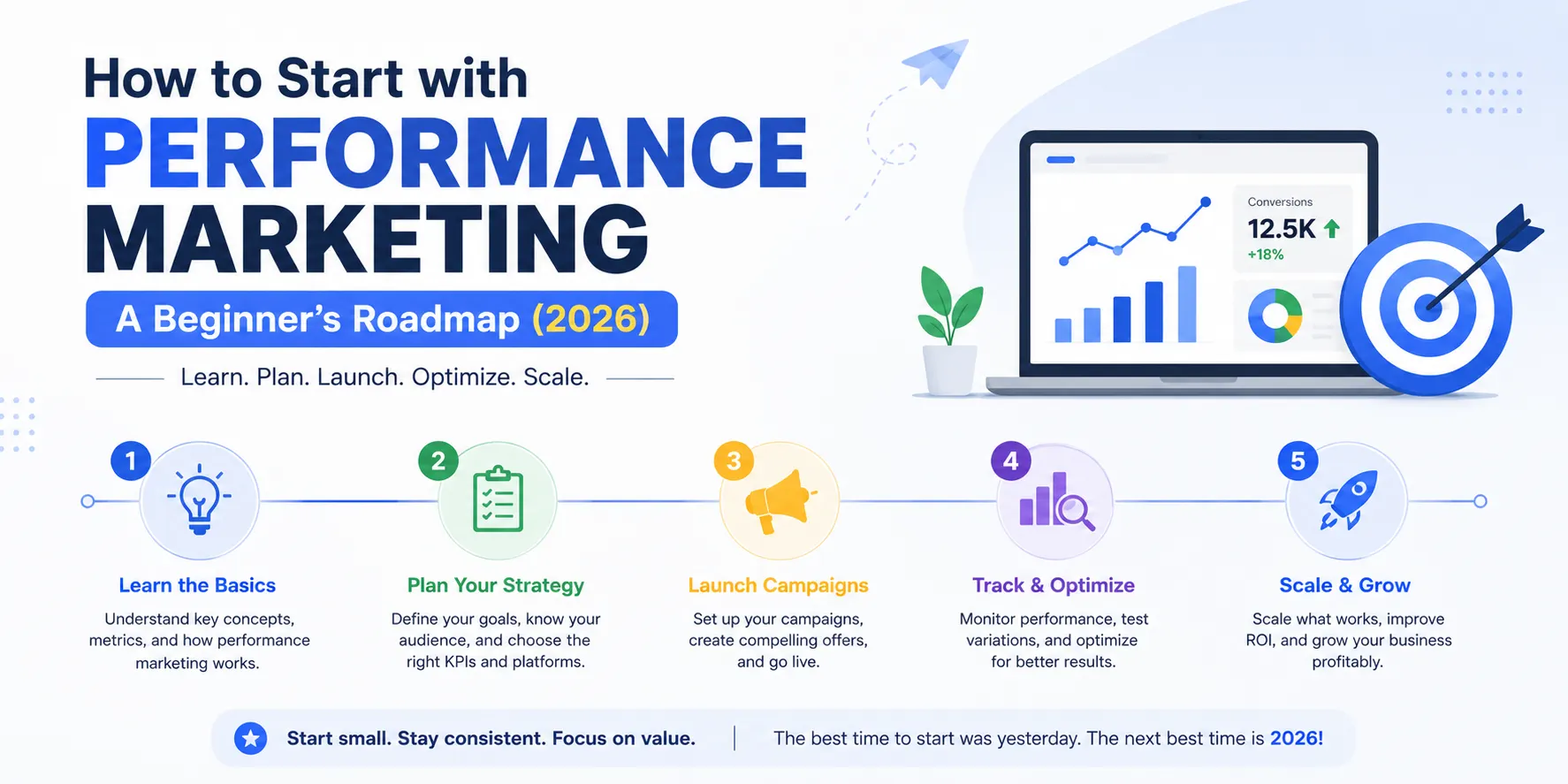
How to Start with Performance Marketing: A Beginner's Roadmap (2026)
If you've been reading about performance marketing as a career or trying to figure out whether it pays well, you've probably realized something: nobody tells you what to actually do on day one. Not the theory. Not the definitions. The real, step-by-step actions.
This guide skips the "what is performance marketing" part — if you still need that, read our Performance Marketing Career Reality Check first. Here, we're focused on one thing: getting you from zero to your first live campaign, with real numbers, real tools, and a real 30-day plan.
Step 1: Define One Clear Goal Before You Touch a Platform
Every beginner's instinct is to open Google Ads or Meta Ads Manager first. Don't. Start by picking exactly one goal:
- Website traffic
- Leads (form fills, sign-ups, calls)
- Sales (e-commerce or direct purchase)
- App installs
Pick one. Not three. A single, clear goal decides which platform you should use, what you'll track, and what "success" even looks like for your first campaign. Trying to optimize for leads and sales and traffic at once is the fastest way to confuse your data before you've even collected any — and it's one of the most common reasons beginners give up on performance marketing before it's had a fair chance to work.
Step 2: Build Your Minimum Tool Stack
You don't need twenty tools to start. Here's the actual minimum:
- Google Ads Manager — for search intent campaigns
- Meta Ads Manager — for Facebook/Instagram campaigns
- Google Analytics 4 (GA4) — to see what happens after the click
- A UTM builder — free, and non-negotiable (more below)
- A simple spreadsheet — to log spend, clicks, conversions, and notes for every test you run
That's it. Resist the urge to buy paid tools or courses before you've run even one small test campaign with these five — this is the actual toolkit performance marketing runs on, nothing fancier is needed to start.
Step 3: Set Up Tracking Before You Spend a Single Rupee
This is the step almost every beginner skips — and it's the one that costs the most later. If you launch ads without tracking in place, you'll have spend data but no idea what that spend actually did.
Before your first campaign:
- Install the Meta Pixel on your website (or landing page) if you're running Meta Ads.
- Set up GA4 with conversion events for your one goal from Step 1.
- Build UTM links for every ad — source, medium, and campaign name at minimum — so you can tell your spreadsheet exactly which ad drove which result.
If tracking isn't live before launch, you're not really practicing performance marketing yet — you're just paying for a guess. Tracking is what separates performance marketing from traditional advertising in the first place.
Step 4: Choose ONE Platform to Start — Google or Meta
Don't run both in week one. Pick based on your goal and how people find what you're offering:
Choose Google Ads if:
- People actively search for what you offer ("plumber near me," "buy running shoes online")
- You're selling something with clear purchase intent
- Your budget is tight and you want to pay for intent, not attention
Choose Meta Ads if:
- Your product is visual or impulse-driven (fashion, food, home decor, apps)
- You're building awareness for something people don't yet know they need
- You want to target by interest, behavior, or lookalike audiences rather than keywords
If you're genuinely unsure, Google Ads is usually the gentler starting point for beginners — the intent-based nature means your first results are easier to interpret.
Step 5: Launch Your First Test Campaign — With Real Numbers
Here's a walkthrough with concrete figures to work from, not just vague advice to "start small."
Budget: As a general starting guideline, many beginners in India find ₹500–1000/day workable for either platform — enough to generate meaningful clicks within a week without risking much on an unproven setup. Treat this as a starting reference, not a rule; adjust based on your own product cost and what you can comfortably afford to test with.
Google Ads first campaign:
- Campaign type: Search
- Keywords: 5–10 tightly relevant terms (avoid broad match starting out — use phrase match)
- Ad copy: 2–3 headline variations, one clear CTA
- Landing page: the exact page that matches what the ad promises — not your homepage
Meta Ads first campaign:
- Campaign objective: match it to your Step 1 goal exactly (don't pick "awareness" if your goal is leads)
- Audience: one interest-based audience, roughly 1–5 million people as a rough starting range — not hyper-narrow, not too broad
- Creative: 2–3 image or video variations, short copy, one CTA button
- Placement: let Meta's automatic placements run first; don't manually restrict yet
Either way: as a general rule, give the campaign at least 5–7 days before making any changes — this is a common benchmark in performance marketing for letting a platform's algorithm exit its learning phase. Most beginners kill campaigns after 24–48 hours out of impatience, which usually isn't enough data to judge anything fairly.
Your First 30 Days: A Week-by-Week Roadmap
Week 1 — Setup and Launch Get tracking live, build your first campaign, and launch. Do nothing else. Don't touch bids or budgets mid-week.
Week 2 — Let Data Collect Resist the urge to check every hour. Log daily spend and clicks in your spreadsheet, but don't make changes yet. You need volume before you can trust any number.
Week 3 — First Optimization Pass Now look at the data. Pause the worst-performing keyword, ad, or audience. Shift budget toward whatever's showing the lowest cost per result. Make one change at a time so you know what caused what.
Week 4 — Review and Decide Look at your CPA (cost per acquisition) and, if applicable, ROAS (return on ad spend). Decide: scale the budget, keep testing, or kill the campaign and start a new test with a different angle. This review cycle is the core loop you'll repeat for as long as you do performance marketing — launch, wait, read, adjust.
How to Read Your First Campaign's Numbers
You'll hear these terms everywhere — here's what actually matters when you're staring at your own dashboard for the first time:
- CTR (Click-Through Rate): tells you if your ad is relevant enough to earn a click. Low CTR usually means weak creative or the wrong audience, not a tracking problem.
- CPC (Cost Per Click): what you're paying per click. Useful for comparing keywords or audiences against each other, not much else on its own.
- CPA (Cost Per Acquisition): what you're paying per actual result — a lead, a sale, a sign-up. This is the number that tells you if the campaign is working.
- ROAS (Return on Ad Spend): revenue generated for every rupee spent. Only relevant if your goal is direct sales.
Don't judge a campaign on CTR alone. A high CTR with no conversions just means you're attracting clicks that don't convert — that's a landing page or offer problem, not a win.
Mistakes That Cost Beginners Their First Three Months in Performance Marketing
- Turning ads off too early. Judging a campaign after 2 days of data is like judging a movie from its trailer.
- Chasing CTR instead of conversions. A pretty ad that doesn't convert is still a losing ad.
- Skipping tracking setup. Without it, you're spending money you can't learn from.
- Running on two platforms at once as a beginner. You'll never know which one is actually working, or why.
- Copying someone else's campaign structure without understanding it. What worked for a different product, audience, or budget won't automatically work for yours.
What to Learn Next: Your 90-Day Path
Once your first campaign has run its course, here's where to go next:
- A/B testing — testing one variable at a time (headline, image, audience) to systematically improve results
- Retargeting — showing ads to people who visited but didn't convert, usually your highest-ROI campaigns
- Audience segmentation — splitting broad audiences into smaller, more relevant groups
- Scaling budgets — increasing spend on what works without breaking your CPA
If you're building toward this as a career, this is also the point to explore what performance marketing roles typically pay in India and how it compares to broader digital marketing career paths.
Performance marketing isn't learned by reading — it's learned by running a small, real campaign and watching what the data tells you. Start with ₹500 a day, one platform, one goal, and one honest look at your numbers after a week. That's the entire roadmap.