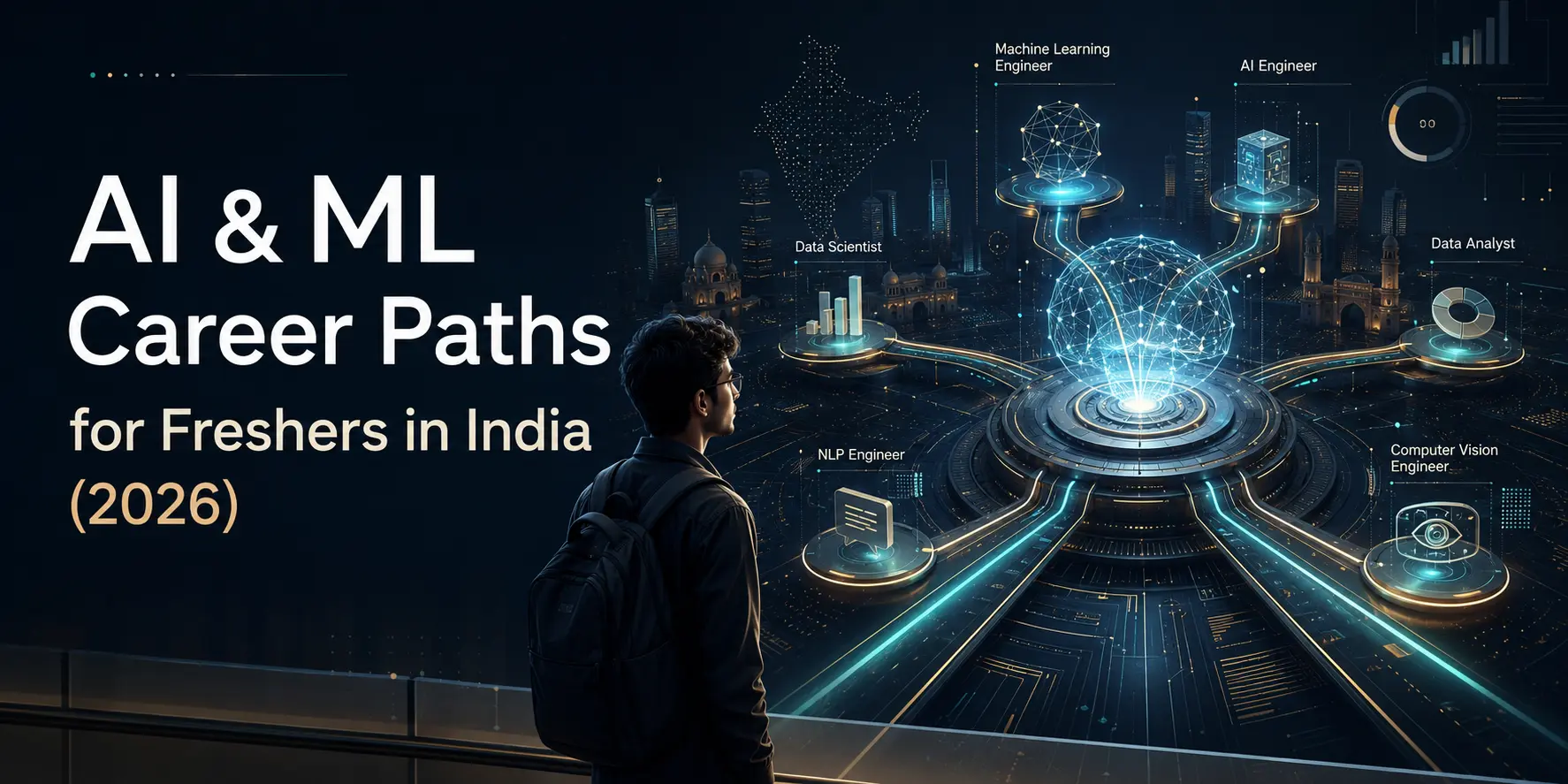
Most In-Demand AI and Machine Learning Career Paths for Freshers in India (2026)
"I want to get into AI" isn't really a plan — it's more like six different jobs wearing the same trench coat. Each one wants a different skill stack, and each one has a different realistic starting point if you're coming in with zero work experience. This guide walks through the roles that are actually hiring freshers in India right now, what each one asks of you, and which one is likely to fit where you're starting from — based on real industry and government data, not the round, made-up numbers you see floating around LinkedIn.
The 6 Paths, at a Glance
*These salary numbers come from independent salary-data aggregators (see sources below) — think of them as directional averages, not guaranteed offers. What you actually get depends heavily on city, company tier, and how strong your portfolio is.
Is the AI/ML Demand Real, or Just Hype?
Fair question. "AI is booming" gets said about literally every tech trend, so a little skepticism is healthy. Here's what actually backs it up:
A joint Deloitte–NASSCOM report puts India's AI talent demand at roughly 600,000–650,000 professionals in 2022, climbing past 1.25 million by 2027, on the back of 25–35% annual growth in the AI software and services market.
The World Economic Forum's Future of Jobs Report 2025 surveyed employers representing over 14 million workers across 55 economies, and AI and Machine Learning Specialists came out among the top three fastest-growing job categories globally — right alongside Big Data Specialists and Fintech Engineers.
NASSCOM's own analysis suggests AI-related job demand in India will cross 1 million by 2026. Meanwhile only about 16% of India's IT workforce is currently considered AI-skilled. That gap is real and measurable — it's not a slide from a sales deck.
There's also LinkedIn data (cited via NASSCOM) showing India's prompt-engineering talent pool growing close to 100% year-over-year in 2025, with AI engineering hiring outpacing several developed economies.
Now, the honest part: none of this means every fresher walks out with a ₹15 LPA offer. Entry-level hiring in AI/ML has become heavily portfolio-driven — companies want to see something you actually built, not just a certificate sitting in a folder. Keep that in mind as you read through the roles below, because it applies to every single one of them.
The 6 AI/ML Career Paths Actually Hiring Freshers
1. Machine Learning Engineer
What the job actually involves: building and shipping models that learn from data — recommendation engines, fraud detection, demand forecasting, that kind of thing. This is the most established entry point into AI/ML, and honestly the one with the clearest path for a fresher.
What you'll need: Python, the core ML algorithms (regression, classification, trees), SQL, data preprocessing, and comfort with at least one framework — Scikit-learn to start, moving to TensorFlow or PyTorch as you go.
On pay: salary aggregators like Payscale, cross-checked against a few other industry guides, put early-career ML engineer pay in India somewhere in the ₹6–10 LPA range. Strong portfolios and product-company offers tend to push toward the top of that. If this path fits you, our Diploma in Machine Learning & AI is built around exactly this progression — Python, core ML algorithms, and deployment.
2. Data Scientist
This role sits closer to analysis and insight than pure engineering — you're exploring data, testing hypotheses, building models to answer specific business questions, and then explaining what you found to people who don't care how the model works, just what it means.
Core skills: Python or R, statistics, SQL, data visualization (Power BI/Tableau), and enough ML fundamentals to build and interpret models without necessarily deploying them at scale.
Why it might suit you better than ML Engineer: it asks for less pure software-engineering depth and rewards statistical reasoning and communication instead — a genuinely good fit if you're coming from analytics, stats, or even a non-engineering quantitative background. Our Diploma in Data Science & AI covers this exact mix of statistics, Python, and business communication.
3. Generative AI / LLM Developer
This is the newest lane, and arguably the one growing fastest. The work involves building applications powered by large language models — chatbots, AI assistants, retrieval-augmented generation (RAG) pipelines, document-processing tools, automation workflows — usually plugging into APIs from providers like OpenAI, Anthropic, or Google.
What you need: Python, LangChain or something similar, prompt engineering, vector databases, and an understanding of how to design a RAG pipeline.
Why it's growing so fast: prompt-engineering and LLM-application skills are still in much shorter supply than classical ML skills, and that shows up directly in the LinkedIn talent-growth numbers mentioned earlier. Our Diploma in Generative AI & Prompt Engineering covers LangChain, RAG, and vector databases from the ground up.
4. NLP Engineer
The job: building systems that process and understand human language — sentiment analysis, chatbots, document classification, translation.
What it asks for: Python, text-processing fundamentals, deep learning basics, and increasingly, familiarity with transformer-based models (the architecture behind today's LLMs) rather than just the older NLP toolkit.
Reality check: there are fewer pure-fresher openings here than in general ML or GenAI, since NLP has traditionally demanded deeper specialization. It works well as a second role — something to move into after a year or two in ML or GenAI.
5. Data Analyst with AI Skills
The job itself is fairly traditional — dashboards, reporting, business insight — increasingly layered with AI-assisted tools for automation and faster analysis.
What you need: Excel, SQL, Power BI or Tableau, basic Python/Pandas, and familiarity with AI-assisted analytics tools.
Why this is probably the easiest way in: of everything on this list, this path has the lowest technical bar and the most fresher openings, simply because nearly every company — not just the tech-first ones — needs this skill set now. If you're coming from a non-engineering background, this is likely your most realistic starting point. Our Certification in Data Analytics & AI is built specifically for this lower-barrier entry route.
6. MLOps Engineer
The problem this role solves: keeping a model running reliably once it's actually in production — watching for performance drift, automating retraining and deployment. This is where a lot of the real cost shows up after a model gets built.
What it takes: Python, basic cloud platform knowledge (AWS/Azure/GCP), Docker and Kubernetes fundamentals, and an understanding of CI/CD.
The catch: this is genuinely one of the best-paid and most durable AI tracks, but it's rarely something you walk into straight out of college. Most people grow into it after some grounding in software engineering, DevOps, or ML engineering first. Our Advanced Certification in Machine Learning & AI covers the deployment, Docker, and cloud fundamentals that feed into this track.
What Companies Actually Look For (Not What LinkedIn Influencers Say)
Based on how fresher-level AI/ML hiring actually plays out in India right now, rather than what gets repeated on social media, here's what tends to matter:
A real project beats a certificate. A model you built yourself, cleaned, evaluated, and can explain end-to-end will carry more weight in an interview than a course-completion badge ever will.
Fundamentals over framework-fluency. Interviewers are far more likely to probe whether you understand why a model works — bias-variance tradeoff, overfitting, when to reach for which algorithm — than whether you can call .fit() correctly.
You need math intuition, not derivations. Linear algebra, probability, and stats matter for understanding what an algorithm is actually doing under the hood, but you're rarely asked to derive equations from scratch in an interview.
SQL and data-cleaning skills come up constantly. Even in roles with "ML" in the title, a huge chunk of the actual work is preparing data before any modeling starts.
If you're coming from a non-engineering degree and wondering whether these doors are closed to you — they're not, but your path in will likely be harder without a technical background. What tips the scale for most employers is a strong, verifiable project portfolio, not the name on your degree.
Which Path Should You Actually Start With?
- Strong in Python and math, want the clearest fresher pipeline → Machine Learning Engineer
- Enjoy statistics and explaining findings to non-technical people → Data Scientist
- Want the fastest-growing, most in-demand skill right now → Generative AI / LLM Developer
- Coming from a non-engineering or analytics background, want the lowest barrier to entry → Data Analyst with AI Skills
- Genuinely interested in language and text → NLP Engineer (a strong second role after 1–2 years in ML/GenAI)
- Like infrastructure and systems more than the math → aim for MLOps Engineer, but expect to enter through a general ML or DevOps role first
The Bottom Line
The AI/ML job market in India is genuinely growing — that much isn't hype. It's backed by NASSCOM-Deloitte demand projections, WEF's global jobs data, and measurable talent-growth numbers out of LinkedIn. But "AI career" was never one job to begin with — it's at least six distinct paths, each with its own skill demands and its own realistic entry point for a fresher. Figure out which one matches your actual strengths — math and code, stats and communication, or infrastructure and systems — build one real project in that direction, and let that project do the talking when you apply.