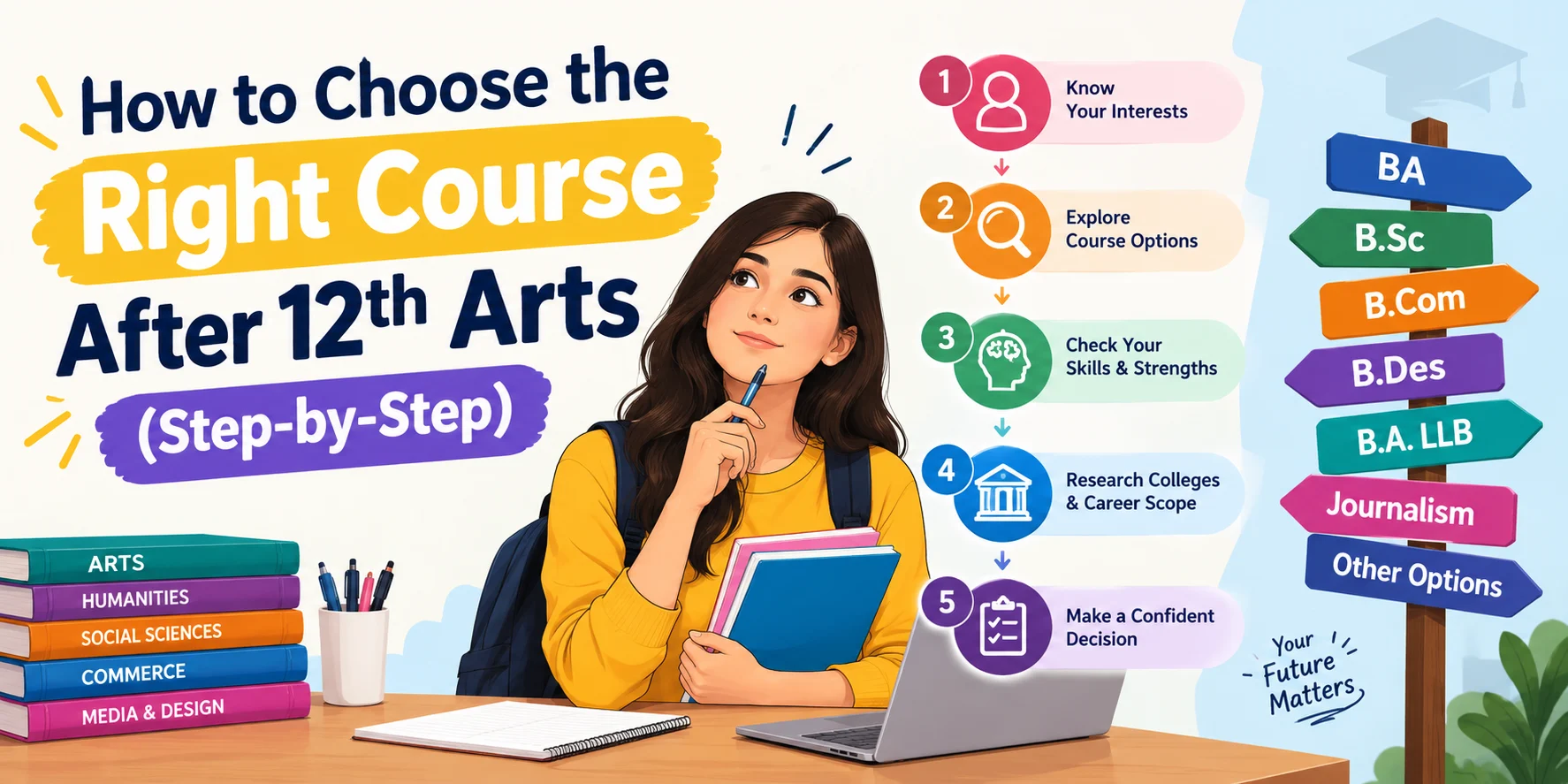
How to Choose the Right Course After 12th Arts: A 4-Step Guide (2026)
Everyone has an opinion on what you should do after 12th Arts: parents, relatives, seniors, even strangers in YouTube comments. But none of them will sit through the course, pay the fees or build a career out of it. You will. That is why the question is not "what is the best course?" but "how do I choose the right course for me?"
This guide gives you a simple 4-step framework used by career counsellors to help arts students make that decision with confidence, plus real comparisons, the official exams you need to know about, and the mistakes to avoid.
Quick Answer: How Do You Choose the Right Course After 12th Arts?
To choose the right course after 12th Arts, follow four steps: (1) decide what you are optimising for (speed, budget, security or passion), (2) match your natural strengths to a career path, (3) compare the real numbers (duration, cost, entrance exam, time to first salary), and (4) shortlist just two options and research them deeply before you decide. There is no single best course for every arts student. The right course is the one that fits your goals, strengths and budget.
Key Takeaways
• There is no universal "best" course after 12th Arts. The right choice depends on your priorities, not on a ranking list.
• If you want to earn quickly on a small budget, skill-based courses like Digital Marketing, Graphic Design or Content Writing usually fit best.
• If you want long-term prestige or a government job, Law (BA LLB), a BA aimed at civil services, or Psychology (BA + MA) fit better.
• Most strong arts careers need no maths at all.
• Shortlist two options, not twenty. Comparing everything at once leads to decision paralysis.
Why Is Choosing a Course After 12th Arts So Confusing?
It is rarely a lack of options that makes this decision hard. It is having too many options with no fair way to compare them. A 3-year BA, a 5-year law degree and a 6-month digital marketing course are not measured on the same scale, so "which one is better?" has no answer until you decide what you want from the next few years.
Three other things make it harder for arts students in particular:
• Outdated advice. Many people still believe arts only leads to teaching or government jobs, which has not been true for years.
• Peer pressure. Friends picking the same college or course can feel like a safe default, even when it does not suit you.
• Too little real information. Course brochures talk about "scope" but rarely show duration, total cost and realistic first-job timelines side by side.
The framework below fixes this by putting your priorities first and the course list second.
The 4-Step Framework to Choose the Right Course After 12th Arts
Work through these four steps in order. Each step removes options that do not fit you, so by Step 4 you are left with a short, realistic list.
Step 1: Decide What You Are Optimizing For
Be honest about what matters most to you right now. Pick one top priority:
• Speed: you want to start earning within about a year, not after a 3 to 5 year degree.
• Budget: you need a course that does not require a large upfront investment or an education loan.
• Security and prestige: you are comfortable with a longer timeline for a government job, a law career or an academic path.
• Passion: you already know which subject excites you (writing, psychology, design, history) and want to build towards it, whatever the timeline.
Use this table to see where your priority points you:
|
Your Top Priority |
What It Means |
Best-Fit Courses |
|
Speed |
Start earning within about a year |
Digital Marketing, Content Writing, Graphic Design (certificate/diploma) |
|
Budget |
Low upfront cost, no education loan |
Digital Marketing, BA from a government college, online skill courses |
|
Security and prestige |
Stable, respected long-term career |
Law (BA LLB), BA for civil services, B.Ed for teaching |
|
Passion |
Build on a subject you love |
Journalism (BJMC), Psychology, Design (B.Des), BA Honours in your subject |
If speed and budget matter most, short skill-based courses move to the top of your list. If security matters most, Law, a civil-services-oriented BA (through the UPSC route) or teaching move up instead. You can explore the wider range of careers on the government-run National Career Service portal before narrowing down.
Step 2: Match Your Strengths to a Career Path
Your strengths matter more than any "top 10 courses" list. Use this table to see which paths match what you already enjoy:
|
If you enjoy… |
Paths worth considering |
|
Writing, storytelling, social media |
Digital Marketing, Content Writing, Journalism (BJMC) |
|
Debate, logic and structured arguments |
Law (BA LLB) |
|
Understanding why people behave the way they do |
Psychology, Sociology, HR |
|
Creating visuals, videos and campaigns |
Graphic Design, UI/UX Design, Digital Marketing |
|
Stability, structured study and exams |
BA (Political Science, History, Public Administration) for government jobs, B.Ed for teaching |
Most arts students find their answers cluster around communication, creativity and understanding people. That is exactly why digital marketing is one of the best courses after 12th Arts for such a wide range of students.
Step 3: Compare the Real Numbers
Interest matters, but so do duration, cost and the entrance exam you need to clear. Here is a quick reality check across the most common paths:
|
Path |
Duration |
Time to First Salary |
Typical Upfront Cost |
Entrance Exam |
|
Digital Marketing (certificate/diploma) |
3–12 months |
3–12 months |
Low |
None |
|
BA (Honours/General) |
3–4 years |
3+ years |
Low–Moderate |
CUET UG for central universities |
|
Law (BA LLB) |
5 years |
5+ years |
Moderate–High |
CLAT, AILET or university tests |
|
Journalism / Mass Communication (BJMC) |
3 years |
3+ years |
Moderate |
CUET UG or college tests |
|
Design (B.Des) |
4 years |
4+ years |
Moderate–High |
NID DAT, UCEED or college tests |
|
Psychology (BA + MA) |
5 years |
5+ years |
Moderate |
CUET UG, then PG entrance |
Before you apply anywhere, check the official exam websites for current eligibility and dates:
• CUET UG (National Testing Agency) for BA and BJMC admissions at central universities such as Delhi University.
• CLAT (Consortium of National Law Universities) for 5-year law programmes at the National Law Universities.
• NID DAT (National Institute of Design) for design programmes.
Keep the long-term picture in mind too. To practise law in India you must enrol with a State Bar Council and clear the All India Bar Examination conducted by the Bar Council of India. To practise as a clinical psychologist you need further specialised study and registration with the Rehabilitation Council of India. These are rewarding careers, but they take longer than the degree alone suggests.
If your top priority from Step 1 was speed or budget, this table probably answers most of your question. For salary ranges, see our guide to high-paying digital marketing jobs in India.
Step 4: Shortlist Two Options, Not Twenty
Do not try to compare every course after 12th Arts at once. Use Steps 1 to 3 to get down to two realistic options, then research only those two properly:
• Talk to people already working in each field. Ask what their first year was really like.
• Read the actual syllabus, not just the brochure. Check how much is practical work versus theory.
• Compare the total cost, including fees, travel, books and living costs.
• Ask about placements with specifics: how many students were placed last year, in which roles, and at what starting salary.
• Try a free sample where possible, such as a demo class, a short online course or a weekend workshop.
Once you are down to two, a direct comparison is far more useful than another general list. If Digital Marketing is one of your two, read our Digital Marketing vs BA after 12th Arts comparison.
5 Common Mistakes to Avoid When Choosing a Course After 12th Arts
1. Following friends. The course that suits your best friend may not suit your strengths or budget.
2. Choosing only by "scope". Every field has scope for skilled people. What matters is whether you will enjoy building those skills.
3. Ignoring the total timeline. A 3-year degree that needs a 2-year master's to get a good job is really a 5-year plan.
4. Missing entrance exam deadlines. CUET, CLAT and design entrance registrations usually close months before results are out, so check dates early.
5. Believing "100% placement" claims without proof. Ask any institute for real numbers and student contacts before you pay.
What Are the Best Career Options After 12th Arts for Girls?
The same 4-step framework applies to every student, whatever their gender. Fit matters more than a separate list. That said, many female arts students prioritise flexible hours, safe working environments and the option to work from home or freelance. Courses that score well on those factors include:
|
Career Option |
Course Duration |
Work-from-Home / Freelance |
Why It Suits Many Students |
|
Digital Marketing |
3–12 months |
High |
Remote, hybrid and freelance work are common, and you can start earning within months |
|
Content Writing |
3–6 months |
High |
Strong demand from brands, agencies and media |
|
Graphic Design and UI/UX |
6 months–4 years |
High |
Portfolio-based careers with plenty of freelance work |
|
Journalism (BJMC) |
3 years |
Medium |
Media, PR and content roles across print and digital |
|
Psychology and HR |
3–5 years |
Medium |
Counselling, people management and well-being roles |
|
Law (BA LLB) |
5 years |
Low–Medium |
Prestigious long-term path with corporate, research and litigation options |
What Are the Career Options After 12th Arts Without Maths?
Most strong arts careers need no maths background, so this rarely narrows your options as much as you might expect:
|
Career Path |
Core Skills Needed |
|
Digital Marketing |
Creativity, writing, communication, basic analytics tools |
|
Journalism and Mass Communication |
Storytelling, research, reporting |
|
Law |
Logical reasoning, reading, argument |
|
Psychology |
Empathy, observation, research methods |
|
Graphic Design and UI/UX |
Visual design, creativity, software tools |
|
Civil Services and Government Jobs |
General studies, writing, current affairs |
No maths does not mean lower pay. Digital marketing and law are both examples of well-paid fields that do not depend on maths.
Your Next Step: A Simple 7-Day Action Plan
1. Day 1: Write down your Step 1 priority (speed, budget, security or passion).
2. Day 2: Use the Step 2 table to list three paths that match your strengths.
3. Day 3: Check duration, total cost and entrance exams for those three paths.
4. Day 4: Cut the list down to two.
5. Day 5: Talk to one person working in each of your two fields.
6. Day 6: Attend a demo class, open day or free online lesson for each option.
7. Day 7: Decide, and note every registration deadline in your calendar.
If Digital Marketing makes your final two, you can start with a beginner-friendly digital marketing course or explore all DizitalAdda digital marketing programmes. For a wider view across Science, Commerce and Arts, read our guide to the best course after Class 12.
Frequently Asked Questions
How do I choose the right course after 12th Arts?
Decide what you are optimising for (speed, budget, security or passion), match that with your natural strengths, compare the duration, cost and entrance exams of matching courses, and shortlist two options to research in depth. This 4-step method works better than picking from a ranking list.
Which course is best after 12th Arts?
There is no single best course for everyone. If you want to start earning quickly on a small budget, Digital Marketing is one of the strongest choices. If you want long-term prestige, Law (BA LLB) is a good fit. If you are aiming for government jobs, a BA in Political Science, History or Public Administration fits best.
How do I select a career after 12th Arts if I have no clear interest?
Start with your priority rather than your passion. Rank speed, budget, security and passion in order of importance, then try a short, low-cost course or workshop in one or two fields. Real experience usually reveals interests faster than thinking about them.
Which stream is best after 12th Arts?
For fast, flexible and well-paying careers, skill-based paths like Digital Marketing and Design are strong picks. For long-term stability or academic careers, traditional degrees such as Law, Psychology or a government-oriented BA fit better.
What are the best career options after 12th Arts for girls?
Digital Marketing, Content Writing, Journalism, Psychology, Graphic Design, UI/UX Design and Law are popular choices because they offer flexible work, freelance or remote options and strong demand. The best option still depends on your own strengths and goals.
Can I build a good career after 12th Arts without maths?
Yes. Most strong arts careers, including Digital Marketing, Journalism, Law, Psychology, Design and Civil Services, do not require maths in Class 12.
Is a short-term course better than a degree after 12th Arts?
It depends on your goal. A short-term course such as Digital Marketing gets you job-ready in months and costs less. A degree is necessary for careers that legally require one, such as law, teaching or clinical psychology, and for most government jobs. Many students do both, pursuing a BA while taking a skill course alongside it.
Can I do a digital marketing course along with a BA?
Yes. Many digital marketing courses offer weekend or flexible batches, so you can build a job-ready skill while completing your BA. This combination gives you both a degree and practical experience by the time you graduate.
Which entrance exams should arts students know about?
The main ones are CUET UG for central universities, CLAT and AILET for law, NID DAT and UCEED for design, and university-specific tests for journalism and other programmes. Always check the official exam website for the latest dates and eligibility.
What if I still can't decide after reading this guide?
Narrow your choice to two options using Steps 1 to 3, then read a direct comparison such as Digital Marketing vs BA after 12th Arts. Speaking to a career counsellor or someone working in each field can also help you decide.
Conclusion
The right course after 12th Arts is not the one with the best reputation. It is the one that matches what you are optimising for and what you are naturally good at. Use the 4-step framework to narrow your options honestly, go deep on just two, and make your decision with real information instead of pressure. Whichever path you choose, the arts skills you already have (communication, creativity and understanding people) will remain some of the most valuable skills in the job market.