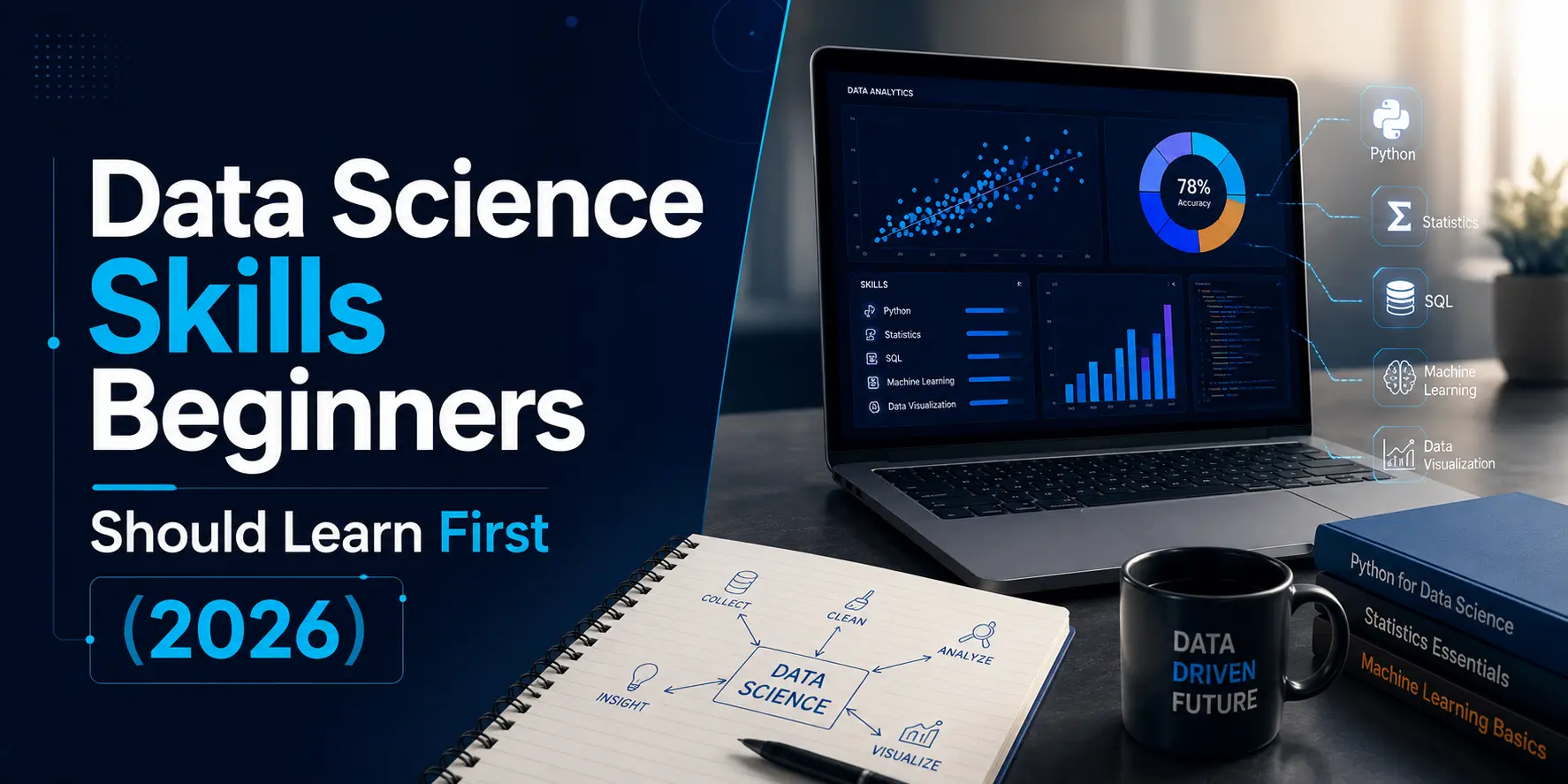
Most Important Data Science Skills a Beginner Should Learn First in India (2026 Guide)
Python. Statistics. Machine Learning. SQL. Dashboards. Deep Learning.
That's a lot to learn. Many beginners in India try to study everything at once, feel overwhelmed after a few weeks, and end up giving up.
The ones who actually land data roles don't learn more — they learn less, in a stricter order. One skill at a time, applied to a real dataset before moving on. That's really the whole secret.
Stop guessing what to learn next. This roadmap gives you the exact order to master data skills—one step at a time—so you build real job-ready skills instead of getting overwhelmed.
The Learning Sequence at a Glance
*Based on roughly 8–10 hours a week of consistent study. Full timeline breakdown further down.
Why Order Beats the List
Type "data science skills to learn" into Google and you'll get the same six or seven ingredients every time — Python, SQL, stats, Excel, ML, visualization. What almost nobody tells you is what to touch first. That's the actual gap.
Jump into machine learning before you're comfortable cleaning data, and you'll spend your time fighting broken datasets instead of learning models. Learn Python syntax before you have a problem to solve with it, and none of it sticks — there's nothing for the syntax to hang onto.
The sequence below is built on one idea: each skill should set up the next. If you'd rather have someone walk you through this in order instead of stitching it together from random tutorials, our Diploma in Data Science & AI and Diploma in Data Analytics & AI are both structured around this exact progression.
Step 1: Start With Excel, Not Python
Most Indian beginners skip straight to Python. That's a mistake. Excel makes you think in rows, columns, and logic manually — before any programming language does the thinking for you.
Focus on:
- Pivot tables — probably the single most useful thing you'll learn for summarizing data fast
- VLOOKUP / XLOOKUP and INDEX-MATCH
- Conditional formatting and data validation
- Basic charting
You don't need to master every function in Excel. You need enough fluency that when Pandas introduces you to "group by" and "filter," it already feels familiar, because you did it by hand first, in a spreadsheet, long before you saw a line of code. Worth noting: an analysis of over 300 real Indian data analytics job descriptions found Excel showing up in roughly 81% of them — ahead of every other tool, SQL included.
Step 2: SQL, Because Every Recruiter Checks for It
Companies keep their real data in databases, not spreadsheets. SQL is how you talk to a database, and it's the one technical skill that shows up in nearly every data role posting in India. A 2026 analysis of over 1,000 data analyst postings found SQL still sitting at the top of the required-skills list, appearing in roughly half of all listings.
Learn it roughly in this order:
SELECT, WHERE, ORDER BY first — basic filtering and sorting. Then GROUP BY with aggregate functions like SUM, COUNT, and AVG. After that, JOINs: inner, left, right. This is where most beginners get stuck, so don't rush it. Once joins feel natural, move to subqueries and CTEs (WITH clauses), and finally window functions — ROW_NUMBER, RANK, LAG/LEAD. That last group is what separates someone who "knows SQL" from someone who's actually job-ready.
Practice on real-ish datasets — sales records, e-commerce orders, employee tables — rather than toy examples that never get messy. Recruiters ask SQL questions in the very first technical round as a foundational, interview-tested skill, routinely. This isn't optional groundwork. It's a filter.
Step 3: Python — Just the Data Stack, Not the Whole Language
A lot of beginners try to learn Python the way a software engineer would: data structures, OOP, algorithms, before ever touching a dataset. Wrong entry point for data work. Learn just enough core Python to be dangerous, then jump straight to the libraries that matter.
Priority order:
- Basic syntax — variables, loops, conditionals, functions
- Pandas — loading, cleaning, filtering, reshaping data. This is where you'll actually spend most of your working hours
- NumPy — the numerical layer underneath Pandas
- Matplotlib / Seaborn — for visualizing what you find
Here's a fair benchmark: you're ready to move on once you can take a genuinely messy CSV — missing values, inconsistent formatting, duplicate rows — and turn it into an analysis-ready dataset with Pandas, without googling every single method. One more thing worth knowing before you stress about this step: entry-level analyst postings in India often don't ask for Python at all. It tends to show up more at mid-level or Data Scientist-adjacent roles. Don't let it hold up your first job search once Steps 1 and 2 are solid.
Step 4: Statistics — Everyone Skips It, Every Interviewer Tests It
This is the step most beginners in India avoid, and it's exactly why so many self-taught profiles get filtered out in interviews. You don't need a math degree. You do need to be comfortable with:
- Descriptive statistics: mean, median, mode, standard deviation, variance
- Probability basics: conditional probability, normal and binomial distributions
- Hypothesis testing: p-values, confidence intervals, the logic behind A/B testing
- Correlation vs. causation
That last one alone comes up in nearly every data science interview in the country. The point isn't memorizing formulas — it's being able to look at a dataset and tell whether a pattern actually means something or is just noise. Which, not coincidentally, is exactly what a hiring manager will hand you a sample dataset and ask you to do.
Step 5: Power BI / Tableau — Make the Analysis Usable
You can build the best model in the world, but if you can't explain it to a non-technical stakeholder, you're going to struggle to get hired in India right now. Most companies need insight communicated clearly a lot more urgently than they need advanced modeling on day one.
Learn Power BI or Tableau — dashboarding is one of the more in-demand, genuinely job-ready skills in Indian analytics hiring at the moment, and Power BI in particular shows up across a large share of analyst postings. Alongside the tool itself, learn to actually tell a story with data: picking the right chart, avoiding visuals that mislead, and structuring a dashboard around a business question rather than just dumping numbers on a page.
This is also the quickest skill on this list to turn into something you can show off. A well-built dashboard on a public dataset — Indian census data, e-commerce sales, IPL stats, whatever you find interesting — is something you can pull up in your very first interview. Our Certification in Data Analytics & AI is built around exactly this SQL-to-dashboard pipeline for people starting out.
Step 6: Machine Learning — Only Once Everything Above Is Solid
This is where most beginners want to start. Which is precisely why it's last on this list. Without solid data-cleaning, SQL, and statistics underneath it, machine learning just produces people who can copy a model.fit() line from a tutorial but can't say what the model is actually doing, or why it broke on real, messy data.
Work through it in this order: supervised learning basics first (linear regression, logistic regression, decision trees), then model evaluation — accuracy, precision, recall, F1-score, confusion matrix. Knowing which metric actually matters for a given business problem is a very common interview question in India, so don't treat this as an afterthought. After that, unsupervised learning basics like K-means clustering, and scikit-learn as your main library before you go anywhere near TensorFlow or PyTorch.
Resist the pull toward deep learning or generative AI before this foundation is set. Most entry-level and mid-level data roles in India — data analyst, junior data scientist, business analyst — lean far more on solid stats, SQL, and classical ML than on anything deep-learning related. NASSCOM's industry skills reporting has flagged a structural shortage of trained data professionals in India more than once, which is good news here: the foundation-first path still leads somewhere real, not into an already-crowded field.
Step 7: One Real Project, Start to Finish
Skills on a resume are just claims until something backs them up. A finished project is the backup. It's also the single highest-leverage thing a beginner can do in this job market: pick one real, messy dataset — not a pre-cleaned Kaggle competition — and take it all the way through:
- Clean it with Pandas
- Explore it with statistics
- Pull in a related dataset with SQL, if you can
- Build a simple model or dashboard from it
- Write up the findings as a business recommendation, not a technical report
One project like this, documented properly on GitHub or LinkedIn with a clear write-up, will do more for your job search than five half-finished online courses sitting in your browser tabs. If building this alone feels daunting, the live-project tracks inside our Data Analytics and Data Science courses exist specifically to produce this kind of output with mentor feedback along the way.
A Realistic Timeline
Studying consistently at 8–10 hours a week, here's roughly what it looks like:
- Excel + SQL fundamentals: 3–4 weeks
- Python + Pandas: 4–6 weeks
- Statistics: 3–4 weeks
- Visualization / BI tools: 2–3 weeks
- Machine learning fundamentals: 6–8 weeks
- End-to-end project: 3–4 weeks
Add it up and you're looking at somewhere between 5 and 7 months to go from zero to a job-ready beginner portfolio. Structured, mentor-led training with live projects tends to land at the faster end; fragmented self-study across unconnected YouTube videos tends to land at the slower end, or beyond it. Our Advanced Certification in Data Analytics & AI compresses this same sequence into a mentored six-month track for anyone who wants the faster route with guidance built in.
The Bottom Line
The beginners who actually break into data roles in India aren't the ones who've touched the most tools. They're the ones who followed an order where each skill reinforced the last — and who can point to one real project as proof they can do the whole job, not just a slice of it.
Start with Excel and SQL. Build Python and statistics on top of that. Only then move into machine learning. Skipping ahead doesn't save time; it just means relearning the same ideas later, under interview pressure, without the foundation underneath them.
Not sure which course matches where you're at right now?