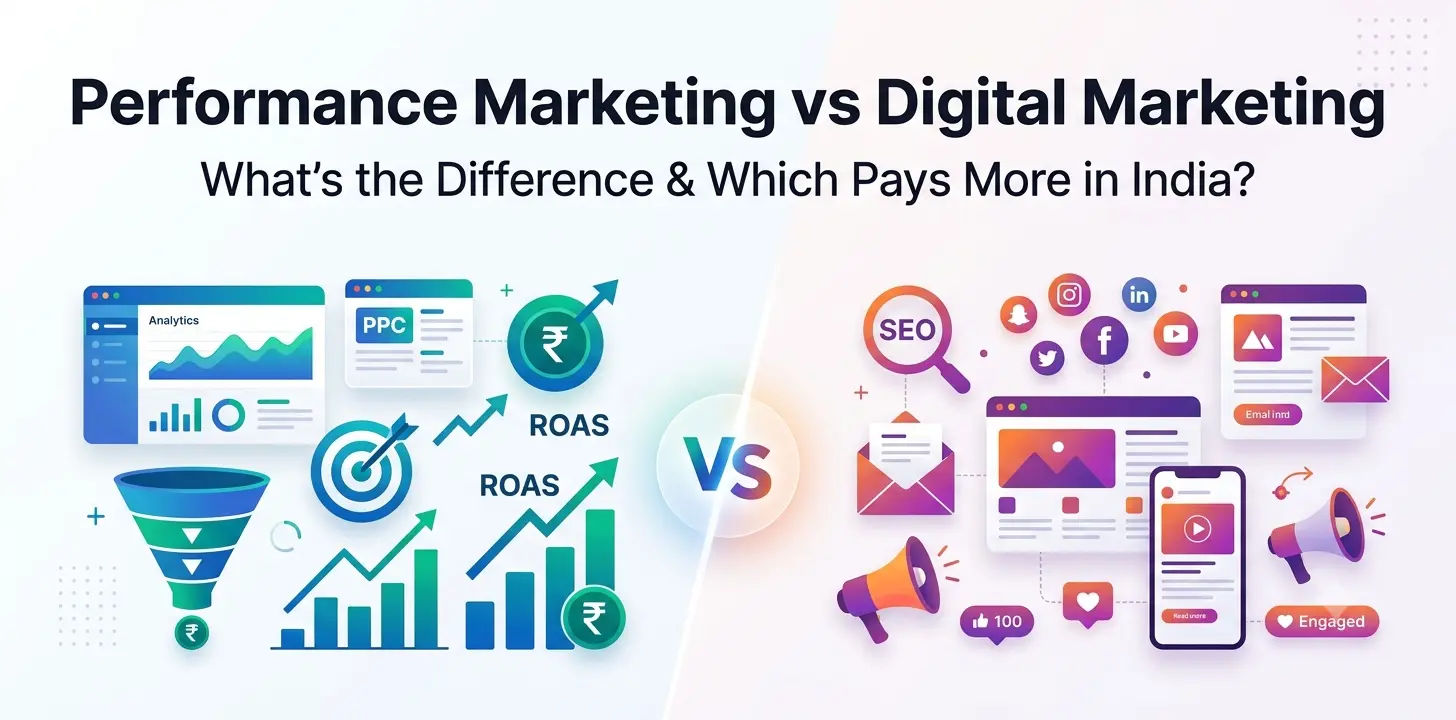
Performance Marketing vs Digital Marketing: What's the Difference & Which Pays More in India?
If you are new to digital marketing, then there is a possibility that you may assume “performance marketing” and “digital marketing” are the same thing. But in actuality, they are not, and the salary gap is the witness.
In India in 2026, a generalist Digital Marketing Executive typically earns about ₹2.5–4.5 LPA at the entry level, you know. Meanwhile, a Performance Marketing Executive who’s focused on performance-specific tasks like Google Ads and Meta Ads, at the same early experience stage, is often around ₹4–6 LPA. Then, when you reach the manager level, things shift: a general Digital Marketing Manager usually sits near ₹8–9 LPA, but a Performance Marketing Manager averages roughly ₹12.65 LPA, and the top end can even reach ₹24.5 LPA, sometimes more. (Source: Glassdoor India, May 2026)
This isn't a slight difference that you can ignore. This is a significant gap that you can add to your earnings. And all this starts with choosing the right direction from the very start. In this writing piece, we are going to discuss the difference between performance marketing and digital marketing, as well as what strategy professionals follow in this field, and help you with to find out what is best fit for your career.
Table of Contents
- What Is Digital Marketing? (The Full Scope)
- What Is Performance Marketing? (The Specific Scope)
- Performance Marketing vs Digital Marketing: The Core Differences
- Who Does What — Roles Side by Side
- Which Pays More in India in 2026?
- Performance Marketing vs Digital Marketing: Which Should You Learn?
- The Honest Career Decision Framework
- Frequently Asked Questions
What Is Digital Marketing? (The Full Scope)
Digital marketing is that broad umbrella term for anything marketing-wise that happens through digital channels, like search engines, social media, email, websites, apps, and other online content. It’s a wide category that kind of includes many modules in this— search engines, social media, email, websites, apps, and online content.
- SEO (Search Engine Optimisation) — Getting organic traffic from Google and other search engines
- Content Marketing — Blog posts, videos, podcasts, infographics that attract and educate audiences
- Social Media Marketing — Building brand presence and community on Instagram, LinkedIn, YouTube, Twitter/X
- Email Marketing — Campaigns, drip sequences, newsletters sent directly to subscriber inboxes
- Performance Marketing — Paid advertising where you pay only for measurable results (clicks, leads, sales)
- Marketing Analytics — Tracking, measuring, and drawing insights from all marketing activity
- Marketing Automation — Using tools like HubSpot or Marketo to automate campaign workflows
In other words, digital marketing is what a company actually does across all these channels, together. A Head of Digital Marketing at a larger brand will usually oversee teams working across most, or even all, of these areas at the same time, kinda in parallel.
What Is Performance Marketing? (The Specific Scope)
Performance marketing is one particular discipline inside digital marketing— the paid advertising side, where the budget is tied directly to trackable results, measurable outcomes, and not just vibes.
The defining principle: in performance marketing, the advertiser pays only when a specific, pre-agreed result happens. A click. A lead. A sale. An app install. Not for visibility. Not for reach. For results.
If you want to go deeper on the concept itself, the full breakdown is in our What Is Performance Marketing guide →
The channels performance marketers work with are:
- Google Search Ads and Google Display Ads
- Meta Ads (Facebook and Instagram)
- LinkedIn Ads (for B2B campaigns)
- Programmatic advertising (DV360, The Trade Desk)
- Affiliate marketing networks
- YouTube Ads (for video performance campaigns)
Everything a performance marketer does is quantified. Every campaign has a target CPA, ROAS, or CPL. Every rupee spent is tracked to an outcome. There is no ambiguity in the role.
Performance Marketing vs Digital Marketing: The Core Differences
The simplest way to understand the difference: digital marketing is what a company's marketing department does. Performance marketing is what their paid media team does specifically. Every company that does performance marketing also does broader digital marketing. Not every digital marketer is a performance marketer.
Who Does What — Roles Side by Side
Here, many people feel confused. But the list below gives you the right insight about the roles.
Digital Marketing Executive (Generalist)
- Writes and schedules social media posts across platforms
- Manages basic content calendar and coordinates with the content team
- Runs basic email campaigns in Mailchimp or similar
- Tracks website traffic in GA4 and shares weekly reports
- May assist the paid media team with creatives or basic campaign setup
- Reports to: Digital Marketing Manager
Performance Marketing Executive
- Builds and launches paid campaigns on Google Ads and Meta Ads Manager, kinda like on autopilot but with attention.
- Sets up audience segments, exclusions and lookalike audiences, then double-checks the whole flow.
- Tests ad variations (creative headlines, CTAs) and optimises based on the results, not feelings.
- Track CPA, ROAS, and CTR across campaigns and report them to the marketing lead.
- Manages campaign budgets daily, scaling what’s working, pausing what’s not.
- Reports to: Performance Marketing Manager or Head of Growth
Digital Marketing Manager (Generalist)
- Owns the entire digital marketing strategy across SEO, content, social, email and ppc
- Manages a team of specialists across several functions
- keeping everyone aligned and on point
- Coordinates with agency partners, internal designers and product teams
Sometimes it’s a bit of chaos, but it works - Sets and reports overall marketing KPIs — traffic, leads, conversions
- Brand Metrics Reports to: VP Marketing or Chief Marketing Officer
Performance Marketing Manager
- Owns the full paid media P&L — responsible for ad spend efficiency and revenue attribution
- Manages Google Ads and Meta Ads accounts with ₹50 lakh to ₹5 crore+ monthly budgets
- Builds attribution models to track which channels are driving actual revenue
- Leads media planning — deciding how to allocate budget across channels for a campaign
- Reports directly to CMO or VP Growth with revenue accountability
- Reports to: CMO, VP Marketing, or Head of Growth
The performance marketing manager role is defined by revenue accountability. It is why it pays significantly more — and why it is also harder to hire for.
Which Pays More in India in 2026?
This is the question most readers came here to answer, so here it is clearly.
Performance marketing pays more at every level of experience — and the gap widens as you go senior.
(Sources: Glassdoor India — Digital Marketing Salary May 2026)
City-wise for Performance Marketing Managers specifically:
- Bengaluru: ₹15.9–17.6 LPA
- Gurugram: ₹15.2–16.8 LPA
- Mumbai: ₹12–16 LPA
- Hyderabad: ₹11–15 LPA
- Pune: ₹10–14 LPA
The reason for the salary premium is simple: performance marketing output is directly measurable. When a performance marketer reduces CPA by 20% on a ₹1 crore monthly budget, the business saves ₹20 lakh a month. That impact is visible, attributable, and worth paying for. A generalist digital marketer's contribution — while real — is harder to isolate in numbers. The market pays for what it can measure.
Which Should You Learn?
The answer depends entirely on what you want from your career — not on which sounds more impressive or which is trending on LinkedIn.
Choose a Digital Marketing generalist path if:
- You enjoy working across multiple channels and don't want to specialise early
- You want to eventually move into a CMO or marketing leadership role (generalist managers become generalist leaders)
- You're interested in brand building, storytelling, and the creative+strategic side of marketing
- You are comfortable with a slower salary growth curve in exchange for broader skill exposure
- You want to start a marketing agency eventually — generalists make better agency founders
Choose Performance Marketing specialisation if:
- You are comfortable with data and numbers and want your work to be directly measurable
- You want the fastest possible salary growth in digital marketing — the numbers above make the case clearly
- You enjoy the analytical and iterative loop of testing, reading results, and optimising
- You want to be directly accountable to business outcomes, not brand metrics
- You're drawn to the idea of managing large budgets and being responsible for revenue attribution
The honest middle ground: many marketing careers start as generalist and specialise at the 2–3 year mark. Spending your first 1–2 years covering the breadth of digital marketing — SEO, content, social, email, paid — before going deep on performance marketing is not a bad path. You come to performance work with more context, which makes you a better strategist.
The Honest Career Decision Framework
The fastest career move for a fresher who wants maximum earning potential from digital marketing in India in 2026 is basically this: start with digital marketing fundamentals, just to get a grip on the whole ecosystem, then focus on performance marketing within the first 12–18 months, so you can move quicker.
If you want to build both — a strong generalist base and a performance specialization, DizitalAdda's Advanced Digital Marketing Course covers the full spectrum across 60+ modules, from SEO and content fundamentals through Google Ads, Meta Ads, GA4, and AI marketing tools, with 100% placement assistance. The programme is designed specifically for students who want to start broad and specialise fast.
Also worth reading before you decide anything, in full: Why a Digital Marketing Course Is Worth It in 2026 — a practical breakdown of what to look for in a programme before you finally commit.
Frequently Asked Questions
- What is the main difference between performance marketing and digital marketing?
Digital marketing is this wide umbrella covering all online marketing — like SEO, content, social media, email, and paid ads. Performance marketing is a narrower thing inside it, where advertisers only pay once there are measurable results (clicks, leads, sales). So yeah, all performance marketing counts as digital marketing, but not every digital marketing job is really performance marketing. - Which pays more — performance marketing or digital marketing?
Performance marketing pays more at every experience level. The average Digital Marketing Manager in India earns ₹8–9 LPA. The average Performance Marketing Manager earns ₹12.65 LPA, with top earners reaching ₹24.5 LPA. (Source: Glassdoor India, May 2026.) The salary gap is driven by the direct measurability and revenue accountability of performance marketing roles. - Can I do performance marketing without knowing digital marketing basics?
Technically, yes — you can jump straight into Google Ads without knowing SEO. Practically, your campaigns will be weaker for it. Understanding how landing pages, content, and SEO work makes you a significantly better performance marketer because you understand the full user journey, not just the paid portion of it. - Is performance marketing better than digital marketing for freshers?
It tends to pay better from Day 1, but the learning curve feels steeper. A generalist digital marketing role gives you wider exposure across channels, which is helpful as background if you’re still unsure what exact direction you want to lean into. A performance marketing role puts you directly on campaign execution from early on. If you are clear that you want the analytical, data-driven path and the higher salary, performance marketing is a better starting point.
The Bottom Line
Performance marketing and digital marketing are not rivals — one is a subset of the other. But the difference matters enormously when you're deciding where to invest your learning time, because the salary and career trajectories diverge sharply the moment you specialise.
If you’re trying to maximise earning potential in digital marketing in India in 2026, then specialising in performance marketing is the most direct path that the data backs up. The skills are learnable, the need is genuine, and the salary gap between generalists and specialists is just getting wider, not smaller.
Build your performance marketing skills with DizitalAdda's Advanced Digital Marketing Course →