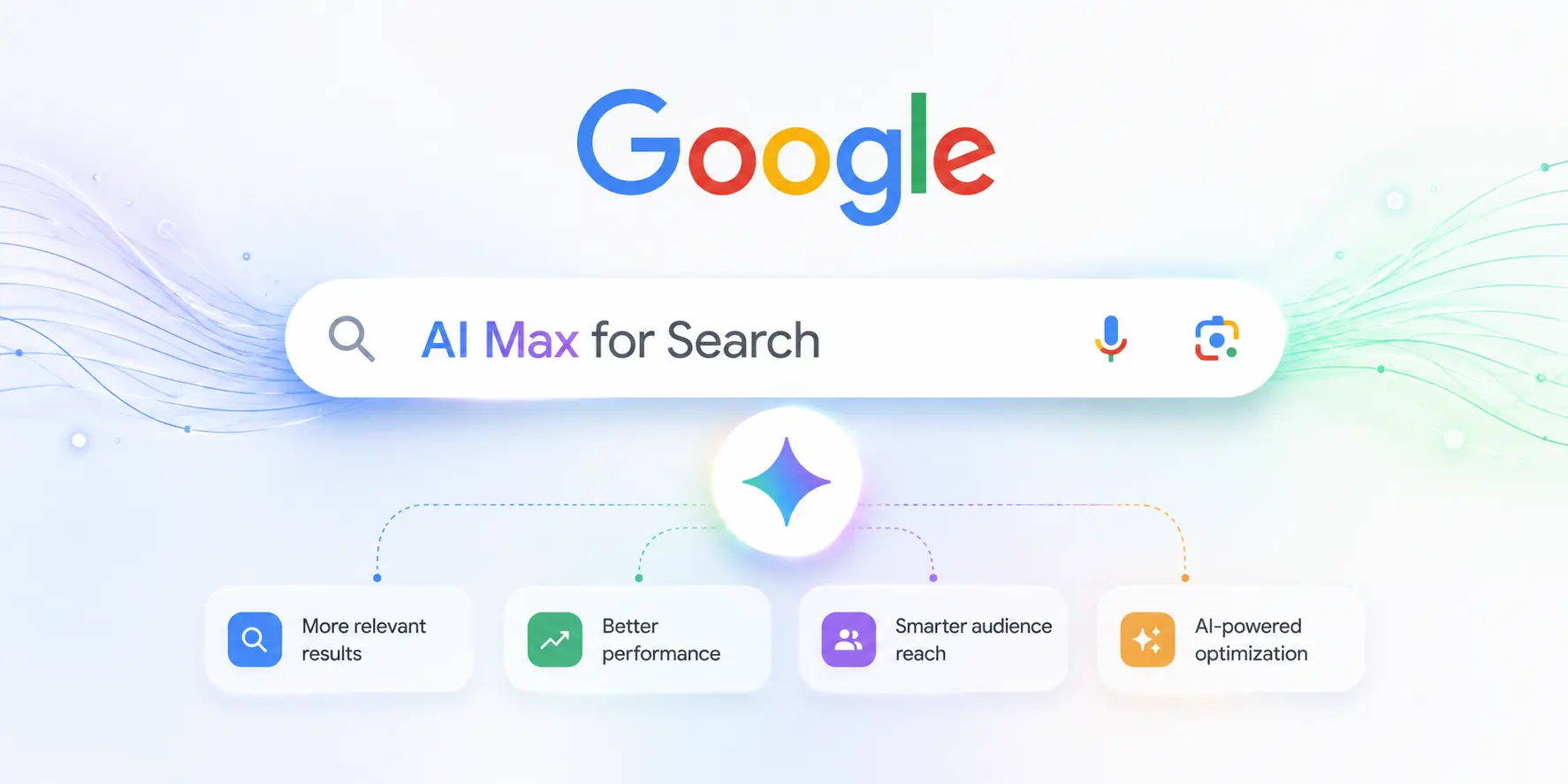
What Is Google AI Max for Search? (2026 Guide)
For over a decade, winning at Google Ads meant one thing: picking the right keywords.
That's changing fast. People aren't typing three-word phrases into Search anymore — they're asking full questions, pasting descriptions, even searching with images. Google's answer to this shift is AI Max, and understanding Google AI Max for Search is quickly becoming one of the most useful skills a PPC marketer — or a student building toward one — can have in 2026.
Did you know? Advertisers using AI Max are seeing roughly 27% more conversions at a similar cost per acquisition compared to traditional keyword-only campaigns.
Why Search Ads Are Changing in the First Place
To understand why AI Max exists, it helps to understand what broke.
Keyword matching was built for a simpler era of search — short, predictable queries like "buy running shoes online." Marketers could reasonably predict the handful of ways people would phrase that search, and bid on those exact phrases.
That assumption doesn't hold anymore. Search today includes:
- Long, conversational queries — "best running shoes for flat feet under ₹5000"
- Multimodal search — typing a description, pasting an image, or combining both in the same search box
- AI-assisted discovery — features like AI Overviews and AI Mode that summarize and interpret intent before a user even clicks
No keyword list, however long, can keep up with that variety. That's the gap AI Max is built to close.
What Is Google AI Max, in Plain English?
AI Max is a set of AI-powered features inside Google Search campaigns, as described in Google's official Ads Help documentation.
It moves targeting away from rigid keyword matching and toward understanding intent. Instead of listing every possible keyword variation a customer might type, AI Max reads the full context of a search — however long or unusual — and matches it to your ads automatically.
It works through three main levers:
1. Search-Term Matching
Finds relevant searches beyond your exact keyword list, including long, conversational queries your keyword list would never have caught. This is the core "understanding" engine — it's what let Royal Canin's ads show up for a query like "how many times a day to feed a puppy" without anyone manually bidding on that exact phrase.
2. Text Customization
Google's AI adjusts your ad copy in real time to more precisely answer the specific search someone typed — rather than showing the same static headline to everyone.
3. Final URL Expansion
Sends users to the most relevant page on your site for their specific query, instead of whichever landing page you manually assigned to a campaign.
Used together, your ads can now show up for — and speak directly to — searches you'd never have thought to bid on manually. Google introduced the full feature set in its official launch announcement on the Google Ads & Commerce blog.
AI Max vs Keyword Match: What's the Real Difference?
Traditional keyword match (exact, phrase, broad) relies on you predicting how people search.
AI Max flips that. It relies on Google's models understanding meaning, so your campaign adapts to real search behavior instead of a fixed keyword list.
AI Max vs Performance Max
These two get confused often, so it's worth being precise:
If someone asks you the difference in an interview, that table is your one-line answer.
Must read: Performance Marketing Jobs India 2026: Complete Career Guide
How to Set Up AI Max (Step-by-Step Overview)
You don't need to rebuild your account from scratch. AI Max layers on top of an existing Search campaign:
- Open an existing Search campaign in Google Ads (or create a new one)
- Enable AI Max in the campaign settings — it sits alongside your regular keyword targeting rather than replacing it
- Turn on the levers you want — search-term matching, text customization, and/or final URL expansion can be switched on individually
- Add brand and content exclusions if there are topics or phrasings you don't want your ads matched to — this keeps you in control even as targeting broadens
- Monitor the Search terms report closely for the first few weeks to see exactly what new queries are triggering your ads
- Adjust exclusions and budget based on what you learn, then scale up
This is also why the "student angle" of this topic matters — reading a search-term report and knowing what to exclude is a very learnable, very demonstrable skill. For a practical walkthrough of what changes in reporting once AI Max is live, WordStream's rollout breakdown is a useful companion read.
Real Brands, Real Results
Numbers on a blog post are one thing. Seeing how actual global brands used AI Max is what makes this click, according to Think with Google's May 2026 report.
Lufthansa Group
Air travel intent is messy — a search could mean a business trip next Tuesday or "a long weekend in Amsterdam" three months out.
Instead of building thousands of manual campaigns for every route, Lufthansa Group let AI Max adapt to how people actually search and plan trips.
Result: destination campaigns cut by 66%, with return on ad spend up 24%.
Etsy
Etsy's catalog is built on one-of-a-kind, handmade, and vintage items — inventory that's genuinely hard to match to fixed keywords, since no two sellers describe products the same way.
By leaning on AI Max's ability to understand meaning rather than exact phrasing, Etsy drove a 36% year-over-year increase in holiday gross merchandise sales, with new buyer acquisition up 21%.
L'Oréal (SkinCeuticals)
L'Oréal wanted to test whether AI could match complex user intent to specific product pages — like sending someone straight to the right serum, not just a generic category page.
Testing the full AI Max feature set against their traditional keyword strategy, L'Oréal saw a 126% higher ROAS and a 33% increase in conversion rate.
Ikea (US)
For an established brand like Ikea, the challenge isn't being found — it's turning broad discovery into store visits.
Using all three AI Max levers together, Ikea recorded a 127% increase in physical store visits, a 65% lift in unbranded clicks, and a 28% boost in incremental ROAS.
Royal Canin
Royal Canin needed to reach pet owners at very specific, very niche moments — like someone Googling "how many times a day to feed a puppy."
Using search-term matching and text customization, Royal Canin drove a 263% surge in conversions while cutting cost per acquisition by 73%, at the same spend level.
Five different industries, five different problems — same underlying shift: let AI handle the matching, and focus your energy on strategy.
Where AI Max Genuinely Helps (and Where to Be Careful)
To keep this balanced — and because topic completeness means covering trade-offs, not just wins — here's what's worth knowing before you flip the switch.
Where it helps:
- Uncovering demand you were never targeting in the first place (long-tail, conversational searches)
- Reducing the manual workload of building and maintaining huge keyword lists
- Improving relevance between the search, the ad copy, and the landing page automatically
Where to be careful:
- Less granular control — you're trusting Google's matching more than a hand-built keyword list, so brand and content exclusions become more important, not less
- Learning curve on reporting — you need to actively read the search-terms report to understand what's actually triggering your ads
- Not a replacement for strategy — AI Max optimizes matching and copy, but budget allocation, audience definition, and overall campaign goals are still your job
How to Measure Whether AI Max Is Working
Don't just watch overall conversions — track these specifically:
- Search terms report — what new queries are showing your ads, and are they relevant
- ROAS and CPA, compared before/after — measured over at least 2-4 weeks to account for the AI's learning period
- Unbranded vs branded click share — a rising unbranded share (like Ikea's 65% lift) signals genuine new-demand capture, not just cannibalizing existing brand searches
- Landing page performance by URL — since final URL expansion can send traffic to pages you didn't originally plan for
What This Means If You're Building a Marketing Career
Here's the honest read for students and early-career marketers: the "safe" PPC skill — carefully hand-picking keywords and match types — is becoming less valuable by the year.
That's not bad news. It's an opportunity.
This shift is recent enough that nobody has a 10-year head start on you. Spend the next month genuinely understanding AI Max, and you'll walk into interviews ahead of marketers who only know the old, manual way of running Search ads.
A few concrete steps:
- Set up a free Google Ads account and run a small AI Max test campaign, even with a ₹500 budget
- Learn to read "search terms" vs "keywords" in campaign reports — that distinction matters more now than ever
- Practice writing brand and content exclusions — this is the skill that shows you understand control, not just automation
- Follow real case studies (like the five above) so you can speak to actual results in interviews, not just definitions
Where to Learn AI Max as a Beginner
You don't need a paid course to get started.
Google Skillshop offers free, official Google Ads certifications — including modules on Search campaign automation and AI-powered features. Having "Google Ads Certified" on your resume or LinkedIn is one of the easiest credibility signals you can add as a student.
Pair that certification with hands-on practice in a free test account, and you'll understand AI Max better than most people already working in the field.
Related readings: How to Start with Performance Marketing
Where This Is Headed
AI Max is one piece of a bigger shift: Search itself is becoming a conversation, not a query box. As AI Overviews and AI Mode handle more of the "research" part of a search, ads that can understand context — not just keywords — will matter more every year.
The marketers who stay valuable through that shift won't be the ones who resist it. They'll be the ones who learn to steer it.
Key Takeaways
- Google AI Max for Search shifts Search ads from manual keyword matching to AI-driven intent matching, using search-term matching, text customization, and final URL expansion
- Five different global brands — Lufthansa, Etsy, L'Oréal, Ikea, and Royal Canin — all saw double-digit to triple-digit gains after adopting it
- It's not a "set and forget" tool — exclusions and search-term monitoring still matter
- For students and early-career marketers, this is a rare chance to learn a skill before it becomes "expected" rather than "impressive"
- Free certification through Google Skillshop is the easiest first step
FAQ
Q1: Is AI Max the same as Performance Max?
A: No. Performance Max runs ads across all Google channels from one campaign. AI Max is an AI upgrade specifically within Search campaigns.
Q2: Do I need a big budget to use AI Max?
A: No. It's available at any budget level within a standard Google Search campaign.
Q3: Is AI Max only for big brands like Etsy and Lufthansa?
A: No — those are just the public case studies. AI Max is a standard feature available to any advertiser running Google Search campaigns.
Q4: Does AI Max replace the need for keywords entirely?
A: No. AI Max layers on top of your existing keyword targeting rather than replacing it — you still set a foundation, AI Max just extends your reach beyond it.
Q5: Will AI Max hurt my brand safety or show my ads on irrelevant searches?
A: It can, if you don't set exclusions. Brand and content exclusions exist specifically so you keep control over what your ads do and don't match to.
Quick Glossary
- AI Max — AI-powered features within Google Search campaigns for intent-based ad matching
- Search-term matching — AI Max's core feature for matching ads to relevant queries beyond your exact keyword list
- Final URL expansion — automatically sending traffic to the most relevant page on your site
- Performance Max — a separate Google Ads campaign type that runs across all channels, not just Search
Now that you understand Google AI Max for Search, check out our next guide on - How to Start with Performance Marketing: A Beginner's Roadmap (2026).