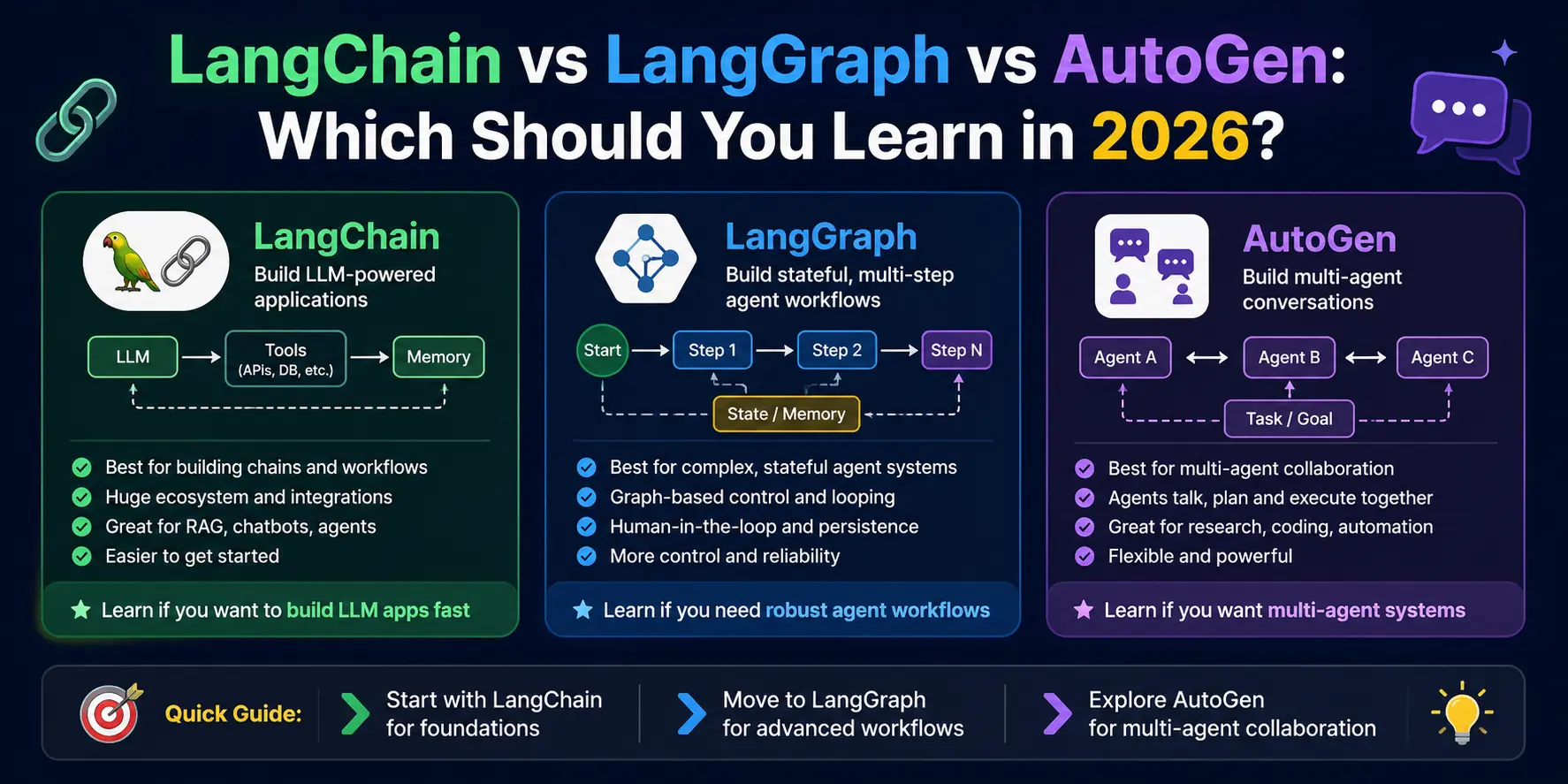
LangChain vs LangGraph vs AutoGen: Which Should You Learn in 2026?
Quick answer: AutoGen entered maintenance mode in October 2025. It's no longer what Microsoft recommends for new projects. Its official successor is Microsoft Agent Framework (MAF), which reached a stable 1.0 release in April 2026. LangChain and LangGraph, meanwhile, are both actively developed. LangChain handles fast integration and tool-calling. LangGraph handles structured, stateful agent workflows built on top of it.
If you found this page searching "LangChain vs AutoGen," read this first. A lot of comparison content online was written before this shift. It may point you toward a framework that's no longer actively developed.
What Actually Changed
For a long time, "LangChain vs AutoGen" was a reasonable framing. LangChain focused on tool integration and simple chains. AutoGen, from Microsoft Research, offered a distinct, conversation-based approach to coordinating multiple AI agents.
That comparison is now outdated in one important way. In October 2025, Microsoft announced that AutoGen would move into maintenance mode. It still receives bug fixes and security patches, but no new features or architectural improvements. Microsoft's own AutoGen repository now directs new users toward Microsoft Agent Framework instead. MAF launched as a stable 1.0 release in April 2026, unifying AutoGen's multi-agent ideas with Semantic Kernel, Microsoft's other agent toolkit, into one actively maintained framework.
A community-driven fork called AG2 has also emerged. It continues AutoGen's original conversation-based agent model for teams that want that architecture without following Microsoft's newer roadmap.
None of this means AutoGen is broken or unusable today. Existing projects built on it will keep working. It means that if you're starting something new in 2026, AutoGen itself is no longer where active development is headed.
LangChain vs LangGraph: The Comparison That's Still Current
LangChain is best understood as a toolkit. It bundles document loaders, embeddings, vector store connections, and simple "chain" logic for building applications on top of language models. It's the fastest way to wire a model up to real data and tools. It remains the most common starting point for straightforward use cases like a single chatbot or basic RAG application.
LangGraph is built on top of LangChain. It adds something LangChain alone doesn't handle well: structured, stateful control over complex, multi-step agent behavior. Instead of a simple chain of steps, LangGraph models a workflow as a graph. Nodes represent actions or agents, and edges represent the conditions under which the workflow moves from one step to the next. This makes it possible to build agents with branching logic, error recovery, long-running processes, and human-in-the-loop approval steps — the kind of control production systems need, not just prototypes.
In practice, most teams don't choose one or the other. They start with LangChain's components for basic integration, then bring in LangGraph once the project needs more reliable, structured control over agent behavior. DizitalAdda's Diploma in Generative AI & Prompt Engineering teaches both in that same order for exactly this reason.
Where AutoGen's Successors Fit
Microsoft Agent Framework (MAF) is the direct, Microsoft-supported path forward if you were considering AutoGen. It combines AutoGen's multi-agent coordination ideas with Semantic Kernel's enterprise integration features into one framework with stable APIs and long-term support. It's a natural fit for teams already working inside the Microsoft/Azure ecosystem.
AG2 is the community fork worth knowing about if you specifically want AutoGen's original conversation-style multi-agent model. Agents coordinate by messaging each other in a group conversation, without adopting Microsoft's newer graph-based approach.
CrewAI is also worth mentioning here. It's become the framework most commonly compared alongside LangChain/LangGraph in current 2026 discussions, more so than AutoGen now is. CrewAI models agents as a team of specialists, each with a defined role and task. That tends to be the fastest path to a working multi-agent prototype for teams that don't need LangGraph's level of granular control.
Decision Framework: Which Should You Actually Learn?
The LangChain-then-LangGraph pairing has the largest learning resources, the widest tool ecosystem, and the most transferable concepts if you later explore other frameworks.
Why This Matters for Your AI Career, Not Just Your Code
Framework churn is a normal part of working in AI right now. The underlying concepts — state management, tool calling, multi-agent coordination — hold steady even as the specific frameworks change every year or two.
This is why employers care less about which single framework a candidate memorized. They care more about whether that candidate understands why a framework is structured the way it is. That understanding transfers when the tooling shifts, and it always shifts.
It's also why structured programs — like DizitalAdda's Diploma in GenAI & Prompt Engineering — teach the underlying patterns of retrieval, state, and orchestration through LangChain and LangGraph specifically, rather than treating any one framework as a permanent skill. If you want a shorter, more focused path, the Advanced Certification in Generative AI & Prompt Engineering covers the same core concepts. The framework you learn today won't be the last one you use professionally. The goal is understanding the pattern well enough to pick up the next one quickly.
Key Takeaways
- AutoGen is in maintenance mode as of October 2025 — bug fixes only, no new features.
- Microsoft Agent Framework is AutoGen's official successor, stable since April 2026.
- LangChain and LangGraph remain actively developed and are still the strongest starting pair for most learners.
- CrewAI and AG2 are the two other frameworks worth knowing about, depending on your use case.
- Concepts transfer across frameworks — that's what to actually optimize for when learning.
Frequently Asked Questions
- Is AutoGen dead?
Not dead, but in maintenance mode. It still works and receives security and bug fixes, but Microsoft has stopped adding new features and now directs new users toward Microsoft Agent Framework instead. - Should I learn LangChain or LangGraph first?
Start with LangChain. It has a lower learning curve and covers the core building blocks — tool calling, embeddings, retrieval — that LangGraph builds on top of. Move to LangGraph once you need more structured control over multi-step or long-running agent behavior. - Is LangGraph a replacement for LangChain?
No. LangGraph is built on top of LangChain, not a separate competitor to it. Most LangGraph projects still use LangChain's components — document loaders, embeddings, retrievers — underneath the graph-based orchestration layer. - What should I use instead of AutoGen for a new project in 2026?
If you're inside the Microsoft/Azure ecosystem, Microsoft Agent Framework is the official, actively developed successor. If you specifically want AutoGen's original conversational multi-agent style outside Microsoft's roadmap, the community-led AG2 fork continues that model. Many teams outside the Microsoft ecosystem are also choosing CrewAI or LangGraph instead. - Does switching frameworks mean starting over?
Not entirely. Core concepts like prompt design, retrieval setup, and tool definitions generally carry over between frameworks. What changes is mostly the orchestration layer — usually the smaller part of the rebuild.