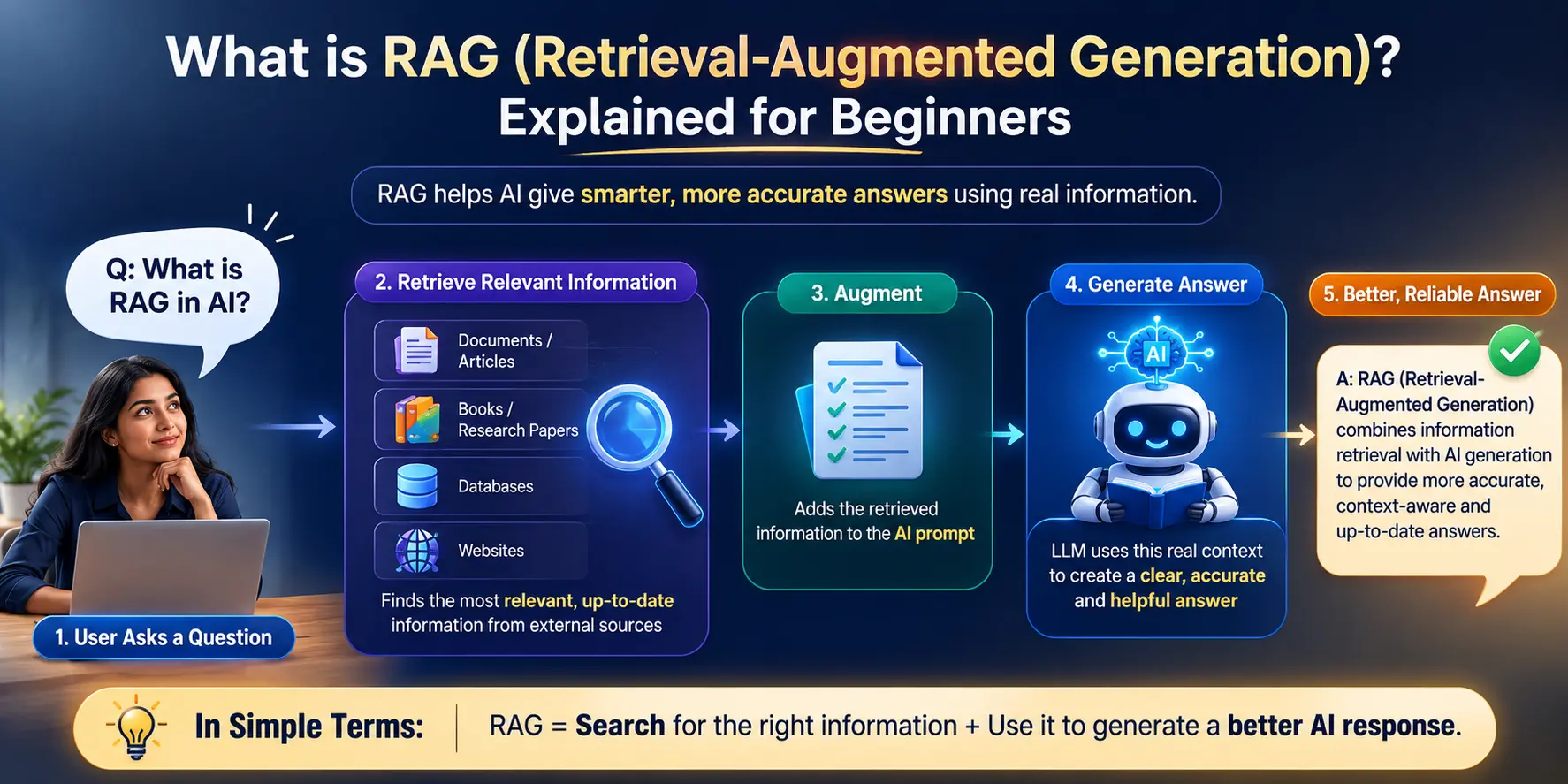
What is RAG (Retrieval-Augmented Generation)? Explained for Beginners
RAG (Retrieval-Augmented Generation) is a technique that lets an AI model search real, current documents and use them as evidence before it writes an answer, instead of relying only on facts it memorized during training. It's the standard fix for AI "hallucination" — confident but false answers — and it's why most production chatbots, internal knowledge assistants, and AI search engines built in 2026 are grounded in a document store rather than the model's memory alone.
If you've used ChatGPT, Gemini, or any AI chatbot at work, you've probably seen it give a fluent, well-formatted answer that turns out to be wrong. RAG is the most widely deployed way to reduce that problem, and it's one of the core skills taught in DizitalAdda's Diploma in Generative AI & Prompt Engineering, because almost every real-world GenAI system built for businesses today uses some form of it.
This guide explains RAG in plain language — no coding background assumed — and links out to the primary research and vendor documentation behind every claim, so you can verify it yourself.
Why was RAG needed in the first place?
Large language models like GPT, Gemini, or Claude are trained on a fixed dataset up to a certain date. This creates three problems:
- They don't know what happened after their training cutoff.
- They don't know your organization's private data — product catalogues, internal policies, customer records — because none of it was part of the training.
- They hallucinate. When a model doesn't know something, it often generates a plausible-sounding but invented answer rather than admitting uncertainty.
AWS's official explainer on RAG describes it as a way to point a large language model at an authoritative external knowledge source before it generates a response, rather than depending purely on what's baked into the model's parameters — which addresses all three problems at once, without retraining the model itself.
How much does RAG actually reduce hallucinations?
This is the part most beginner explainers skip, and it's the part that matters most.
- A peer-reviewed evaluation of RAG-based chatbots answering cancer-information questions found that grounding responses in curated, reliable sources cut hallucination rates roughly in half compared to a standard chatbot with no retrieval step, and made the model far more willing to say "I don't know" instead of guessing (study in JMIR, via PMC).
- A 2026 systematic review of 50 studies comparing RAG against fine-tuning in medical AI found RAG consistently produced larger accuracy gains — in the range of roughly 6% to over 50% over baseline models depending on task difficulty — while avoiding the "catastrophic forgetting" risk that comes with retraining a model on new data (Authorea systematic review, 2026).
The honest caveat: RAG reduces hallucination, it doesn't eliminate it. If the retrieval step pulls the wrong document, the model can still generate a confidently wrong answer built on the wrong evidence.
Where did RAG come from?
RAG isn't a marketing term — it's a specific architecture first proposed by Meta AI (then Facebook AI Research) in a 2020 paper, Retrieval-Augmented Generation for Knowledge-Intensive NLP Tasks. The authors combined a pre-trained language model's internal ("parametric") knowledge with an external, searchable ("non-parametric") index of documents, and showed it outperformed models that relied on internal knowledge alone on fact-heavy tasks (Lewis et al., 2020, arXiv:2005.11401). Every production RAG system today — from a customer-support bot to an enterprise search tool — is a descendant of that architecture.
How does RAG actually work? (Step by step)
A RAG system has two phases: Retrieval and Generation.
- Documents become searchable. Your source material — PDFs, wikis, manuals — is broken into chunks and converted into numerical representations called embeddings, stored in a vector database.
- A user asks a question. That question is converted into an embedding too.
- The system retrieves the closest matches. The vector database compares the question's embedding against the stored document embeddings and returns the passages most closely related in meaning — not just keyword overlap.
- The model generates an answer using that retrieved text. The retrieved passages are added to the model's prompt as context, and the model writes an answer grounded in that material.
- The answer is returned, often with sources, so a user can verify where the information came from — the same pattern AI search engines like Perplexity use.
An Example
Imagine a bank wants an internal chatbot that can answer "What is our current policy on loan restructuring for MSMEs?"
Without RAG, the model either doesn't know or invents a plausible-sounding but incorrect policy. With RAG, the system searches the bank's actual policy documents, retrieves the current MSME restructuring policy, and writes an answer grounded in that retrieved text — not guesswork. This is why RAG has become the standard approach for customer support, internal knowledge assistants, legal research tools, and healthcare information systems, anywhere accuracy matters more than creativity.
RAG vs. fine-tuning: what's the difference?
In short: if your goal is factual accuracy on a large or changing set of documents, use RAG. If your goal is changing how the model writes or behaves, fine-tuning fits better. In practice, many production systems combine both — AWS's prescriptive guidance on RAG architectures walks through exactly how the two are layered together.
Common RAG misconceptions
"RAG means the AI is 100% accurate." Not true — see the hallucination-reduction stats above. Retrieval quality and document quality both still matter.
"RAG is only for developers." Not anymore. Several no-code platforms let you build a working RAG pipeline by uploading documents. Understanding the mechanics underneath still helps you debug it when retrieval goes wrong.
"RAG and vector databases are the same thing." A vector database is one component — the storage and search engine. RAG is the overall technique combining retrieval with generation.
Where RAG is used today (ranked by how commonly it's deployed)
- Customer support chatbots answering from a company's actual product documentation
- Internal knowledge assistants for HR policies, legal documents, or SOPs
- AI search engines like Perplexity, which retrieve web sources before generating an answer
- Legal and healthcare research tools, where factual grounding is non-negotiable
- E-commerce assistants answering product-specific questions accurately
Why this matters if you're building a career in AI
Demand for engineers who can build production RAG systems — not just explain the concept — is growing quickly in India. One 2026 hiring-data analysis found postings requiring LangChain, LangGraph, or production RAG skills growing at over 80% year-on-year on major Indian job platforms, while the pool of engineers who can point to an actual shipped RAG system remains small.
Separately, industry salary tracking puts LLM/GenAI engineer roles among the highest-paying fresher specializations in India in 2026, with senior roles in hubs like Bengaluru reaching significantly above general software salaries.
Must read: AI Jobs in India Salary 2026
The gap that gets a resume shortlisted is usually the gap between "I know what RAG is" and "I've built a RAG pipeline that works on messy, real documents." That gap closes through hands-on practice — connecting a vector database, wiring it into an orchestration framework, and fixing what breaks the first time you test it on real data.
How to start learning RAG in 2026
- Vector databases — tools like Pinecone, Chroma, or FAISS
- Orchestration frameworks — LangChain or LangGraph, which connect the retrieval and generation steps
- No-code RAG builders — useful for prototyping before learning the underlying frameworks
Structured, mentor-led programs — like DizitalAdda's Diploma in Generative AI & Prompt Engineering or the shorter Advanced Certification in GenAI & Prompt Engineering — build this progression into a live project, so learners leave with a working RAG application in their portfolio rather than notes on the concept.
Frequently Asked Questions
- Is RAG the same as ChatGPT's web browsing?
Not exactly, but related. When a chatbot "searches the web," it's using a form of retrieval very similar to RAG — pulling in external information before generating a response, instead of answering purely from training data. - Do I need to know coding to learn RAG?
Basic Python helps significantly, since most RAG frameworks like LangChain are Python-based. You can understand RAG conceptually and experiment with no-code tools without deep coding knowledge. - Is RAG only useful for chatbots?
No. RAG is used in search engines, document Q&A tools, recommendation systems, research assistants, and any application where an AI needs to answer using a specific, defined set of information rather than general training data. - What's the difference between RAG and pasting information into a prompt?
Manually pasting text works for small amounts of information in one conversation. RAG is built for scale — automatically searching across thousands or millions of documents and retrieving only the most relevant pieces, every time a new question is asked. - Will RAG become outdated as AI models improve?
Unlikely in the near term. Even as models get larger context windows, RAG stays valuable because it keeps information current, verifiable, and specific to an organization's own data — something a general-purpose model's training data can't replace.