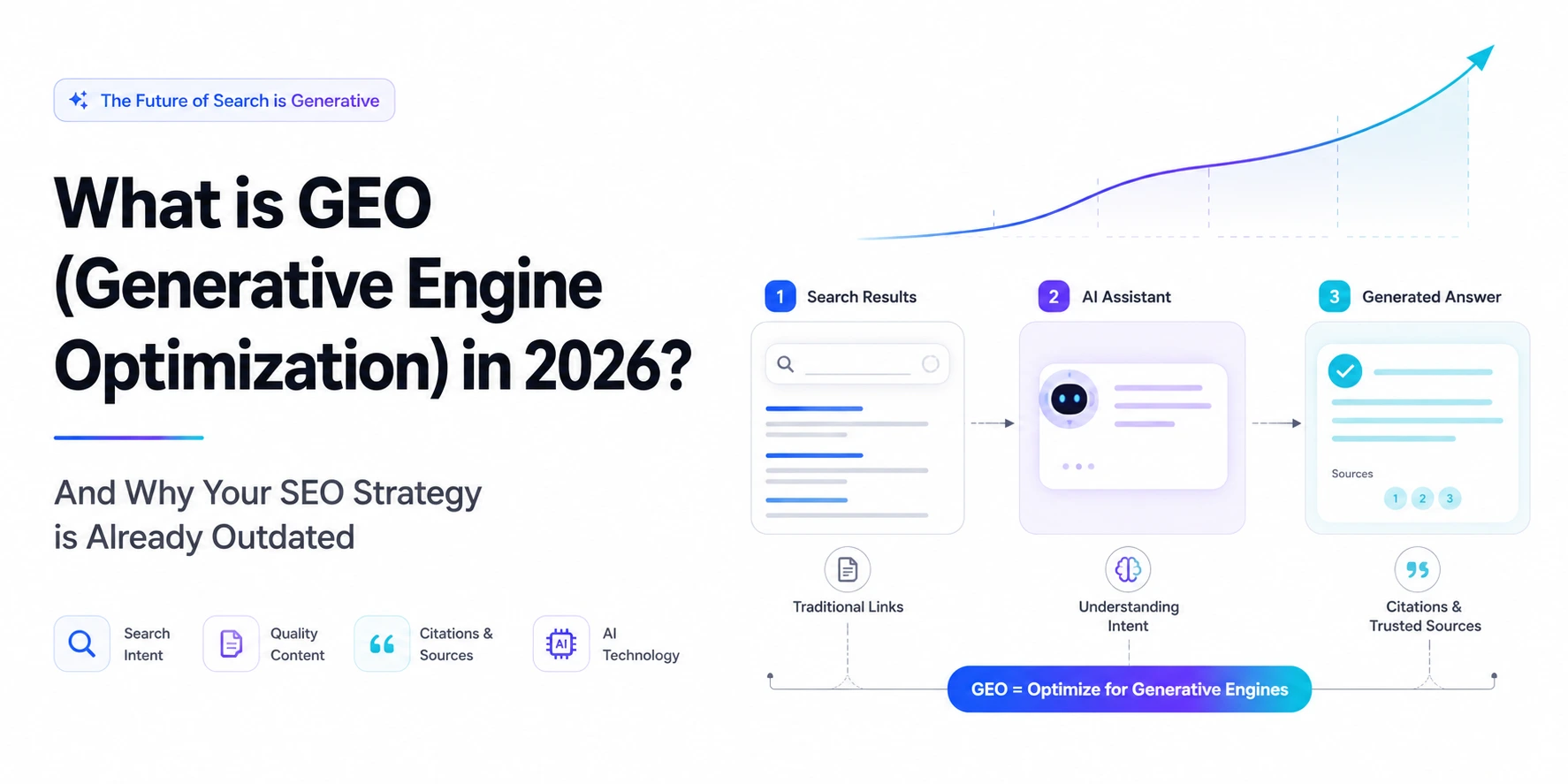
What is GEO (Generative Engine Optimization) in 2026 — And Why Your SEO Strategy is Already Outdated
Are you still following the traditional SEO methods? Doing keyword research and just making backlinks using them, so you are optimizing your page only for search engines, not for AI models.
I realized this in late 2024 when a client of mine — a coaching institute in Laxmi Nagar, Delhi — saw their organic traffic drop 30% without a single Google penalty. Their rankings hadn't changed. Their content hadn't changed. What changed? Their potential students had started asking ChatGPT and Perplexity which institute to join — and my client's name never came up.
That's not an SEO problem. That's a GEO problem. And most Indian marketers still haven't heard of it.
Who is This Article For?
Before we go deep, let me be clear about who this is written for:
- SEO professionals who've noticed declining click-through rates despite stable rankings
- Digital marketing students who want to future-proof their career in 2026
- Small business owners in India who depend on search visibility for leads
- Content creators and bloggers trying to understand why AI tools don't cite their content
If you're a complete beginner to digital marketing, you might want to start with understanding basic SEO first — then come back here. For everyone else, let's get into it.
So, What Exactly is GEO (Generative Engine Optimization)?
GEO or Generative Engine Optimization is where you optimize your content in a way that AI platforms such as ChatGPT, Google’s AI Overview, Perplexity, and Gemini cite you or give references to you or your business in their generated response.
Imagine someone searches for “best digital marketing course in Delhi” on ChatGPT. What ChatGPT does is not give you the top ten blue links to websites. Rather, it comes up with its synthesized answer, which may mention particular sources or merely cite credible organizations or brands. This is how Generative Engine Optimization can help you.
The term itself was coined in 2023 by researchers at Princeton, Georgia Tech, IIT Delhi, and the Allen Institute for AI — and it was published as a peer-reviewed paper at KDD 2024. So this isn't some catchword a marketing agency invented to sell you a new service. It has academic foundations.
By 2026, what started as a research concept has become a boardroom priority for major enterprises — and a massive blind spot for most Indian SMBs and freelancers.
How to Do SEO for Beginners – Complete Step-by-Step Guide
GEO vs SEO — What's Actually Different?
Now, many of you may confuse SEO and GEO. Well, GEO is NOT a replacement for SEO. It's an evolution. Below is the table differentiating it:
Why Does GEO Matter So Much in 2026?
Numbers don't lie, even when they're inconvenient.
Traditional search engine usage is projected to drop by 25% by the end of 2026, as AI chatbots and virtual assistants absorb more of the search demand. ChatGPT alone reached 800 million weekly active users by late 2025 — doubling from 400 million just eight months earlier. Meanwhile, 35% of US consumers now use AI at the product discovery stage, compared to just 13.6% who use traditional search for the same purpose.
And it's not just a Western trend.
India's digital ecosystem is moving fast. Users are increasingly relying on AI assistants and voice search rather than traditional links — especially in sectors like healthcare, education, real estate, and finance. In metros like Delhi, Bangalore, and Mumbai, the shift is already visible. Students are asking AI which courses to take. Patients are asking AI which hospitals to trust. Buyers are asking AI which products to buy.
If your brand isn't being named in those AI answers, you simply don't exist for that user — no matter how well you rank on Google Page 1.
How GEO Actually Works — The Mechanics
Okay, enough context. Let me explain what actually makes AI engines cite one piece of content over another.
1. Structured, Answer-First Content
AI models are trained to extract clear, direct answers. If your blog buries the answer in paragraph seven after 400 words of introduction, an AI will likely skip you. Content that leads with the answer, then explains the reasoning, gets cited far more often.
2. Adding Statistics and Data
This one surprised me when I first studied it. Adding statistics to your content is the single most effective GEO tactic — it improves AI visibility by up to 41%, according to research from Princeton and Georgia Tech. Why? Because AI models prefer citing sources that have verifiable, specific claims over vague, generic statements.
So instead of writing "GEO is growing fast," write "The GEO market is projected to reach $365.4 million in 2026 at a 42.9% CAGR." One of those sentences gets cited. The other doesn't.
3. Schema Markup and Structured Data
Content with proper schema markup — especially FAQ schema, HowTo schema, and Article schema — shows 30–40% higher AI visibility. This is because structured data makes your content machine-readable in the precise way AI systems prefer.
If your website doesn't use schema markup yet, that's the first technical fix you need to make. It's not as complicated as it sounds.
4. Topical Authority Over Keyword Density
Old SEO was about putting your keyword in the title, meta, H1, and then 15 more times in the article. GEO doesn't care about keyword density. It cares about topical depth.
5. Content Distribution Across Multiple Platforms
Here's an insight most people miss: distributing your content across multiple publications increases AI citations by up to 325% compared to publishing only on your own website. Guest posts, syndicated articles, PR mentions, podcast appearances — all of these build the kind of distributed presence that AI models interpret as authority.
This is why brand mentions beat backlinks in the GEO world. You want AI to "see" your name across dozens of credible contexts — not just on your own site.
Common Mistakes to Avoid in GEO
I've seen these mistakes repeatedly among bloggers and marketers who are just discovering GEO:
Mistake 1: Treating GEO as a separate strategy from SEO GEO and SEO are not competitors. The best approach is integrated. Strong technical SEO (fast site, clean structure, schema) creates the foundation. GEO-focused content strategy sits on top of that foundation. Don't abandon what's working in SEO while chasing GEO.
Mistake 2: Assuming more content means more AI citations Quantity doesn't work here. One deeply researched, data-rich, well-structured article will get cited far more often than ten thin pieces on similar topics. Focus on making fewer pieces genuinely excellent.
Mistake 3: Ignoring Hindi and regional language optimization This is a uniquely Indian opportunity. AI systems are increasingly processing vernacular and bilingual content. If your target audience includes users who search in Hindi, Marathi, Tamil, or Bengali — optimizing content in those languages for AI citation is a wide-open space right now. Very few Indian brands are doing this.
Mistake 4: Only focusing on Google AI Overviews But most marketers equate GEO to Google. Yet ChatGPT, Perplexity, Claude, and Gemini all have their own preferences when it comes to content and citations. The full scope of a GEO approach takes into account all major AI search engines, not just Google’s.
Mistake 5: Not tracking AI visibility as a KPI What gets measured, gets managed. There is now a range of solutions such as Brand24 and Semrush AI suite, and others dedicated solely to tracking GEO, that will help you measure your brand mentions in response generated by AI. If you aren’t using them, you’re flying blind.
Get Cited by ChatGPT: Complete GEO Guide for Modern SEO
How to Start with GEO Today — A Practical 30-Day Plan
You don't need to overhaul your entire content strategy overnight. Here's a realistic starting plan:
Week 1 — Audit Your Existing Content Pick your top 5 performing blog posts. Check if they answer questions directly in the first 200 words. If they don't, rewrite those introductions. Add at least one specific statistic with a credible source to each article.
Week 2 — Technical Setup Add FAQ schema to your top 10 articles. If you're on WordPress, the Yoast SEO or RankMath plugins make this straightforward. If you're on a custom site, ask your developer — it's a one-hour job.
Week 3 — Content Structure Overhaul For your next 3 new blog posts, write every H2 subheading as a question. Structure each section as: question → direct answer (2–3 sentences) → explanation → data point. This format is highly AI-friendly.
Week 4 — Distribution Push Identify 3 credible platforms in your niche where you can contribute content — industry blogs, newsletters, LinkedIn articles, or podcast appearances. Even one quality guest post on a credible Indian platform starts building your distributed presence.
This isn't a complete GEO transformation — that takes 3–6 months of consistent work. But this 30-day plan starts moving the needle without requiring you to rebuild everything at once.
Unpopular Opinion: Most Indian Digital Marketing Courses Are Teaching You 2019 SEO
I'll say something that might get me some pushback in the comments: the vast majority of digital marketing courses being sold in India in 2026 are still predominantly teaching traditional SEO — keyword research, meta tags, link building — while barely touching GEO or AI search optimization.
That's not entirely their fault. Curriculum takes time to update. But if you're investing ₹30,000–₹1,00,000 in a digital marketing course, ask the institute directly: "How much of your curriculum covers GEO and AI search optimization?" If the answer is vague or they haven't heard of the term, that's important information.
The Indian GEO market is still in its early-adopter phase. Most SMBs haven't started yet. That gap — between where the market is and where it's going — is exactly the kind of first-mover opportunity that rarely lasts more than 12–18 months before everyone catches up.
Frequently Asked Questions About GEO
1. Is GEO only for large businesses with big budgets?
Not at all. In fact, small businesses and individual bloggers have a real advantage in GEO right now because the competition is still low. The strategy is — structured content, schema markup, targeted distribution — are largely free or low-cost.
2. Will GEO kill traditional SEO completely?
No — and anyone claiming that is overstating the case. Google still processes billions of searches daily, and traditional organic search isn't disappearing overnight. The more accurate framing is that GEO is an additional layer of visibility that increasingly matters, especially for brand discovery and top-of-funnel queries. Think of it as adding a new channel, not replacing an existing one.
3. How long does it take to see results from GEO?
Realistically, 3–6 months of consistent effort before you start seeing measurable AI citation increases. This is similar to traditional SEO timelines. Those who are starting now will be well-positioned high but those who wait another year will find the space considerably more competitive.
4. What tools can I use to check if AI tools are mentioning my brand?
A few options worth exploring: Brand24 (tracks brand mentions across AI platforms), Semrush's AI visibility features, and simply manually testing prompts in ChatGPT, Perplexity, and Gemini related to your category. Ask "what are the best [your service] in [your city]?" and see if you appear. That manual check takes 10 minutes and gives you a baseline.
5. Does GEO work for local businesses in India?
Yes, and this is an underexplored opportunity. AI models are getting better at providing location-specific recommendations.
The Bottom Line
GEO isn't a trend. It's a structural shift in how people find information, make decisions, and discover brands.
So, if you're reading this in 2026 — is that most of your competitors in India haven't started yet. Enterprise marketing teams are getting GEO initiatives in place, but the SMB and freelancer market is still wide open.
Start small. Restructure one article this week. Add schema markup. Publish one piece somewhere other than your own site. Each of these moves your content closer to the kind of AI-friendly, citation-worthy presence that GEO requires.
The marketers who adapt now won't just survive the shift — they'll thrive.