What Is E-E-A-T? How Experience, Expertise, Authority, and Trust Impact SEO
If you have been involved in SEO and content work, then there is a high chance that you may have come across the term known as E-E-A-T.
Then you might have thought about what it was and why it matters for your website.
So, let’s find the answer to your question and understand everything step by step without any complexity.
What Does E-E-A-T Stand For?
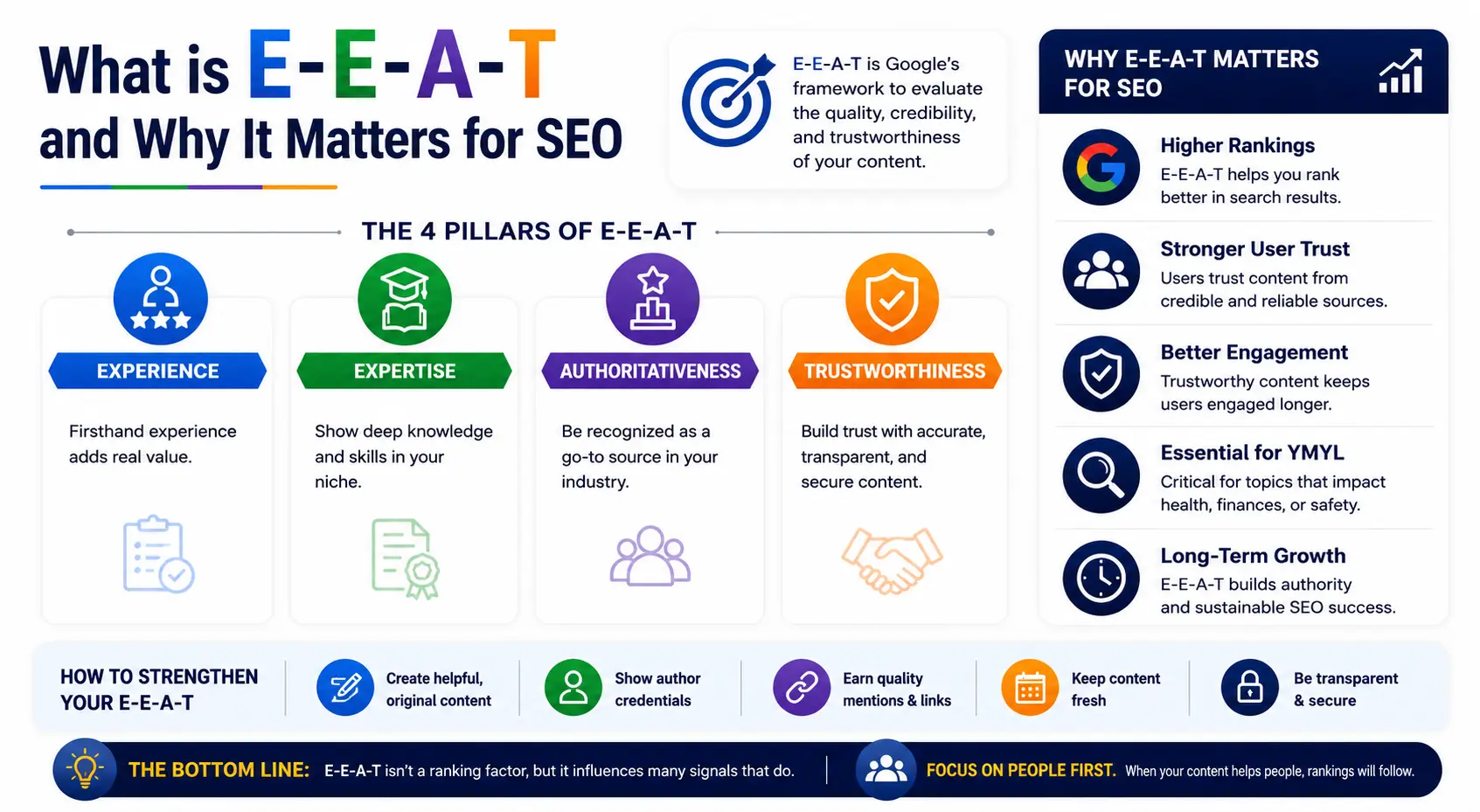
E-E-A-T stands for Experience, Expertise, Authoritativeness, and Trustworthiness.
The concept comes directly from Google’s Search Quality Evaluator Guidelines, a document used by human quality reviewers to determine whether search results provide valuable, trustworthy, and relevant information to users.
- Experience — Has the author actually used this product, visited this place, or lived through this situation? First-hand knowledge matters.
- Expertise — Does the content demonstrate real subject matter knowledge, not just surface-level coverage?
- Authoritativeness — Is the site or author recognized as a credible source in their field?
- Trustworthiness — According to Google, this is the most critical of the four. Your content, your site, and your brand all need to be honest and transparent.
Well, originally the framework was known as a different form of E-E-A-T, that is, E-A-T. This change happened in December 2022, that lead to adding an extra E that stands for experience. This signals that reward content is delivered or written by people who genuinely know about the topic and have real-world experience in the same field.
Why Did Google Introduce E-E-A-T?
The internet has a misinformation problem. Low-quality, AI-spun, and anonymous content flooded search results for years. Google responded by doubling down on content quality signals through its Helpful Content System — a machine-learning layer designed to reward content written for people, not search engines.
E-E-A-T is the philosophy behind that system. It's Google's way of saying: we want to surface content from real experts with real experience, on websites people can actually trust.
Is E-E-A-T a Ranking Factor?
Not directly, but Google has confirmed that E-E-A-T is a standalone algorithm signal. More simply, you can say that if your website’s blogs aren’t getting a specific “E-E-A-T score,” that means you may find it difficult to rank them.
But here's what is true: the signals that demonstrate E-E-A-T — backlinks from credible sites, author credentials, accurate content, site reputation — absolutely influence rankings. Think of E-E-A-T as a framework that shapes how Google's systems evaluate quality, rather than a checkbox you tick.
How Google Evaluates Content Quality
Google's Search Quality Evaluators assess pages against several criteria drawn from the Search Quality Evaluator Guidelines:
- Is the main content high quality and serving a clear purpose?
- Does the site have a strong reputation outside of its own claims?
- Is the author identified, and do they have verifiable credentials?
- Are there clear trust signals — contact pages, privacy policies, editorial standards?
Instead, these quality evaluations help Google refine and improve its ranking systems over time.
Must Read: How to Optimize Content for AI Search
Why E-E-A-T Matters for SEO in 2026
The stakes are higher than ever. Here's why:
Competitive niches are brutal. On health, finance, law and other high importance categories (known as YMYL or Your Money or Your Life) bad E-E-A-T can completely kill a sites ranking.
AI Overviews favor trusted sources. Google uses AI generated summary panels at the top of the search results and sources it considers authoritative from these summaries. If E-E-A-T is poor then it won't be cited.
User trust = engagement signals. Bounces, dwell time and CTR are indirectly a measurement of user trust but with good E-E-A-T you can write content that is actually read and shared.
How to Improve E-E-A-T for SEO
Here's what actually moves the needle:
1. Showcase real experience. Add your own personal experience and observations, rather than simply repeating information from other sites. Try to demonstrate real and unique experience on the topic.
2. Build proper author pages. Make sure every piece of content is linked with an author, along with name, qualifications, relevant experience, and professional profiles. Content published without a clearly identified author can appear less trustworthy and may raise concerns about its reliability.
3. Cite authoritative sources. Link out to government sites, peer-reviewed studies, and recognized institutions. It shows your research is grounded.
4. Earn quality backlinks. Being featured or mentioned by a well-known and trusted website in your industry can significantly boost your credibility and authority. In comparison, having numerous links from low-quality or generic directories often provides far less value and impact.
5. Keep content updated. Outdated information destroys trust fast, particularly in industries where information changes frequently. To maintain trust with your audience, include a “last reviewed” or “last updated” date on your content, and make it a habit to review and update it regularly.
6. Display trust signals site-wide. Clear About Us page, contact information, privacy policy, and editorial guidelines all matter. Small details signal seriousness.
E-E-A-T and Topical Authority
It's important not to see E-E-A-T alone. It relates strongly to topic authority (covering a topic thoroughly means you know it more than someone writing a one-off article on it).
If you run a nutrition blog, Google doesn't just evaluate any single article. It looks at whether your site has broad, deep coverage across nutrition topics, whether your internal linking is logical, and whether your content depth matches that of recognized experts in the field.
Building topic clusters — a central "pillar" page supported by related subtopic articles — is one of the most effective long-term SEO strategies precisely because it builds topical authority systematically.
E-E-A-T and AI-Generated Content
Google doesn’t automatically penalize content simply because it was created with AI. The company has made it clear that the method used to produce content is less important than the value it provides. What matters most is whether the content is accurate, useful, trustworthy, and genuinely helpful to users.
That said, the risks are real:
- AI models hallucinate facts. Publishing unverified AI content erodes trust fast.
- Mass-produced AI content often lacks the first-hand experience Google is increasingly rewarding.
- If your "expert" content is clearly generic and impersonal, it undermines your E-E-A-T signals regardless of how it was written.
Best practice: Use AI to draft and structure, but always have a subject matter expert review, add personal insight, and fact-check before publishing.
E-E-A-T for YMYL Websites
YMYL — "Your Money or Your Life" — refers to topics where bad information can cause real harm: medical advice, financial guidance, legal information, news, and safety topics.
Google places the greatest emphasis on E-E-A-T when evaluating YMYL (Your Money or Your Life) content. A health site written by anonymous authors with no credentials will struggle significantly, even if the information is factually correct.
For websites in YMYL categories, clearly showcasing author expertise and credentials isn’t just recommended—it’s a critical requirement for establishing credibility.
Common E-E-A-T Mistakes That Hurt SEO
- Publishing articles without author attribution
- Thin content that covers topics at surface level
- No "About" page or unclear site purpose
- Outdated stats and facts without revision dates
- Over-reliance on AI with no human review
- Weak backlink profiles from irrelevant or low-quality sites
- No contact information or trust signals
Frequently Asked Questions
Is E-E-A-T a direct ranking factor?
No, it's not a direct ranking factor, but it does affect your ranking if it gets ignored. Author credentials, backlinks, and content accuracy do affect how Google’s algorithm sees your content and gives it a ranking accordingly.
Does E-E-A-T matter for small businesses?
Of course, it does matter for small businesses too. You must have a credible about page, authentic customer reviews, and genuine writings. That all simultaneously builds trust.
Does AI-generated content affect E-E-A-T?
Only if it's low quality or unverified. Google evaluates the output, not the tool used to produce it. Human review is still critical.
What is topical authority in SEO?
It refers to how comprehensively your website covers a particular topic across all of its content. Websites that consistently publish in-depth, interconnected content within a specific niche tend to demonstrate stronger expertise and authority than sites that only publish occasional, unrelated articles.
Conclusion
E-E-A-T is not a shortcut or a hack. It's a framework that rewards the elements that the best content has always been comprised of: experience, expertise, authority, and trust.
In 2026, with AI content flooding every corner of the web, the sites that invest in real human expertise, transparent authorship, and consistently accurate information will be the ones that win long-term visibility — in both traditional search and AI Overviews.
Build trust first. Rankings follow.