How to Optimize Content for AI Search: The New SEO Framework for ChatGPT, Perplexity, and Google AI
Here's something most SEO teams haven't fully processed yet: a growing number of people are skipping Google entirely. Your audience is getting answers directly from AI (ChatGPT, Perplexity, or Google's AI Overviews), bypassing traditional search results and website visits entirely.
The interesting fact is that this isn’t a future just instead its happening right now!
So the question among marketers isn't just "how do I rank on page one?" anymore. It's: how do I get cited by AI? So, let’s figure this out that how to optimize content for AI search — what works, what doesn't, and what most guides skip over entirely.
What Is AI Search Optimization?
AI search optimization (also known as AEO - Answer Engine Optimization) is the practice of optimizing and structuring your content so that each AI model can easily find it worth giving a citation.
Whereas traditional SEO targets crawlers that rank pages. AI search targets language models that summarize and synthesize answers. The signals are different.
Must note this: Google ranks pages. AI engines pick sources they trust and understand.
Why It Matters for B2B Marketers and SaaS Teams
The B2B buying process is changing. Instead of browsing dozens of websites, buyers are asking AI tools to recommend vendors, compare solutions, summarize key differences, and answer research questions. This means your prospects may decide whether you're worth considering long before they visit your website—making visibility within AI-generated answers more important than ever.
That means if ChatGPT doesn't know your product exists, or can't find a credible source to cite, you're invisible at the most critical stage of the funnel.
Here's what's at stake:
- Brand visibility drops if AI engines don't surface your content
- Organic traffic shifts away from click-through searches toward zero-click AI answers
- Trust signals matter more — AI engines prefer sources with demonstrated expertise and consistency
Did you know? Perplexity AI reportedly handles over 100 million queries per month as of early 2025 — and that number is climbing fast.
How AI Search Engines Rank and Choose Content
This is where most guides go shallow. So let's get specific.
How ChatGPT Chooses Sources
ChatGPT (especially with Browse enabled) pulls from pages that are:
- Indexed and crawlable — basic, but often missed
- Clearly structured — headers, short paragraphs, direct answers
- Cited by others — backlinks and brand mentions still matter
- Written with specificity — vague content gets skipped; named tools, data, and examples get cited
Here's what I've seen work: pages that open with a direct answer to a specific question — before any context or backstory — tend to get pulled into ChatGPT responses far more often.
How Perplexity Finds Citations
Perplexity runs live web searches, so it's closer to a real-time crawler. It tends to favor:
- Recent content (freshness matters more here than on Google)
- Structured answers with clear Q&A formatting
- Authoritative domains — high-DR sites get cited more frequently
- Original data or unique insights — if you're the source, you get cited
Note: If your content answers a question in the first 100 words, Perplexity is much more likely to use it as a source.
Must read: how Perplexity indexes and cites sources
How Google's AI Overviews Work
Google AI Overviews pull from pages already ranking in the top 10 — but not always. They favor content that:
- Uses structured data (schema markup)
- Has strong E-E-A-T signals (Experience, Expertise, Authoritativeness, Trust)
- Contains clear, direct answers near the top of the page
- Matches the semantic intent of the query, not just keywords
Step-by-Step: How to Optimize Your Content for AI Search
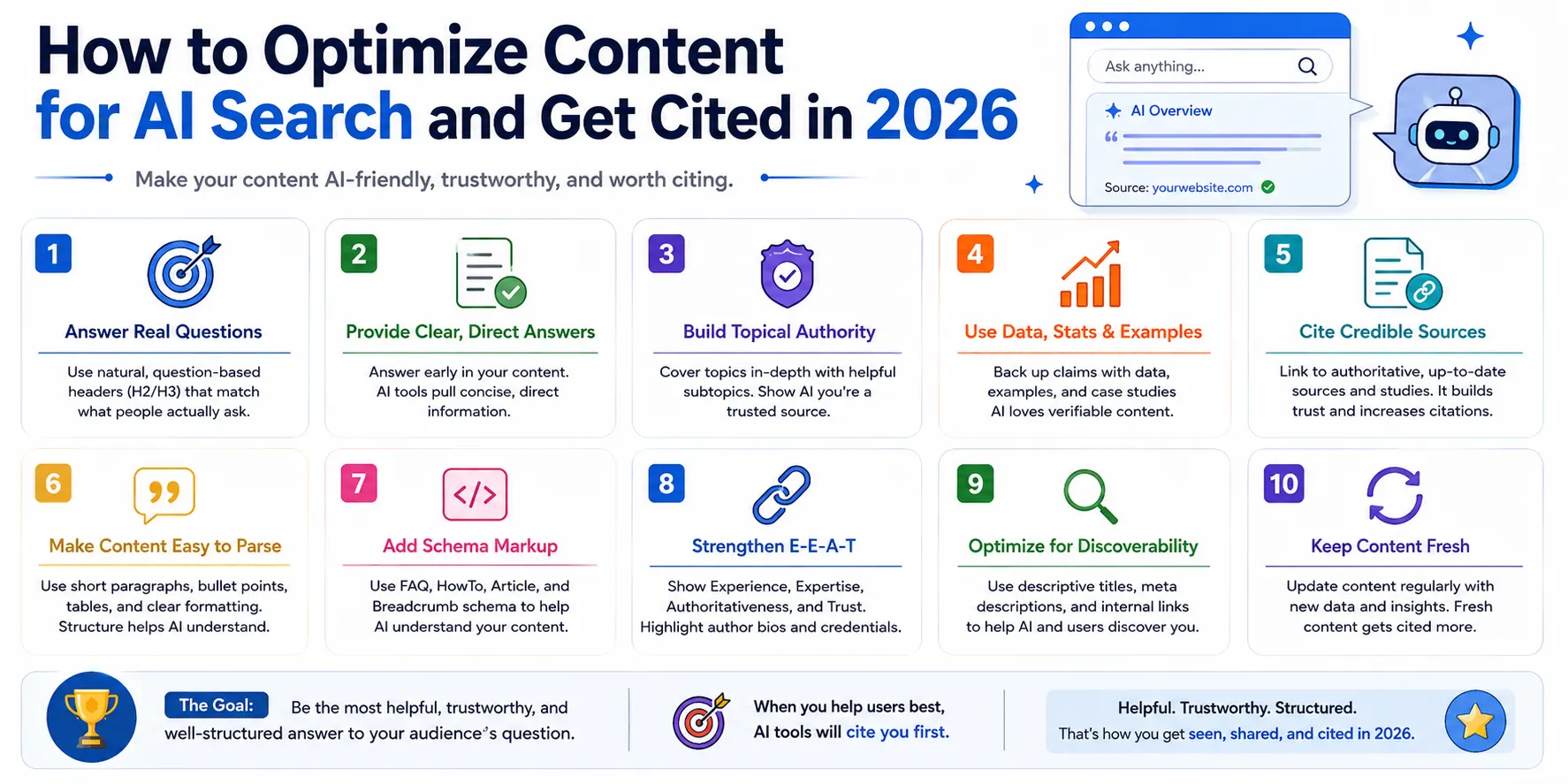
1. Lead With the Answer
Lead With the Answer - give it to them immediately.
AI systems are designed to identify the most direct answer to a user's question. State it clearly in the first paragraph, then use the rest of the page to provide context, details, and supporting information.
Example: If your article is about pricing models, open with: "There are three main SaaS pricing models: flat-rate, usage-based, and tiered. Here's how they differ..." Not with a history of SaaS.
2. Use Clear, Descriptive Headers
Headers are how AI engines understand your content's structure. Every H2 and H3 should read like a question someone might actually ask.

3. Write in Short, Scannable Chunks
Keep paragraphs to 2–3 lines. Use bullet points for lists. Bold the terms that matter most. AI models parse content in chunks — dense walls of text get ignored.
4. Add FAQ Sections
FAQ is a must if you want your website to get cited in the AI search models. FAQs are pre-formatted and help models extract easily and quote it directly. Include 5–6 questions that match real search queries.
5. Build Topical Authority
Publish multiple pieces of content around a core topic. AI engines don't just evaluate individual pages — they assess whether your site consistently covers a subject well.
Example: A SaaS company writing only one blog post about pricing won't be cited as an authority on pricing. A company with 10 deep posts across pricing, benchmarks, and comparisons will.
6. Earn Mentions Across the Web
AI engines track brand mentions across Reddit, Quora, G2, Capterra, LinkedIn, and niche publications. If people are talking about your brand in credible places, that feeds into citation likelihood.
7. Use Structured Data (Schema Markup)
Add schema markup for FAQs, How-To content, and articles. This doesn't guarantee AI inclusion, but it makes your content significantly easier for AI to parse.
Want to Rank in AI Search?: These Are the 10 Best Tracking Tools for 2026
Common Mistakes to Avoid
- Writing for keywords instead of questions — AI searches are conversational. Match that.
- Ignoring content freshness — Stale content gets deprioritized, especially by Perplexity.
- Skipping internal linking — AI engines understand content relationships. A strong internal link structure signals depth.
- Publishing thin content — A 300-word page won't get cited. Depth and specificity win.
- No named author or credentials — Anonymous content ranks lower for trust signals.
Google's Search Quality Evaluator Guidelines
What's Coming Next in AI Search
Here's where things are heading:
- Personalized AI answers — Models will increasingly tailor citations to a user's history and preferences
- Voice + AI search convergence — Optimizing for natural language becomes non-negotiable
- Real-time indexing — Freshness will matter even more as AI engines update faster
- AI agents doing research — Autonomous agents will browse and synthesize content on behalf of users, raising the stakes for structured, reliable sources
The brands that build authority now — with structured, specific, trustworthy content — will be the default citations when AI search matures.
Key Takeaways
- AI search engines like ChatGPT, Perplexity, and Google AI Overviews choose sources based on clarity, structure, trust, and specificity — not just keywords.
- Lead with the answer. Every page should answer its target question in the first paragraph.
- Use descriptive headers, short paragraphs, FAQ sections, and schema markup to make content easy for AI to parse.
- Build topical authority by covering a subject consistently across multiple pieces.
- Earn brand mentions across the web — Reddit, G2, LinkedIn, and niche publications all feed into AI citation signals.
- Freshness matters, especially for Perplexity. Keep key pages updated regularly.
FAQ: AI Search Optimization
Q: How do I get my website cited by ChatGPT?
A: Firstly, make sure that your content is well written for crawling. So, for that, use descriptive headers, include original and reliable data and insights, and get backlinks from credible sources. Models such as ChatGPT and Perplexity cite pages that are easy to read and contain strong authority in the eyes of Google.
Q: How do I appear in ChatGPT answers?
A: To appear in ChatGPT isn’t that hard. You just need to follow some of its algorithms. Like write direct answers in your content, use FAQ, clear and structured headings, and short paragraphs. ChatGPT's Browse feature favors trusted, well-linked sources.
Q: How do I get mentioned in Perplexity AI?
A: Perplexity runs live searches, so freshness and structure matter most. Publish recent, specific content with clear Q&A formatting. Domains with high authority get cited more frequently, so focus on earning quality backlinks and keeping your content updated.
Q: How do I rank in Google's AI Overviews?
A: If you want your content to appear in Google AI Overviews, start by building strong organic rankings. Pages that already perform well in traditional search are more likely to be considered trustworthy sources. From there, add FAQ schema markup, strengthen your E-E-A-T signals, and ensure your content answers queries directly.
Q: How do AI search engines choose sources?
A: They basically evaluate with a set of combinations. Like, content structure, domain authority across the web, backlinks from trusted websites, content’s overall quality.