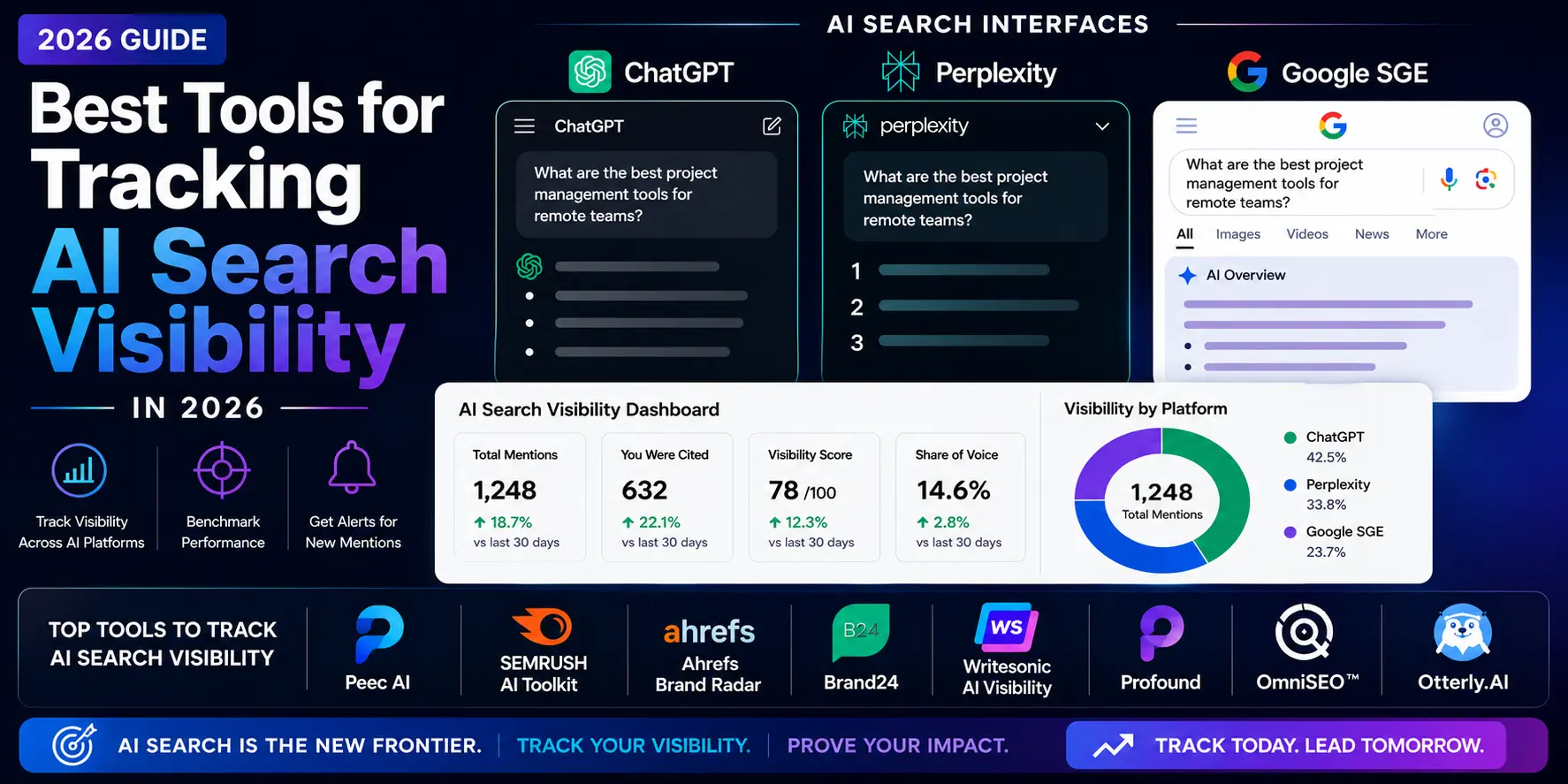
Want to Rank in AI Search? These Are the 10 Best Tracking Tools for 2026
Over 40% of Google searches now go unanswered — because users already got what they needed from an AI. ChatGPT, Perplexity, and Google's AI Overviews are eating traditional click traffic for breakfast. And if you're not tracking where your brand shows up in those AI-generated answers, you're flying blind.
Here's the uncomfortable truth: most SEO teams are still optimizing for blue links while AI search quietly reshapes who gets seen and who gets skipped. The winners in 2026 aren't just ranking on Google — they're being cited by AI engines.
This post breaks down the best tools for tracking AI search visibility in 2026. Whether you're a solo marketer, a growing agency, or a SaaS brand watching your traffic tank, you'll find exactly what you need here — including free AI visibility tracking tools most people don't know exist.
What Is AI Search Visibility?
AI search visibility means how often — and how prominently — your brand, product, or content appears in AI-generated answers.
Think of it as the new "Page 1." When someone asks Perplexity "best CRM for startups," AI engines scan the web, pick sources they trust, and build an answer. Your brand either makes that answer or it doesn't. Traditional rank trackers can't tell you which.
Generative engine optimization (GEO) is the practice of making your content AI-citation-worthy. And to do GEO well, you need GEO tracking tools that show you where you stand.
Why AI Search Tracking Matters in 2026
This isn't a "future trend" anymore. It's happening now.
Google's AI Overviews appear for over 25% of all queries. ChatGPT processes over 100 million searches per day. Perplexity crossed 10 million daily active users. These aren't niche tools — they're the new front door to the internet.
For digital marketers and SEO professionals, ignoring AI search means:
- Lost brand mentions that never show up in standard rank reports
- No visibility into which competitors AI engines prefer to cite
- Zero data on whether your content strategy is actually working for AI platforms
For SaaS businesses and agencies, the stakes are even higher. Buyers increasingly ask AI tools for product recommendations before ever visiting a vendor site. If you're not in the answer, you're not in the consideration set.
The 10 Best Tools to Track AI Search Visibility in 2026
1. Semrush AI Toolkit
Semrush extended its classic rank-tracking suite to include AI visibility scoring across Google AI Overviews, Bing Copilot, and more. It pulls in data on brand mentions, competitor citations, and content gaps — all in one place.
Best for: Agencies and enterprise teams already on Semrush. Standout feature: AI Overview position tracking tied to your existing keyword clusters.
Quick tip: Use Semrush's Topic Research tool alongside the AI Toolkit to find questions that AI engines are actively pulling answers from.
2. Brandwatch Consumer Intelligence
Brandwatch goes beyond SEO. It tracks where your brand gets mentioned across AI-generated content, social media, forums, and news — giving you a 360° view of AI-driven brand presence.
Best for: Brand managers and enterprise marketing teams. Standout feature: Sentiment analysis on AI-cited brand mentions.
3. Peec.ai
Peec.ai is one of the most purpose-built GEO tracking tools on the market right now. It lets you track your brand's appearance across ChatGPT, Perplexity, Google Gemini, and Claude — with share-of-voice reporting per AI platform.
Best for: SaaS companies and D2C brands tracking product visibility in AI answers. Standout feature: Side-by-side comparison of which competitors AI tools cite more than you.
Did you know? Peec.ai was one of the first tools to introduce "AI answer audits" — showing you exactly which sources an AI pulls from for a given query.
4. Profound
Profound (formerly known in beta as "AI Rank Tracker") focuses specifically on tracking brand mentions in AI search responses. It runs scheduled queries across major AI platforms and logs which sources get cited — including yours.
Best for: Content marketers wanting to validate their GEO content strategy.
Standout feature: Historical tracking so you can see how your AI visibility trends over time.
5. Otterly.AI
Otterly.AI is clean, focused, and surprisingly affordable. It tracks your brand and competitors inside AI-generated results, with a dashboard designed for non-technical users. It's become a go-to for smaller agencies and consultants.
Best for: Freelancers, consultants, and small-to-mid agencies.
Standout feature: Automated weekly AI visibility reports sent to your inbox.
6. AthenaHQ
AthenaHQ takes a data-heavy approach to AI SEO monitoring tools. It pulls structured data on AI citation frequency, topic authority scores, and content-to-citation ratios. It's built for teams that want to dig deep.
Best for: In-house SEO teams and data-driven content operations.
Standout feature: Topic clustering that shows which content themes AI engines associate most with your domain.
7. Scrunch AI
Scrunch AI monitors AI-generated content at scale. It tracks how AI tools describe your brand — not just whether you're cited. That distinction matters when you want to control your brand narrative.
Best for: PR teams and brand strategists alongside SEO leads.
Standout feature: Narrative drift detection — alerts you when AI engines start describing your brand differently.
8. Mention + AI Layer (Third-Party Integration)
Mention has long been a solid AI search ranking tool for brand monitoring. In 2025, several agencies started pairing it with custom API integrations to track AI search mentions. It's not native GEO tracking, but with the right setup, it gets close.
Best for: Teams already using Mention who want to extend it without switching tools. Standout feature: Real-time alerts whenever your brand appears in AI-generated summaries indexed across the web.
9. BrightEdge Generative Parser
BrightEdge's Generative Parser is built for enterprise. It analyzes how AI engines interpret and restructure your content — giving you actionable insights into why your pages do or don't make it into AI answers.
Best for: Enterprise SEO teams with large content operations.
Standout feature: Content intent mapping against AI query patterns at scale.
10. Ahrefs AI Overviews Tracker (Free tier available)
Ahrefs quietly rolled out an AI Overviews tracking feature inside its standard rank tracker. It's one of the best free AI visibility tracking tools available — especially if you're already paying for Ahrefs Lite or higher.
Best for: SEO professionals who want AI Overview data without a separate subscription. Standout feature: Keyword-level data on when Google's AI Overviews appear and whether your content is the source.
How to Choose the Right AI Visibility Tool
Not every tool fits every team. Here's a quick decision framework:
- Solo consultant or freelancer? → Start with Otterly.AI or Ahrefs AI Overviews Tracker (free tier).
- Agency managing multiple clients? → Peec.ai or Semrush AI Toolkit gives you multi-brand tracking.
- Enterprise or large in-house team? → BrightEdge or AthenaHQ for depth and scale.
- Brand-heavy or PR-led team? → Scrunch AI or Brandwatch.
- Content-first operation? → Profound or Peec.ai to validate GEO content performance.
What Is Generative Engine Optimization (GEO)? A Beginner's Guide
Common Mistakes When Tracking AI Search Visibility
Honestly, most teams make the same avoidable errors:
1. Only tracking Google. ChatGPT, Perplexity, and Gemini each have different citation behavior. A tool that only monitors Google AI Overviews misses a huge slice of AI search activity.
2. Treating AI visibility like rank tracking. Position 1 on Google doesn't mean you'll be cited by AI. AI engines prioritize authority, clarity, and source credibility — not keyword stuffing.
3. Not tracking competitors. Knowing you're cited 12 times means nothing if your main competitor is cited 80 times. Share-of-voice is the metric that matters.
4. Skipping content audits. Tools give you data. But without auditing why AI engines prefer certain content, you'll keep optimizing the wrong things.
Q&A: Your Top Questions Answered
Q: Which tools track AI search rankings across multiple platforms?
A: Peec.ai and Profound are the strongest options for multi-platform AI search tracking. Both monitor ChatGPT, Google Gemini, Perplexity, and Claude. Semrush AI Toolkit is strong for Google-specific AI Overview tracking.
Q: What is the best GEO tracking tool in 2026?
A: Peec.ai leads for share-of-voice tracking across AI engines. Profound wins for historical trend data. For enterprises, BrightEdge's Generative Parser goes deepest on content-level diagnostics.
Q: How do you check AI search performance without paid tools?
A: Ahrefs AI Overviews Tracker has a free tier that covers Google AI Overview data. You can also manually run targeted queries in ChatGPT and Perplexity and track citations in a spreadsheet — time-consuming but free.
Q: Are there free AI visibility tracking tools worth using?
A: Yes. Ahrefs' free tier for AI Overviews is the strongest no-cost option. Some teams also use Google Search Console's "AI Overview" filter (where available) as a starting point before investing in dedicated GEO tools.
Q: What's the difference between GEO tracking and traditional SEO tracking?
A: Traditional SEO tracking measures keyword rankings on search engine results pages. GEO tracking measures whether your brand is cited inside AI-generated answers. They measure different things — and in 2026, you need both.
Search Engine Land — AI Overviews and the future of organic search
What's Coming Next in AI Search Visibility
The tools above are solid for 2026. But the space is evolving fast.
Expect real-time AI citation tracking to become standard by late 2026. Right now, most tools run queries on a scheduled basis (daily or weekly). Real-time will change how brands respond to shifts in AI narratives.
Also watch for multi-modal AI search tracking — tools that monitor visibility across voice, image, and video AI search, not just text. Google Lens, ChatGPT's vision mode, and similar tools are creating a new layer of search that barely anyone is tracking yet.
And attribution will get smarter. Right now, connecting "AI citation → traffic → conversion" is murky. The next wave of tools will close that loop.
Conclusion
If you're still measuring success purely by Google rankings, you're measuring the wrong thing. AI search is where attention is shifting — and you need the right tools to track where your brand stands.
The best tools for tracking AI search visibility in 2026 range from lean solo-user tools like Otterly.AI to enterprise-grade platforms like BrightEdge. The right one depends on your team size, budget, and how deep you want to go.
Start tracking now, not after your traffic starts declining.