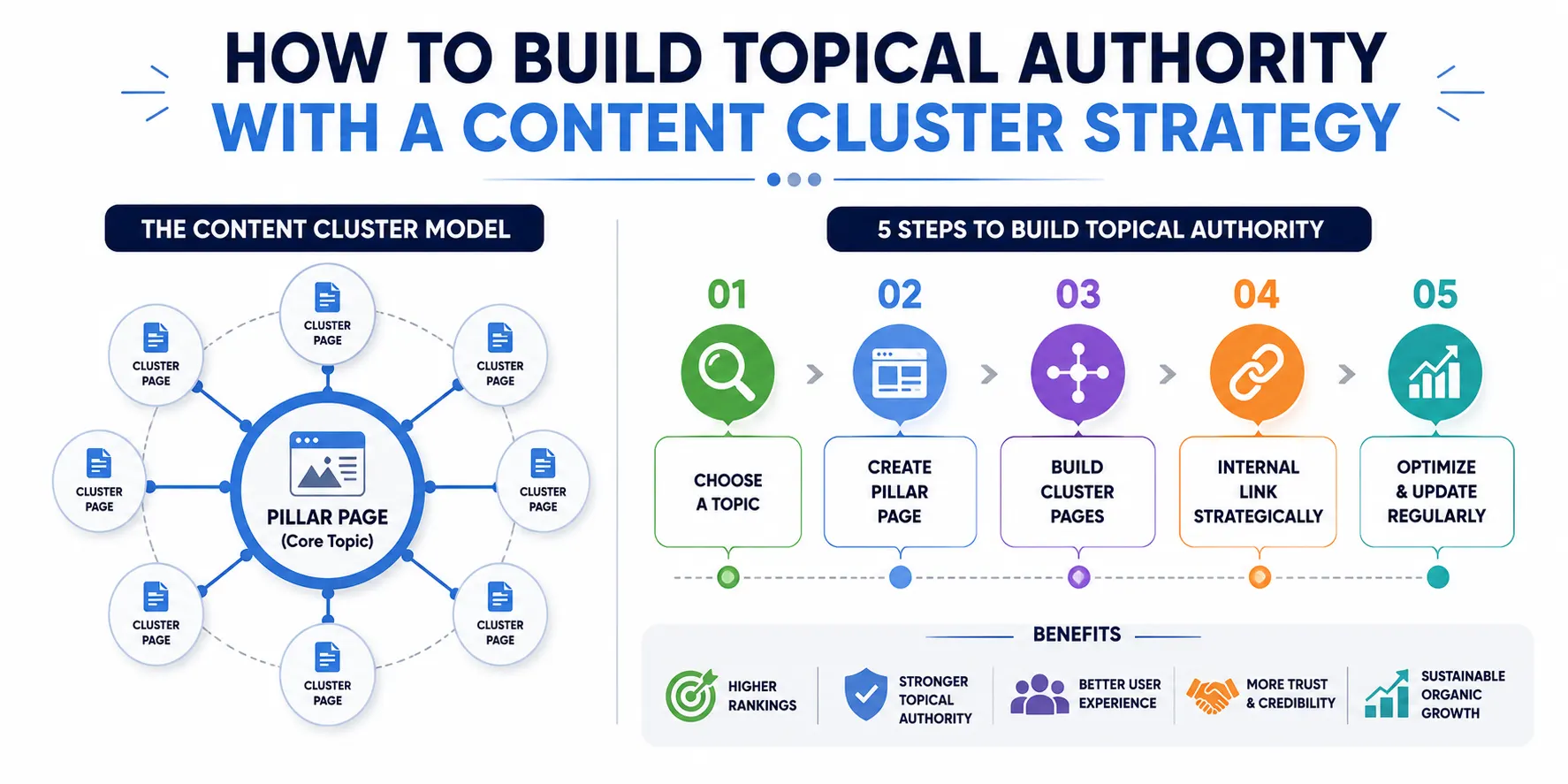
How to Build Topical Authority With a Content Cluster Strategy
You publish content, write with well-researched information, and invest time in creating details. But weeks turn into months, and the page barely gains any visibility. It remains stuck on page three of the search results, with little to no progress.
You might be thinking where you lack? So, the problem usually isn't your writing — it's your strategy. Google no longer rewards isolated articles that chase single keywords. It rewards expertise across a topic. That’s what topical authority is all about. And one of the most effective ways to build it is through content clusters that show search engines you have deep expertise on a subject.
Let’s get into it and find what Topical Authority is in actuality and how you can build a great content cluster strategy for your website.
What Is Topical Authority in SEO?
Topical authority is Google's measure of how deeply and comprehensively a website covers a subject.
Suppose you've published 40 well-structured articles about personal finance — budgeting, investing, debt management, retirement — Google begins to see your site the way a librarian sees a specialist bookstore. You're not just mentioning a topic; you own it.
This matters because Google’s algorithm has, like, evolved a lot over time. It doesn’t simply match just keywords anymore. Instead, it looks at how entity relationships, semantic relevance of things, and also whether your content as a whole really covers that set of questions real users tend to ask.
Topical Authority VS. Domain Authority
Domain authority is a sort of third-party metric, from Moz, that sort of estimates your backlink profile. Topical authority is more about relevance, and depth too. A freshly started site can still build real topical authority in one niche, even if it does not have thousands of backlinks . Domain authority by itself can’t really give you that. Sure, both matter, but when you are new the topical authority piece tends to be the more reachable lever.
What Is a Content Cluster Strategy?
A content cluster is a group of interlinked articles that collectively covers one subject from every angle.
It has two components:
Pillar Page — A pillar page is an in-depth resource built around a broad topic, such as SEO. It gives readers a complete overview of the subject while linking to more focused articles that explore specific areas in greater detail.
Cluster Content — Focused articles that go deep on subtopics (e.g., "What Is Technical SEO?", "How to Do Keyword Research", "Link Building for Beginners"). Each links back to the pillar.
When we talk about internal links, so those aren’t only for navigation. They actually help Google determine that these pages are relevant and help strengthen the overall topic focus of the cluster, making it easier for search engines to recognize the relationship between the content and your expertise in that area.
Why Content Clusters Build Topical Authority
Here are three practical reasons why this approach is so effective:
1. Complete topic coverage signals expertise. Google wants to know you've thought through all of a subject, not just the parts with high search volume. Clusters force you to cover the edges, which is exactly what earns trust.
2. Internal linking distributes authority. When your pillar page picks up a backlink, that authority kinda slides through your internal links toward your cluster pages. Is it like a rising tide… lifts all boats, you know?
3. Semantic SEO alignment. Modern search engines read language more contextually. So when your articles keep leaning on related terms, phrase snippets, and connected entities around one central topic, Google’s Knowledge Graph starts tying things together—more firmly—linking your content to the same subject zone.
How Google Actually Determines Topical Authority
Google doesn’t use a specific “topical authority score,” but it does look at a variety of signals to understand how knowledgeable and trustworthy your website is on a particular subject.
- Content depth and breadth — Do you cover your content topics properly or just write it anyway?
- Internal linking — Doing internal linking logically or not? Cause this may affect the page content quality.
- E-E-A-T — Experience, Expertise, Authoritativeness, and Trustworthiness. Author credentials, first-hand experience, and accurate information all contribute.
- User engagement — This is very important because the more user engagement, the more your content is really worth reading, and the more people are staying on your page.
- Entity relationships — Google Maps topics to entities. Being consistently associated with the right entities (through content, structured data, mentions) strengthens your positioning.
Know: What Is E-E-A-T And why it matters for SEO
A Step-by-Step Guide to Building Topical Authority Through Content Clusters
Step 1 — Choose a Core Topic
Choose a topic that can easily support at least 10 articles. However, with this, also make sure that it is specific enough to avoid making it too broad. Like "Marketing" is too broad. Whereas when we write “Digital Marketing Courses for 12th Pass Students” is better.
Specificity makes topical authority achievable.
Step 2 — Build a Topical Map
A topical map is basically a planning document; it lists every question, little subtopic, and angle your audience might end up typing into a search bar when they’re thinking about your core theme. It’s not just a list of keywords either.
Use tools like Google's "People Also Ask," keyword research tools, and forums like Reddit or Quora to find real questions. That way, you can find real questions, not just imagined ones.
Group these by theme — those groups become your clusters.
Step 3 — Create a Comprehensive Pillar Page
Your pillar page should:
- Cover the topic broadly (think 2,000–4,000 words)
- Answer the most important beginner-to-intermediate questions
- Link out to each cluster article
- Target your primary keyword and its closest variants
Step 4 — Publish Cluster Content Systematically
Each cluster article should:
- Tackle one specific subtopic in depth
- Link back to the pillar page naturally
- Link to 1–2 other relevant cluster articles
- Target long-tail or question-based keywords
Don't publish everything at once. A steady cadence (2–4 articles per month) signals consistent activity to Google and keeps content quality high.
Remember: Don’t just put everything out in one go; keep a steady cadence, like 2–4 articles per month. This is often read as consistent activity by Google, and it also helps content stay reasonably high quality, you know, without rushing everything.
Step 5 — Implement Strategic Internal Linking
This is where most sites leave value on the table. Use descriptive anchor text (not "click here"). Link from older, higher-authority pages to new ones. Audit your internal links every few months — as clusters grow, new linking opportunities emerge.
Step 6 — Update and Expand Regularly
Topical authority is not something you build once and then relax. Keep adding new subtopics as they pop up, sort of as the whole area unfolds. Also, refresh older pieces with newer data, better instances, and clearer examples. Google tends to reward freshness, so your content cluster should expand along with your own expertise, not before it.
A Real Content Cluster Example
Pillar Page: The Complete SEO Guide
Cluster Articles:
- What Is Technical SEO? (and Why It Matters)
- On-Page SEO: The Complete Checklist
- How to Do Keyword Research (Step-by-Step)
- Link Building Strategies That Still Work
- E-E-A-T: How Google Evaluates Your Expertise
- Content Optimization: Beyond Keywords
Here, every cluster article is linked back to the pillar and vice versa. The end result is a well-connected content hub that helps search engines easily crawl and understand your content, while strengthening your site's reputation as a trusted source of "SEO expertise."
Don’t Make These Mistakes That Kill Topical Authority
- Publishing random topics: Many people waste their time and energy writing and publishing articles on random topics and end up with nothing in their hands. So, stick to your main pillar and make sure that every article relates to it.
- Weak internal linking: Reinforcing is important, and those articles that don’t do so miss the opportunity to strengthen one another.
- Thin content: A 500-word article covering a complex topic signals the opposite of expertise. At least write 1500 words on a complex topic to show the detailing and depth you have given to the content, or else skip it.
- Ignoring search intent: If you’re aiming at a keyword like “best email subject lines” but the page kinda tells a brand story, instead of actually helping with subject lines, it’s pretty unlikely to land the way readers expect. So, always match format and depth to what the searcher actually wants.
- Treating keywords as the finish line. Keywords are entry points, not the goal. The goal is to fully satisfy the reader's need — that's what keeps people on your site and signals quality to Google.
Does AI-Generated Content Build Topical Authority?
Short answer: it depends entirely on how you use it.
Google’s point of view is pretty straightforward… it doesn’t punish AI content just for being AI content, but it absolutely goes after low-quality. A cluster built on generic AI output that rehashes surface-level information is not going to earn topical authority because it doesn’t really show real expertise.
The smarter approach: use AI to do the research, edit outlines, and handle drafts — then do human edits by yourself and analyse content. Bring first-hand experience and original insight. This combination satisfies E-E-A-T while keeping production sustainable.
How Long Does It Take to Build Topical Authority?
Frequently Asked Questions
What is topical authority in SEO?
Topical authority refers to how much expertise and credibility a website demonstrates on a particular subject. It develops over time as you regularly create valuable, in-depth content that thoroughly addresses different aspects of a topic.
How many articles are needed for topical authority?
No specified number guarantees this. You don't need dozens of articles to get started. In many cases, a content cluster made up of 8–12 well-written, highly relevant articles is enough to begin building topical authority.
Is topical authority a ranking factor?
While Google not officially label it as the ranking factor, but its search systems do favor websites that cover topics thoroughly and give well-rounded coverage of the subject.
How does internal linking affect topical authority?
Internal links signal to Google which pages are related and how they connect. They also distribute PageRank within your cluster, helping all pages rank better.
What's the difference between a topic cluster and a content hub?
They’re sort of used interchangeably. A content hub usually means the visual layout, or the way people browse, and a topic cluster is more about the SEO plan and how the internal links get threaded together. In practice they’re describing the same underlying approach, just from different angles, and sometimes people talk about it like it’s the exact same thing.