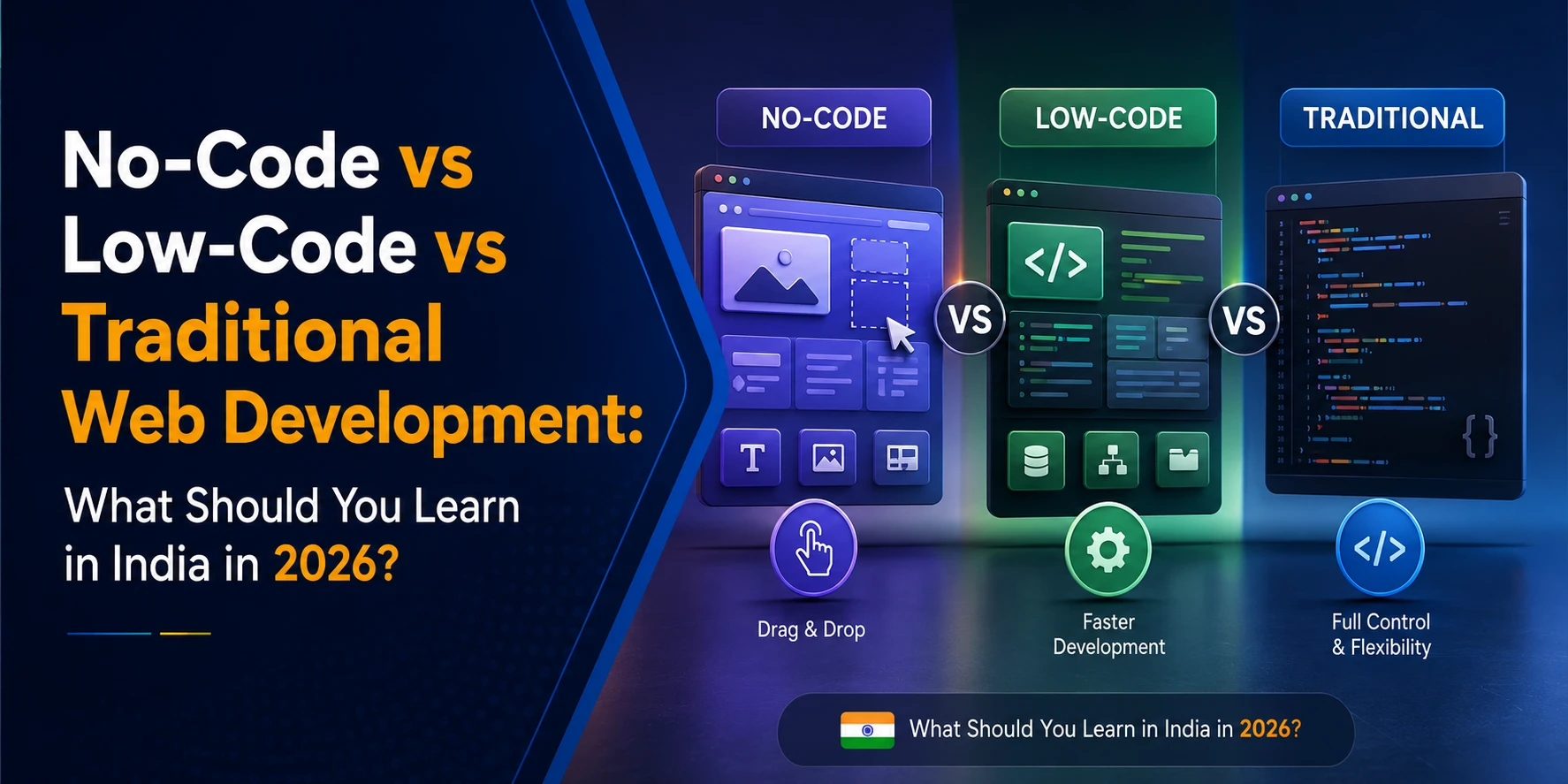
No-Code vs Low-Code vs Traditional Web Development: What Should You Learn in India in 2026?
According to Gartner, 70% of new enterprise applications will use no-code or low-code tools by 2026 — up from less than 25% in 2020. It’s a pretty big jump, and if you are a student or already a working professional, thinking about a web development career in India right now, it brings up this kind of uncomfortable question: does learning the traditional web stuff still make sense… or should you be learning Webflow and Bubble instead?
This guide gives you a straight answer , not some messy vague “it depends” — on the no-code vs low-code vs web development debate, what the Indian job market is actually saying about each one, and which route makes sense depending on your goal.
Table of Contents
- What Is No-Code, Low-Code, and Traditional Web Development?
- No-Code vs Low-Code vs Traditional Development: Key Differences
- Who Uses What — Real Use Cases in India
- Will No-Code Kill Web Developer Jobs in India?
- What Should YOU Learn? A Practical Decision Framework
- Top Tools to Know Across All Three Approaches
- How to Start Learning Web Development in India
- Frequently Asked Questions
What Is No-Code, Low-Code, and Traditional Web Development?
Before comparing them, here is a clear, one-line definition of each:
No-Code — Build websites and apps that are fully functional, without having to write any code at all. You use drag-and-drop visual editors plus ready-made templates in a way that feels kind of guided. Basically, anyone can do it, even if you are not technical. The platforms you might use are Webflow, Wix, Bubble, Shopify, and Framer.
Low-code sits in the middle. Visual builders do most of the hard parts, but later you can add little bits of custom code if you need more control or extra logic. This one usually needs some technical background, though—not necessarily deep, but still. Common platforms are Microsoft Power Platform, Zoho Creator, Mendix, OutSystems, and Retool.
Traditional Web Development — You build everything from the beginning. You write the code yourself using programming languages and frameworks. That means you get full control over performance, how the system is structured, and how it grows at scale. But yeah, it requires strong coding skills. Typical stack: HTML, CSS, JavaScript, React, Node.js, Python, Django.
All three approaches really help; they just solve different problems and fit different people.
No-Code vs Low-Code vs Traditional Development: Key Differences
This is the comparison most articles bury in paragraphs. Here it is as a table, because that is the most honest way to look at it:
One thing this table makes clear: the job market demand column tells a different story from the "speed and cost" columns. No-code wins on ease; traditional development wins on employability. That gap is the whole career decision.
Who Uses What — Real Use Cases in India
Knowing the definitions is one thing. Knowing when each approach actually gets used in practice is more useful.
No-Code is the right choice when:
- A D2C brand founder needs a Shopify store live in three days, not three months
- A marketing team needs a landing page for a campaign without waiting on a developer
- A startup wants to validate a product idea with an MVP before committing to full development
- A freelancer is building client websites at the ₹15,000–50,000 range
Low-Code makes sense when:
- An NBFC or insurance company needs an internal customer dashboard with some custom business logic
- A mid-size IT services firm needs to build workflow automation for approvals and reporting
- A business analyst wants to build department tools without fully depending on the IT team
Traditional Web Development is non-negotiable when:
- You are building a product like a SaaS platform, a fintech app, or a consumer marketplace
- You need full performance optimisation — high traffic, real-time data, complex APIs
- Security and compliance are critical (banking systems, healthcare platforms, government portals)
- The product will scale to lakhs of users
The simple framing: no-code for speed and simplicity, low-code for internal business tools, traditional development for anything that needs to scale, perform, or compete.
Will No-Code Kill Web Developer Jobs in India?
No. And the hiring data backs that up clearly.
There are currently 20,000+ open web developer positions in India for freshers alone, and full-stack developers remain one of the top-five most-hired IT roles in the country in 2026. No-code is not replacing those jobs.
What no-code IS doing is more specific — and worth understanding honestly:
- It is eliminating the low-end freelance web development market. Basic client websites that used to earn a developer ₹15,000–40,000 per project are now being built by business owners directly on Wix or Webflow. That segment of work is shrinking.
- It is reducing demand for certain entry-level tasks within larger teams — quick prototypes, internal landing pages, basic content sites.
- Around 25–30% of no-code SaaS projects end up being rewritten in custom code within two years because of performance limits and scalability ceilings. That rewrite work goes to traditional developers.
The deeper truth is that no-code and traditional development are solving different problems entirely. No-code handles speed and simplicity for non-technical users. Traditional development handles complexity, performance, and scale. The Indian companies hiring the most developers — TCS, Infosys, Amazon, Flipkart, Razorpay, HDFC, CRED — are not replacing their engineering teams with Webflow. They are expanding those teams.
What IS changing is this: a developer in 2026 who can also work with no-code and low-code tools — knowing when to reach for which — is more versatile and more hireable than one who only knows traditional code. The skill is in knowing which tool to use for which problem, not in treating them as competitors.
What Should YOU Learn? A Practical Decision Framework
This is the question the no-code vs low-code vs web development debate is really about. Here is a clean decision framework based on your goal:
The honest career answer for India in 2026: If a salaried developer job — at any company from a startup to an IT giant — is your goal, you need traditional web development skills. No-code does not show up in software engineer job descriptions. It shows up in job descriptions for marketing coordinators, operations analysts, and business users building internal tools. The web development course roadmap that actually leads to developer roles covers HTML, CSS, JavaScript, React, and one backend framework — not Wix or Webflow.
Top Tools to Know Across All Three Approaches
No-Code Tools Popular in India (2026)
- Webflow — Best for design-heavy marketing sites and SaaS landing pages. SEO-friendly, growing fast in Indian startups and agencies.
- Shopify — The go-to for D2C e-commerce. Most Indian D2C brands run on it.
- Bubble — Best for building web app MVPs without code. Popular with early-stage founders.
- Framer — Rising quickly for AI-native site building.
- Wix — Still the most widely used by small businesses and individual freelancers.
Low-Code Tools Being Adopted in Indian Enterprises
- Microsoft Power Platform — Widely used in BFSI and IT services for internal apps and automation.
- Zoho Creator — Strong presence in Indian mid-market companies.
- Retool — Growing in fintech and SaaS companies for internal dashboards.
- Mendix / OutSystems — Enterprise-grade, used by large corporates and government projects.
Traditional Web Development Stack (What India Hires For)
According to the Stack Overflow Developer Survey, JavaScript, HTML/CSS, Python, and React remain the most-used technologies globally — and this mirrors Indian hiring data almost exactly. The practical stack for India:
- Frontend: HTML, CSS, JavaScript, React or Next.js
- Backend: Node.js or Python (Django/Flask)
- Database: MySQL, PostgreSQL, or MongoDB
- Version Control: Git / GitHub
How to Start Learning Web Development in India
If you have landed on traditional web development as your path — which makes the most sense for career goals — here is the straightforward roadmap:
Step 1 — Foundations first HTML, CSS, and JavaScript. Not "I've watched a playlist" familiar — actually comfortable. Build two or three basic static pages that actually look like something.
Step 2 — Add React React is the most-hired frontend framework in India. Once your JavaScript is solid, React is the natural next step. Build a small project — a to-do app, a weather dashboard, a portfolio site.
Step 3 — Learn the backend Node.js with Express is the most common pairing with React in Indian company stacks. Alternatively, Python with Django if you prefer Python. Add a database (MySQL or MongoDB) and connect everything end-to-end.
Step 4 — Build three portfolio projects Specifically in domains companies care about — an e-commerce UI, a data dashboard, a user authentication system. Document each on GitHub with a clear README explaining what you built and why.
Step 5 — Get placed, not just trained This is where structure matters. DizitalAdda's Web Development programme covers this full stack — from HTML basics through full-stack React and Node.js — with live project work and placement support built into the curriculum. The difference between self-learning and a structured programme with industry mentors is typically 3–6 months off your time-to-hire.
Also worth exploring for career context: a DizitalAdda blog post on web developer salary after completing a course.
Frequently Asked Questions
Is no-code development good for a career in India in 2026?
It depends entirely on which career. If you want to build client websites as a freelancer or manage digital tools as a marketer or operations professional, no-code is genuinely useful and increasingly in demand. If you want a salaried software developer job at an Indian IT company, startup, or product company, no-code alone will not qualify you. Job descriptions for software engineers and web developers in India consistently ask for JavaScript, React, and backend frameworks — not Webflow or Bubble.
What is the salary difference between a no-code developer and a traditional web developer in India?
Traditional web developers (fresher to mid-level) earn ₹4–15 LPA at Indian companies, with full-stack developers at product companies earning significantly more. No-code "developers" — typically freelancers building client sites on Webflow or Shopify — operate on a per-project basis (₹15,000–1,00,000+ per project depending on complexity) or as in-house marketing tech roles (₹3–7 LPA). The ceiling for traditional development careers is substantially higher, particularly at the mid-to-senior level.
Which is better for a fresher — learning Webflow or learning HTML/CSS?
If you are a fresher targeting a developer job: learn HTML and CSS first, always. Webflow is built on the same concepts — understanding the underlying structure of the web makes you better at every tool, including no-code ones. Start with the fundamentals before reaching for platform shortcuts.
Will no-code platforms replace web developers in India in the next 5 years?
No — but they will reshape the lower end of the market. According to Gartner, 70% of new enterprise apps will use no-code/low-code by 2026, but this is primarily internal business applications and simple marketing sites — not complex products. The demand for traditional developers building scalable, secure, and performant applications is growing, not shrinking.
Can I get a developer job in India with only no-code skills?
Not at software development roles. You can get roles as a digital marketing specialist, CMS manager, website operations executive, or Shopify store manager with no-code skills — and those are real, valuable jobs. But if the goal is a software developer or web engineer role, you need traditional development skills. The job descriptions are explicit about this.
Final Word
The no-code vs low-code vs web development debate sounds like a technical question, but it is really a career question. And the career answer in India in 2026 is fairly clear: no-code is a productivity tool, low-code is an enterprise automation layer, and traditional web development is what companies actually hire for when they are building products.
Learn all three conceptually. Know when to use which. But if you are investing time in building a career, invest it where the jobs are.