What Is Agentic AI? How AI Agents Are Changing the Way We Work
Table of Contents
- What Is Agentic AI? A Clear Definition
- AI Agents vs. Generative AI: What's Actually Different?
- How AI Agents Make Decisions: The Architecture Behind the Work
- Why This Matters for Business Leaders and Operators Right Now
- What Industries Benefit Most from Agentic AI?
- Multi-Agent Systems: When One Agent Isn't Enough
- Common Mistakes When Deploying AI Agents
- What's Next for Agentic AI
- Frequently Asked Questions
Introduction
Imagine hiring an assistant who doesn't just answer questions — they actually do the work. They research, plan, make decisions, use tools, and come back with finished results. That's the shift agentic AI brings to the table.
Most people have used some form of AI by now. You've typed a prompt, got an answer, moved on. But that's not what agentic AI is. Agentic AI doesn't wait to be asked. It acts. It plans. It figures things out on its own, step by step, until a goal is reached.
In this post, you'll learn exactly what agentic AI is, how it works under the hood, why it matters for your business or team right now, and what separates a hype headline from a real transformation. If you're exploring how AI agents can automate workflows, cut manual work, and prepare your organization for the next wave — you're in the right place.
📌 Quick Definition
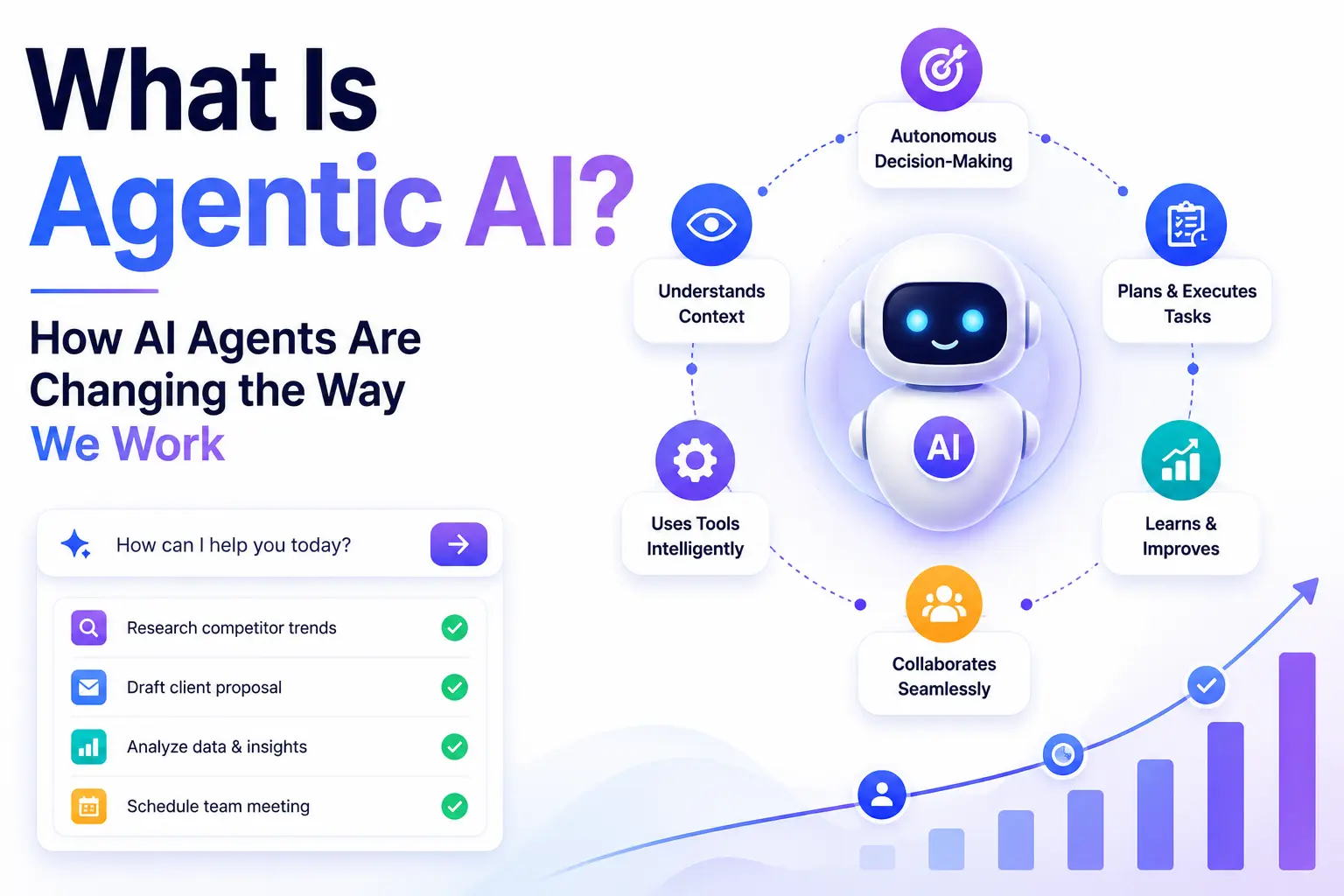
Agentic AI is an AI system that takes autonomous, multi-step actions to accomplish a goal — using memory, tools, and reasoning — without needing a human to manage every step. Unlike chatbots that respond to prompts, agentic AI perceives, plans, acts, and reflects until the task is complete.
What Is Agentic AI? A Clear Definition
Agentic AI refers to AI systems that can take autonomous, multi-step actions to accomplish a goal — without needing a human to guide every move.
Here's the key distinction: traditional AI (even most generative AI tools) is reactive. You ask, it responds. One prompt, one output. Done.
Agentic AI is proactive. You give it a goal like "research our top 5 competitors, summarize their pricing, and draft a comparison report." It breaks that into steps, searches the web, reads pages, synthesizes findings, and delivers the report. No hand-holding required.
The "agent" part is deliberate. These systems behave like agents — perceiving their environment, reasoning about it, deciding what to do next, taking action, and learning from the results.
If you want to understand the foundational AI capabilities that power these agents, DizitalAdda's Generative AI & Machine Learning courses cover the core concepts in depth.
Did you know? The term "agent" in AI dates back to the 1990s in academic research, but the capability to build truly useful autonomous agents only became practical with large language models (LLMs) after 2022.
AI Agents vs. Generative AI: What's Actually Different?
This is where most explanations go wrong. People lump everything together. They're not the same.
Generative AI (think ChatGPT, Claude, Gemini in basic mode) generates content based on your input. It's impressive, but it's stateless. Every conversation starts fresh. It doesn't follow through on anything.
Agentic AI builds on generative AI but adds three things:
- Memory — the ability to remember context across steps or sessions
- Tool use — calling external tools like web search, code execution, APIs, databases
- Planning — breaking a big goal into subtasks and executing them in sequence (or in parallel)
A simple example: Ask ChatGPT "how do I set up a drip email campaign?" It'll explain the concept. Give that same task to an agentic AI system like AutoGPT or a custom LangChain agent — it'll log into your email platform, create the sequence, write the emails, schedule them, and report back.
That's not a small difference. That's an entirely different category of tool.
How AI Agents Make Decisions: The Architecture Behind the Work
Understanding the architecture helps you actually use this stuff well. Here's what's happening inside an AI agent — what we call the 6-layer agent stack:
1. Perception The agent takes in inputs — text, data, files, API responses, user messages.
2. Reasoning It uses an LLM (like GPT-4, Claude, or Gemini) to think through the problem. It asks itself: What do I know? What do I need? What should I do next? To understand how these models are trained and fine-tuned, see DizitalAdda's Advanced Machine Learning & AI Certification.
3. Planning It creates a task plan. Some agents use a framework called ReAct (Reason + Act), where they alternate between thinking and taking action. Others use more structured planners like ReWOO, where all the reasoning happens upfront before any tools are called.
4. Tool Calling This is where agentic AI gets real leverage. Agents can call tools: web browsers, code interpreters, email clients, CRM systems, databases, calendars. Tools are what let an agent do things in the world, not just talk about them.
5. Memory Short-term memory keeps the current task's context. Long-term memory (stored in vector databases like Pinecone or Weaviate) lets the agent remember past interactions, company knowledge, or user preferences across sessions.
6. Reflection The best agents review their outputs before finishing. Did I accomplish the goal? Did anything go wrong? This self-evaluation loop is what separates mediocre agent outputs from reliable ones.
Quick tip: When evaluating an AI agent platform, ask: does it support tool use, memory, and multi-step planning? If it's only one of the three, it's not really an agent — it's a fancy chatbot.
Why This Matters for Business Leaders and Operators Right Now
Here's the honest truth: most AI implementations in businesses today are still in the "chatbot" phase. A few smart prompts, some saved time on writing, maybe a customer support bot. Useful — but nowhere near the ceiling.
Agentic AI moves the ceiling dramatically. And the organizations getting ahead right now are already deploying agents, not just prompts.
Where real-world businesses are using AI agents today:
Sales & CRM: Agents that research leads, personalize outreach, update CRM records, and follow up — without a human touching each step. Companies using tools like Salesforce Einstein or Clay with AI agents are seeing 30–40% reductions in sales rep admin time.
Finance & Operations: Autonomous agents that pull reports, flag anomalies, generate summaries, and route approvals. KPMG and Deloitte are both piloting agentic workflows in audit and compliance.
Customer Support: Multi-agent systems where a frontline agent handles the query, a specialist agent looks up account data, and an escalation agent routes edge cases — all without human involvement until truly necessary.
Software Development: GitHub Copilot Workspace and Cursor now support agentic coding — the agent reads a bug report, traces the code, writes a fix, runs tests, and submits a PR.
Marketing: Agents that monitor competitor content, generate drafts, A/B test variations, and update campaigns based on performance data.
What Industries Benefit Most from Agentic AI?
Almost every knowledge-work industry has a use case. But some are seeing faster returns than others:
Healthcare: Agents that handle patient intake, summarize medical records for doctors, and automate insurance prior authorizations. According to the Stanford HAI 2024 AI Index Report, AI agents reduced prior authorization processing time by 60% in pilot programs — a significant operational win for overstretched clinical teams.
Legal: Document review agents can scan thousands of contracts, flag risky clauses, and generate summaries — work that used to take junior associates weeks.
E-commerce & Retail: Inventory agents that monitor stock levels, trigger reorders, reroute shipments, and update product listings dynamically.
HR & Recruiting: Screening agents that read CVs, score candidates, schedule interviews, send follow-ups, and build shortlists — giving recruiters time to focus on the actual conversations.
Financial Services: Fraud detection agents that monitor transactions in real time, flag anomalies, and trigger investigation workflows automatically.
Multi-Agent Systems: When One Agent Isn't Enough
One agent can do a lot. But some workflows are too complex, too parallel, or too specialized for a single agent to handle alone.
That's where multi-agent systems come in.
Think of it like a team. There's an orchestrator agent that manages the overall goal and delegates. Specialist agents handle specific tasks — one searches the web, one writes, one reviews, one sends. They pass information between each other using emerging protocols like MCP (Model Context Protocol) and A2A (Agent-to-Agent).
A real example: A marketing agency built a multi-agent system where one agent monitors news for brand mentions, a second evaluates sentiment, a third drafts response posts, and a fourth gets human approval before publishing. The whole chain — from alert to drafted response — runs in under 10 minutes. That used to take a team of three people a few hours.
Frameworks like LangGraph, crewAI, and AutoGen make building these systems accessible without a large engineering team. If you want to build your own, DizitalAdda's Advanced Generative AI & Prompt Engineering course covers the foundations you'll need.
Common Mistakes When Deploying AI Agents
Here's what trips teams up most often:
1. Over-automating too fast. Connecting an agent to a live system before you trust the outputs is how you end up with 500 accidental emails sent to your customer list. Test in sandbox mode first.
2. Not scoping the goal tightly enough. "Improve our marketing" is not an agent-friendly goal. "Draft three subject line variations for this email sequence and A/B test them in Mailchimp" is.
3. Skipping the memory layer. An agent without memory is an agent that starts from zero every time. It'll ask the same clarifying questions, miss past context, and frustrate users fast.
4. Treating agents like chatbots. Agents need different evaluation criteria — task completion rate, accuracy, latency, tool call efficiency. Not just "did it sound right?"
5. Ignoring governance. Know which agent has access to what. Log every tool call. Build an audit trail. This matters especially in regulated industries.
What's Next for Agentic AI
The pace of progress here is fast. A few things worth watching:
Voice-native agents — agents that operate through voice interfaces, letting non-technical users direct workflows without any typing.
Agent marketplaces — pre-built specialist agents you can plug into your workflows like apps in an app store. Salesforce, Microsoft, and several startups are building these now.
Long-horizon agents — current agents struggle with tasks that take days or weeks. Research is actively advancing on agents that can maintain goals and context over much longer timeframes.
Regulatory frameworks — the EU AI Act already touches on autonomous systems. Expect clearer compliance requirements for agentic deployments in finance, healthcare, and HR within the next 2–3 years.
Honestly, the organizations that are experimenting with agents today — even imperfectly — will have a meaningful head start on everyone who waits for a "finished" solution. There's no finished. There's only the next iteration.
Frequently Asked Questions
Q: What is agentic AI in simple terms? Agentic AI is an AI system that can set a plan and carry it out — step by step — on its own, using tools like web search, code execution, and APIs to complete a goal without needing a human to manage every action.
Q: How is agentic AI different from ChatGPT? ChatGPT (in its basic form) responds to prompts one at a time. Agentic AI takes a broader goal, breaks it into tasks, and executes those tasks sequentially or in parallel — using memory and external tools. ChatGPT can be part of an agentic system, but by itself it isn't one.
Q: What are the best tools for building AI agents? Popular frameworks include LangChain, LangGraph, crewAI, and AutoGen for developers. For lower-code options, Relevance AI, Microsoft Copilot Studio, and Make.com with AI integrations are widely used. For enterprise deployments, Salesforce Einstein and IBM watsonx agents are established platforms.
Q: What industries benefit most from agentic AI? Healthcare, legal, financial services, e-commerce, HR, and software development are currently seeing the strongest returns. Any industry with repetitive, multi-step knowledge workflows is a candidate.
Q: Is agentic AI safe to use in business? Yes, with the right guardrails. That means scoped permissions, human approval checkpoints for high-stakes actions, audit logs, and sandboxed testing before live deployment. The risks are real but manageable with thoughtful implementation.
Q: What is a multi-agent system? A multi-agent system uses several AI agents working together — each with a specialized role — coordinated by an orchestrator agent. It's the AI equivalent of a team, where different members handle different parts of a complex workflow in parallel.
Conclusion
Agentic AI represents the next evolution of artificial intelligence—moving beyond generating responses to independently planning, executing, and optimizing complex tasks. By combining reasoning, memory, and tool usage, AI agents can manage multi-step workflows with minimal human intervention, helping businesses improve efficiency, productivity, and decision-making.
As organizations increasingly adopt AI-powered automation, agentic AI is becoming a practical solution across industries, from sales and customer support to healthcare, finance, and software development. The key is to start small: identify a repetitive workflow, define a clear objective, and evaluate where an AI agent can create measurable value.
Businesses that begin experimenting with agentic AI today will be better positioned to adapt to the future of work, where intelligent agents become an integral part of everyday operations.
Key Takeaways
- Agentic AI = AI that autonomously takes multi-step actions to reach a goal, with minimal human guidance
- Unlike generative AI, agents use memory, tool use, and planning — not just text generation
- The 6-layer agent stack: Perceive → Reason → Plan → Act → Reflect (+ Tool Calling)
- Multi-agent systems allow complex workflows to be split across specialist agents working in parallel
- Real-world use cases exist today in sales, customer support, HR, finance, legal, and software development
- Key risks include hallucination cascades, tool misuse, cost blowouts, and data exposure — all manageable with proper governance
- Start small: pick one repetitive workflow, map its steps, and build a single focused agent before scaling
- The businesses investing in agentic AI workflows now are building a compounding advantage