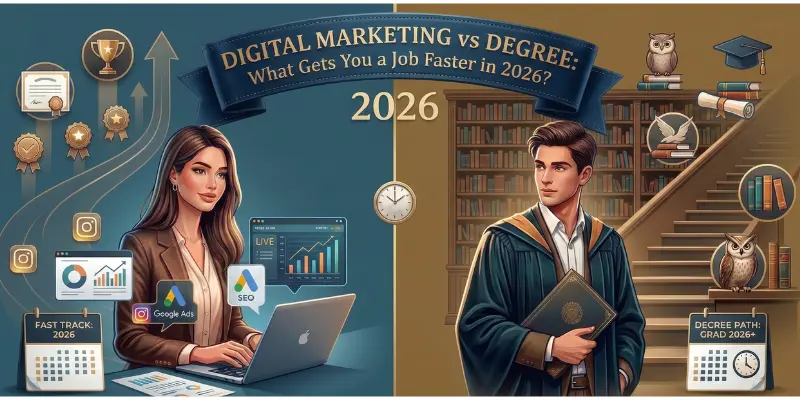
Digital Marketing vs Degree: What Gets You a Job Faster in 2026?
The thing is, a lot of students are sitting with the dilemma that “Should I go for a regular degree — B.Com, BBA, B.Sc, whatever — or should I just learn something practical, like a digital marketing course, and start building a career faster?”
In this post, we are going to break down the real differences between a traditional degree and a Digital Marketing course — the costs, timelines, job outcomes, and salary realities. Also, you'll see which path tends to land jobs faster in 2026, what companies actually look for now, and where most people make the wrong decision.
First, What Are We Actually Comparing Here?
A traditional degree — think B.Tech, B.Com, BBA, B.Sc, BA — is a 3 to 5 year academic program. It gives you theoretical knowledge, a degree certificate, and, if you're lucky, some colleges provide placements at the end of it.
A Digital Marketing course, on the other hand, is a skill-based program. Duration usually ranges from 3 months to 1 year, depending on the level. It's practical, it's job-focused, and honestly — it's designed specifically to make you employable quickly.
Both have a place. But they work very differently in the real world.
The Time Factor — And Why It Matters More Than People Admit
This is the part that most students overlook when they're making this decision.
A traditional degree takes 3 years minimum. Add to that the entrance exam prep, admission process, and the fact that most colleges don't actually give you job-ready skills —In most cases, it takes around 4 to 5 years before you start making decent money.
A focused Digital Marketing course? You can complete it in 3 to 6 months. Start working as a freelancer or in an agency role while you're still studying. Some students we know were earning ₹20,000 to ₹35,000 a month before they even finished their course.
That's a massive difference — not just in time, but in real income and experience.
However, while we are talking about how skills are important now, it doesn’t mean degrees are totally useless. It all depends on your career goal and your current requirement, like if you want early entry into the workforce, then you should focus on your skills along with side education, but if your path is different, like if you want to be a college professor, then your college education is more important, but having skills can boost your journey.
Read more: Why You Should Choose a Digital Marketing Course
The Cost Comparison Nobody Wants to Have
Alright, so here's the uncomfortable truth.
A decent private college degree in India — fees, hostel, books, travel — can cost anywhere between ₹3 lakhs to ₹20 lakhs over 3 years. Government colleges are cheaper, sure, but competition is brutal and seats are limited.
A professional Digital Marketing course from a good institute? That's somewhere between ₹15,000 and ₹80,000. Total. Done.
And here's what makes it even more interesting — students who complete a good digital marketing course are often earning back that investment within 2 to 3 months of getting their first freelance client or job.
With a degree, you might still be paying EMIs long after you've graduated — and still hunting for a job at the same time. That's the part colleges don't put in their brochures.
Digital Marketing: The Skill-First Route
Digital marketing is the process of promoting products online, including search engines, social media, paid ads, email campaigns, content, and analytics.
Digital Marketing is one of the few fields where what you can do matters way more than what certificate you hold. Employers and clients want results. Can you run a Google Ads campaign? Can you grow Instagram engagement? Can you write content that ranks on Google? If yes — they'll hire you. Simple.
And the entry barrier is surprisingly low. You don’t necessarily need any specific degree to start learning it. A laptop, internet connection, and structured training are usually enough.
That’s why the Digital Marketing vs Traditional Degree discussion has become so heated recently. Because the timeline is wildly different. Instead of 3–4 years of college, someone can learn core marketing skills in 6–12 months and start freelancing or applying for internships.
The Honest Comparison Table
Here's a straightforward side-by-side. No exaggeration, no marketing fluff — just what's realistic:
Note: Salary ranges are approximate and depend on institute quality, city, and individual effort.
A Quick Word From Someone Who's Seen Both Sides
"I've hired both degree holders and course-certified freshers. Honestly? The ones who showed me their actual work — a campaign they ran, a blog they ranked, a client they helped — always stood out more than a fancy degree from a college I'd never heard of. Skills are visible. Degrees are just paper until you prove otherwise."
— Senior Digital Marketing Manager, Delhi-based Agency
Read more: Scope of Digital Marketing in 2026
Can You Do Both? (The Smartest Move in 2026)
The students who are doing a degree AND learning digital marketing at the same time. College in the morning, skill course in the evening. Or an online course that fits around their schedule.
By the time they graduate, they have both — a degree for the eligibility boxes and a real, demonstrable skill set that actually gets them hired.
That’s the kind of combination recruiters notice. And yes, it’s completely doable. Most good digital marketing courses — like what DizitalAdda offers — are specifically built to fit around a student's schedule. You don't have to choose between the two.
FAQs — Real Questions, Straight Answers
Is a Digital Marketing course enough to get a job without a degree?
Yes, for most roles in digital marketing — agencies, startups, and freelance work don't require degrees. They want skills and results. A strong portfolio can easily replace a degree certificate.
Which pays more — a digital marketing job or a traditional job after a degree?
At the entry level, digital marketing often pays slightly more — and you get there faster. Senior digital marketing roles are exceptionally well-paying. A degree-holder in a generic field might earn comparably, but it takes 3–5 more years to get there.
Can I do a digital marketing course while still in college?
Absolutely. Most courses are online or evening-based. It's one of the most practical things a college student can do — graduate with both a degree AND a live skill.
What if I come from an Arts or Commerce background — can I still do this?
Yes. Digital marketing has zero stream requirements. Arts students especially tend to do very well in content writing and social media. Commerce students have a natural edge in analytics and paid ads.
Is a Digital Marketing course from a small institute worth it?
Depends on the institute's curriculum and placement support. Look for institutes that offer hands-on projects, real campaign experience, and genuine placement assistance — not just a certificate.
What if I want to do both — degree and digital marketing?
That's honestly the smartest move. Many students are doing exactly this, and they come out of college with a major advantage over everyone else.
Thinking About Starting a Digital Marketing Course?
If you're still figuring things out — that's okay. But if you've been putting off learning digital marketing because you weren't sure if it's "worth it," I hope this blog gave you some real clarity.
DizitalAdda's digital marketing courses are built specifically for students and freshers — no prior experience needed, flexible timings, and actual placement support. Not just a certificate you frame and forget.
Check out DizitalAdda's courses and see which one fits where you are right now.