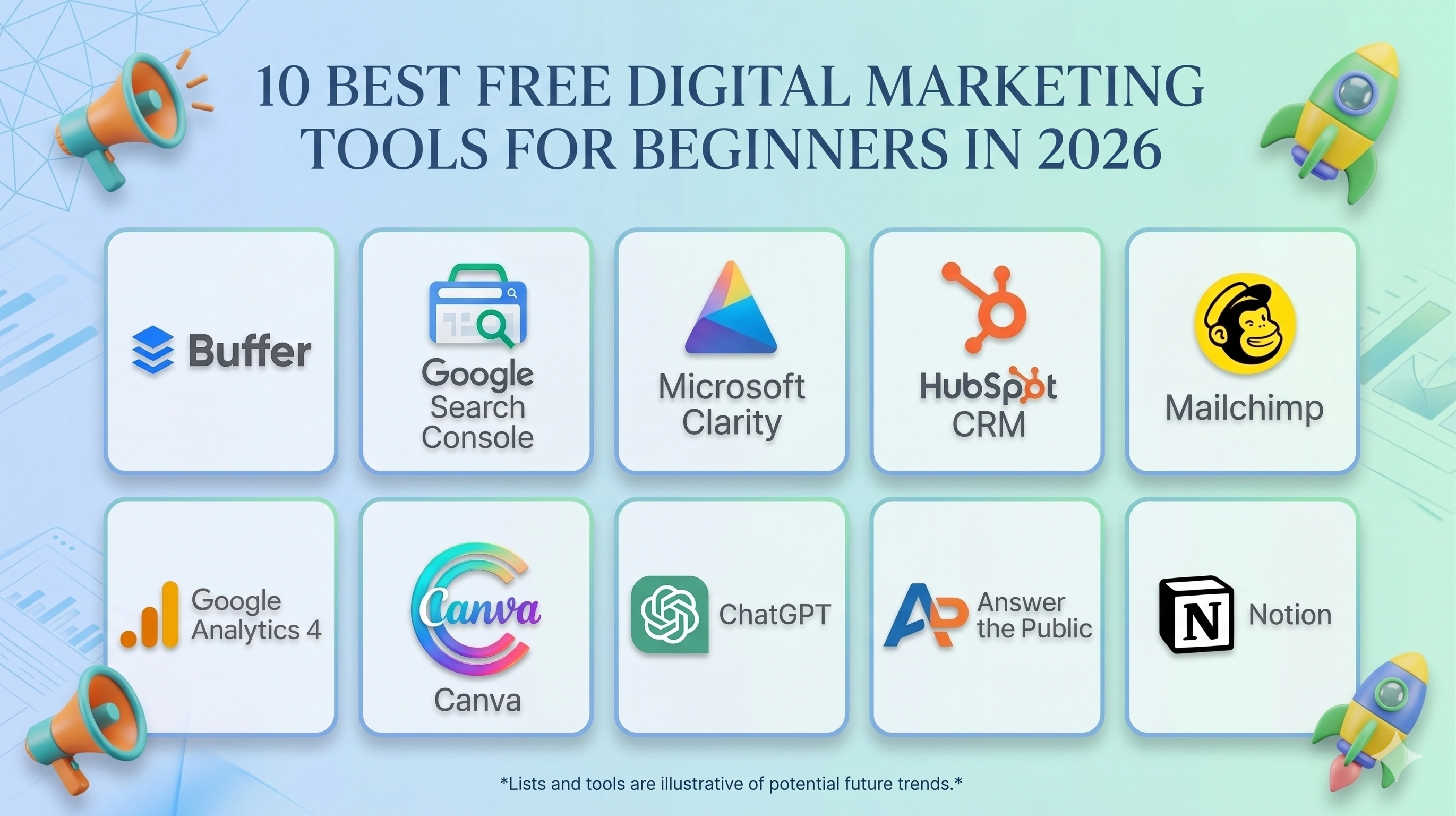
10 Best Free Digital Marketing Tools for Beginners in 2026
Imagine you own a great product, a decent startup idea, or maybe you are a college-going student trying to build your own personal brand. But, every time you Google “digital marketing tools list” to take your business to online platforms, you end up finding tools that cost $99 a month.
But because you are just starting and don’t want to spend too much at the initial stage, then you are at the right place. Here we will give you a comprehensive digital marketing tools list for beginners free. So, let's start discussing the best digital marketing tools list without further delay.
When Free Tools Actually Work
Free digital marketing tools are at their best when you're starting from scratch and need to build momentum without spending money. They’re not meant to replace advanced paid systems or entire marketing teams, but they are powerful enough to help you validate ideas, attract your first audience, and even land early clients. If your goal is to learn, experiment, and grow steadily, free tools can take you surprisingly far.
When you’re consistent and willing to explore, these tools become more than just “free options”—they become your training ground. Many people underestimate how much progress they can make without a budget, but the truth is, most early wins in digital marketing come from effort and strategy, not expensive software.
When free tools actually work best:
- You’re just starting out and need to learn the basics without financial risk
- You want to test ideas before investing in premium tools
- Your goals are small but meaningful (first subscribers, traffic, or client)
- You’re consistent with effort, even if resources are limited
- You’re okay with some limitations in exchange for zero cost
1. Buffer — Social Media Management Without the Drama
Buffer is the social media scheduling tool that quietly became every solo creator's best friend. The free plan lets you connect three social channels and schedule up to ten posts per channel — which sounds modest until you realize most beginners aren't even posting consistently once a week.
Buffer gives you a visual calendar, basic analytics, and a browser extension that makes adding content to your queue easy. No credit card required to sign up. It's the kind of tool that takes twenty minutes to learn and saves you three hours a week.
2. Google Search Console — The SEO Tool You're Probably Ignoring
Google Search Console is completely free, built by Google, and yet it's shockingly underused by beginners. It tells you exactly what search queries bring people to your website, which pages rank, and where Google is having trouble crawling your site.
If you want your content to show up on Google — and, yes, you do — this is non-negotiable. It's like having a direct line to Google's brain. Pair it with Ubersuggest's free tier for keyword research, and you've got a surprisingly solid SEO foundation without paying a rupee.
3. Microsoft Clarity — Free Conversion Optimization That's Actually Useful
Conversion optimization is one of those phrases that makes marketing sound more complicated than it is. Simply put, it means figuring out why visitors leave your site without doing what you want them to do — and then fixing it. Microsoft Clarity is 100% free, has no usage caps, and gives you heatmaps and session recordings so you can literally watch how real people interact with your pages.
Most developers I know discovered Clarity and immediately felt equal parts fascinated and unsettled. Watching someone frantically click a non-clickable element? That's where design improvements come from.
4. HubSpot CRM — Marketing Automation for People Who Hate Spreadsheets
HubSpot's free CRM is the entry point into ai in marketing automation without the enterprise price tag. You get contact management, deal pipelines, email tracking, and basic automation workflows — all free, forever. It's particularly useful if you're in college and doing any kind of freelancing or client work, because it helps you look professional without spending money you don't have.
The platform has embraced ai powered marketing features even in its free tier, like suggesting follow-up times and flagging contacts who've gone cold. HubSpot essentially treats the free plan as a long-term relationship, not a trick to grab your card details.
5. Mailchimp — The Email Marketing Tool That Started It All
Email marketing is still among the top returns on investment (ROI) of all digital marketing tools and platforms available to a beginner. Mailchimp provides a free plan that supports up to 500 contacts and allows you to send 1,000 emails each month. That should be more than enough to start your first newsletter.
There is a drag-and-drop editor for ease of use, some very attractive templates, and easy-to-read analytics (open rates and click-through rates) without having to feel like a data analyst.
While there are some drawbacks to the Mailchimp free plan (including a logo added to the footer), it is one of the best services for building your first audience from the ground up.
6. Google Analytics 4 — Because Guessing Is Not a Strategy
Google Analytics 4 (GA4) is free, powerful, and the closest thing to a universal language in the digital marketing world. It tracks who visits your site, where they come from, what they do, and how long they stick around. It might feel a bit difficult while learning, but once you get it, you won’t go back to other analytical tools. And YouTube does have so many tutorials for this tool.
The real value is that GA4 data integrates naturally with Google Search Console, Google Ads, and basically every other tool in this digital marketing tools list. Understanding your data is the foundation that makes every other marketing effort smarter.
7. Canva — Simple Graphics Without the Stress
Canva helps you create creative designs without any stress. The free plan is really generous - thousands of templates, easy drag and drop designs, presentations, logo, and email banners.
Today, everybody is using this amazing tool, whether they are students, running a business, or freelancers who are doing side hustles. So, if you want one tool to handle most of your design needs, Canva does the job.
8. ChatGPT (Free Tier) — AI Made Simple for Marketers
Look, we can't put together a digital marketing tools list for beginners free without talking about AI. The free version of ChatGPT has genuinely changed how beginners approach content. It drafts social captions, brainstorms blog post ideas, rewrites clunky email subject lines, and helps plan content calendars in minutes.
The role of ai in digital marketing isn't to replace your creativity — it's to handle the blank-page terror so you can focus on strategy. The key is learning to prompt well, which takes an afternoon, not a certification. Think of it as the world's most patient intern.
9. Answer the Public — Find What Your Audience Is Actually Asking
Answer the Public is a keyword and content research tool that visualizes what people are searching for around any topic. Type in "email marketing" and it spits out a wheel of questions, comparisons, and prepositions — real language real people type into Google.
The free plan gives you a limited number of daily searches, which is honestly enough for most beginners mapping out a content strategy. It's the tool that makes you realize just how many specific questions your target audience has — and how many blog posts, videos, or social posts you could create to answer them.
10. Notion — The Command Center for Every Marketing Effort
Notion doesn't fit neatly into a single marketing category, which is exactly why it's so useful. The free plan gives you unlimited pages and a powerful template library for content calendars, editorial planning, competitor research trackers, social media vaults, and campaign dashboards.
Whether you're a student managing a group project or a developer launching a side project, Notion brings together the chaos. Used alongside the other tools in this digital marketing tools list, it becomes the connective tissue that keeps your entire strategy organized and visible.
Read More: Digital Marketing Automation Tools and Techniques
Quick Comparison: All 10 Tools at a Glance
Here's a side-by-side look at the core category, free plan limit, and the standout feature for each tool in this digital marketing tools list for beginners free collection.
Do These Free Tools Have Any Real Limitations Worth Knowing About?
It’s important to be honest about this—free tools do come with limits. So, yes, there are both pros and cons of tools.
Common limitations to keep in mind:
- Buffer's free plan limits you to three channels
- Mailchimp's free tier doesn't include automation sequences
- Canva's best templates are locked behind Canva Pro.
- ChatGPT free version doesn’t provide real-time web access
However, the good news is that most of these tools let you stay free for months, sometimes years, before the limits actually bite. Also, knowing these limits early helps you plan better instead of running into surprises later.
How a Comprehensive Digital Marketing Course from DizitalAdda Can Set You Apart
Well, if you really want to understand all the digital marketing tools, just because you are planning to take your business online or want to make a career in this field. Then, a structured or comprehensive digital marketing course is the best option.
Don’t get me wrong, but a person who learns everything on their own, like figuring out everything from scratch and then applying those learnings into practice. This process takes too much time and many quit before seeing results. The reason behind is their frustration and lack of knowledge. But there are many people who wait patiently and see valuable insights and real growth in their work, but sadly, the number is quite low.
So, yes, enrolling in a top digital marketing institute like DizitalAdda is a worthwhile investment.
Frequently Asked Questions
What is the best free digital marketing tool for absolute beginners?
If you ask me for the best free digital marketing tool for absolute beginners, then my answer would be Canva. Because Canva is easy to use at the initial stage, like its simple, visual, and helps you understand the interface easily.
Is AI in digital marketing actually useful for beginners, or is it overhyped?
AI in digital marketing is really useful, especially for those who are beginners. And when we talk about the hype, then this comes from the people who claim it is fake and say it will do everything by itself. But the reality is that the AI is to assist, not to replace. So, use it wisely.
Can I do real email marketing for free without giving my credit card?
Yes, you can do email marketing without making any purchase. You can use Mailchimp’s free plan that offers 500 contacts and 1,000 sends per month. Most successful newsletters started with a free plan and a commitment to consistency, not a paid subscription.
What's the difference between SEO tools and analytics tools in a digital marketing tools list?
SEO tools help you get found — they focus on keywords, search rankings, and how Google crawls your site. Analytics tools tell you what happens after someone finds you — traffic sources, behavior, conversions, and time on page. You need both: one to attract visitors and one to understand them.
How many tools from this digital marketing tools list should I use at the same time?
Start with just three tools max. If you use more than that, you’ll end up managing tools instead of actually doing marketing. And more gradually, when you feel that you are able to manage the previous ones effectively.
Are AI-powered marketing tools replacing traditional digital marketing skills?
Well, this is one of the biggest myth that the emerging AI tools are replacing traditional marketing tools, but the reality is totally different. The new AI tools are to assist or support the old ones. The fundamentals are always needed no matter what new comes in the market.