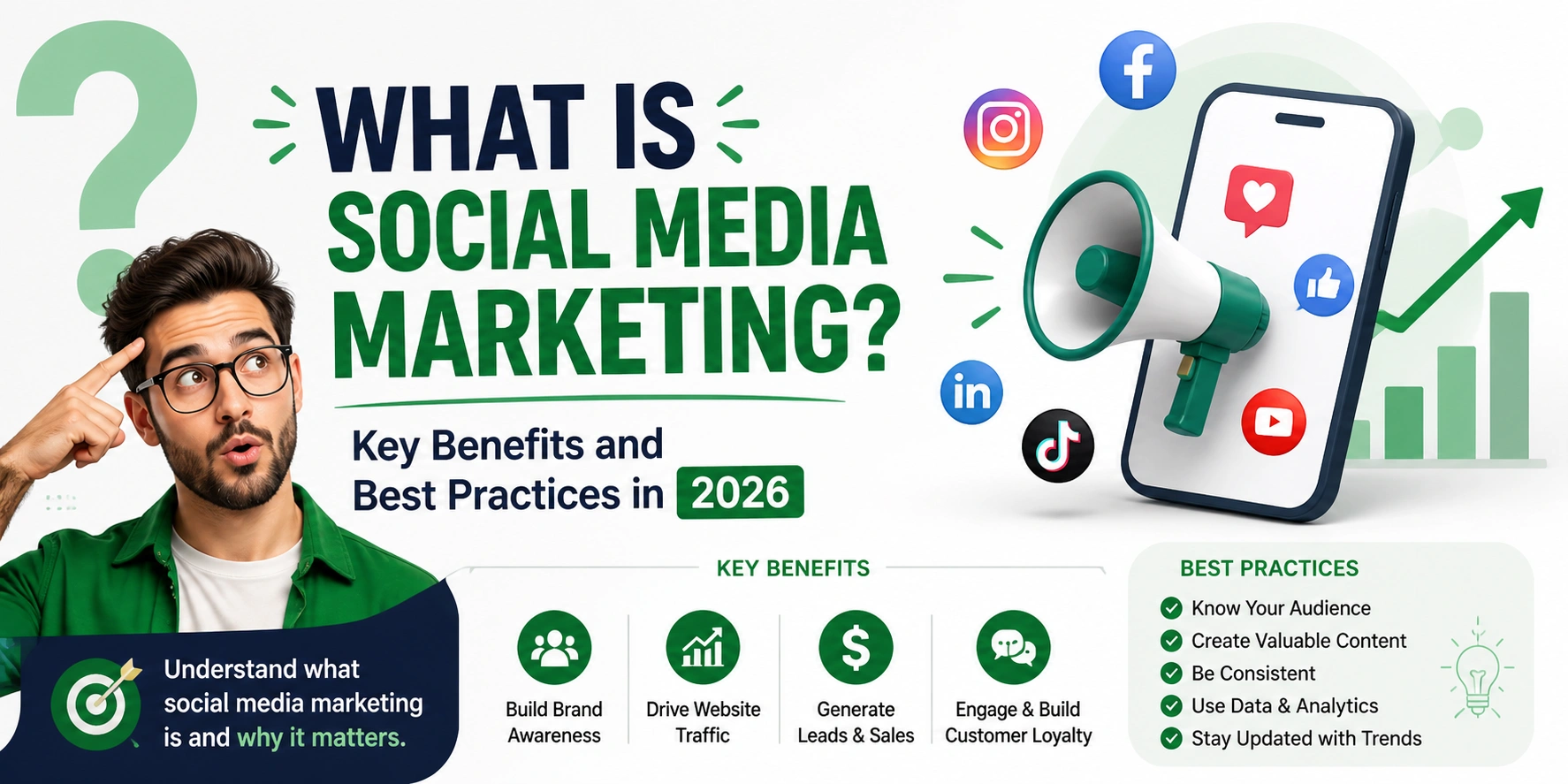
What is Social Media Marketing? Key Benefits and Best Practices in 2026
What is Social Media Marketing in Simple Words?
In simple words, social media marketing (SMM) is a strong form of online advertising that include uses of various social media platforms to promote products, engage audience, and build loyal audience.
Social media marketing helps businesses collect useful feedback and connect more easily with people. It boosts brand awareness, sales, and traffic while enabling businesses to gather feedback, respond to customers, and strengthen relationships.
So, if you're a business owner, ecommerce manager, or just someone trying to figure out how social media marketing actually works — you're in the right place.
How Social Media Marketing Works in the Real World
Social media has driven a complete shift that how businesses influence decisions and how to connect with our potential audience. Social media platforms like Facebook and Instagram user their user data and observe their interests, location, behavior to deliver highly targeted and personalized content that actually connects with them. The algorithms are working at a different level.
So, yes you can say that social media marketing isn’t just a platform for posting attractive content and waiting for likes. Now, it has developed itself into a complete AI system that understand, evaluate and deliver content to its user accordingly. A system that includes content creation, paid advertising, influencer collaborations, community engagement, and performance tracking.
Here's where it shows up in the real world:
- Ecommerce brands use Instagram influencer marketing together with shoppable posts to generate revenue through sales that occur entirely within the application.
- B2B companies use LinkedIn for B2B influencer marketing, thought leadership content, and lead generation — targeting decision-makers by job title and industry.
- Local service businesses use Facebook ads combined with Google-related social advertising to reach nearby customers who are actively searching.
- Creators and personal brands build audiences on YouTube or TikTok by producing regular content, which they later monetise through brand deals, paid posts, and affiliate links.
Why Social Media Marketing Works: Key Benefits You Need to Know
Social media marketing has evolved and turned into the most powerful marketing tool for businesses. This works because it allows brands to reach larger audiences, build real-time connections with them and drive measurable outcomes. And the best part all these can be achieved under low budget unlike traditional marketing method where you have to pay high and expect less.
Here's what social media marketing actually does for your business:
- Brand Awareness at Scale: Businesses can boost their brand awareness through organic content, paid campaigns, and influencer partnerships. Social media is the best weapon in 2026 to put your brand in front of millions of people.
- Direct Access to Your Audience: Through social media, you can have direct access to your audience, or you can have multiple access points, unlike email. Features like direct messages, comments, polls, and stories enable real conversations. This two-way conversation builds loyalty faster than any marketing method.
- Cost-Effective Lead Generation: Some social media platforms, like Meta and LinkedIn, enable you to run hyper-targeted campaigns that suit small business budgets. You can even start with ₹500 per day and then increase the budget accordingly.
- Influencer Power, Even on a Budget: You don't need a Bollywood celebrity. Micro influencer marketing (working with creators who have 5K–100K followers) often drives higher engagement and trust than mega-influencer deals — at a fraction of the price.
- Compounding SEO and Traffic Benefits: Having active social media accounts increases credibility with search engines. Content that is shared frequently can lead to backlinks, increased brand searches, and organic traffic growth - all of which contribute to sustainable, long-term development.
Key Components of Social Media Marketing: Strategy to Analytics
Social media marketing isn't one thing — it's a system of moving parts. Here's how those pieces break down:
1. Content Strategy This is your foundation. Having a solid content strategy can give your social media marketing a clear edge and save your lots of time. The right content strategy means you know who your audience is, when to target them, and what to deliver to them. Without a strategy, you are just improvising, not targeting your actual audience.
2. Social Media Advertising Relying only on organic marketing is not enough. If you really want to thrive in today’s marketing era, you have to do paid marketing too. Facebook Ads, Instagram Ads, LinkedIn Ads, YouTube pre-rolls are now non-negotiable for brands that want consistent visibility.
3. Influencer Marketing This is the fastest-growing slice of SMM. Brands find influencers — whether they're Instagram influencers with a hyper-engaged food niche or YouTube influencers reviewing tech — to authentically promote products through sponsored content and paid posts.
4. Community Management Community management is important to build brand loyalty and create a genuine audience. Many brands outsource this to a social media agency, and they manage their daily engagement and help them build a real audience base.
5. Analytics and Optimisation Post. Measure. Improve. Repeat. Platforms such as Meta Business Suite, Sprout Social, Hootsuite, and native platform analytics reveal your hits and misses while also advising on where your next social media campaign should focus.
How to Get Started: 5 Social Media Marketing Best Practices
No matter from where you start or fixing any stagnant business. These steps are either going to fix your business.
- Define Your Goals Before Your Content: Are you trying to build brand awareness, generate leads, drive ecommerce sales, or recruit talent? Your social media strategy should be built backwards from a specific goal — not "we need to post more." Every campaign, every post, should ladder up to that objective.
- Choose Platforms Strategically, Not Out of FOMO: You don't need to be everywhere. Instagram influencer marketing dominates for lifestyle, fashion, and food. LinkedIn wins for B2B and professional services. YouTube influencer marketing is unbeatable for tutorials, reviews, and long-form education. Pick two platforms and dominate them rather than spreading thin across five.
- Find the Right Influencers for Your Brand: Do not pay attention to the vanity metrics when you find influencers to promote your product. Focus on audience alignment, engagement rate (not how many followers you have), and proof of previous brand partnerships with real metrics.
- Invest in a Consistent Visual Identity: Scroll your competitor's feed. Then scroll yours. Would a stranger know the difference? Consistent colours, fonts, and tone of voice across your social media content — whether managed in-house or by a social media content agency — is what turns casual scrollers into recognisable brand fans.
- Test Paid Posts Before Scaling: Never blow your entire advertising budget on one single campaign. Run small tests on 3–4 ad variations, where the data speaks for itself — and then allocate budget only to what's converting. And therein lies smart social media marketing vs. costly fumbling in the dark.
The Bottom Line on Social Media Marketing
Social media marketing 2026 is no longer a trend your business and you cannot live without it. Instead, this is the marketing tool you need to have, and it is roaring right now. Be it a one-man-band running your ecommerce store or handling marketing for a scaling startup, the rules remain the same — be consistent, target an intent-driven audience and extract actionable insights from your analytics.
The brands winning right now aren't the ones with the biggest budgets. They're the ones with the clearest strategy, the most authentic voice, and the discipline to keep going when the algorithm stops cooperating.
F&Qs
-
How do beginners start social media marketing?
- Define goals
- Pick Platforms
- Create content
- Engage audience
- Track results
-
What is social media marketing in simple words?
Promoting products or services through social platforms to connect with audiences and grow visibility. -
What is social media in digital marketing?
It’s the use of social platforms as a channel within digital marketing strategies. -
What are the advantages of social media marketing?
- Define goals
- Pick Platforms
- Create content
- Engage audience
- Track results
-
What is the role of social media marketing in digital marketing?
It amplifies brand voice, fosters relationships, and supports overall digital campaigns -
What is the main role of social media?
Connecting people, sharing information, and enabling communication across communities.