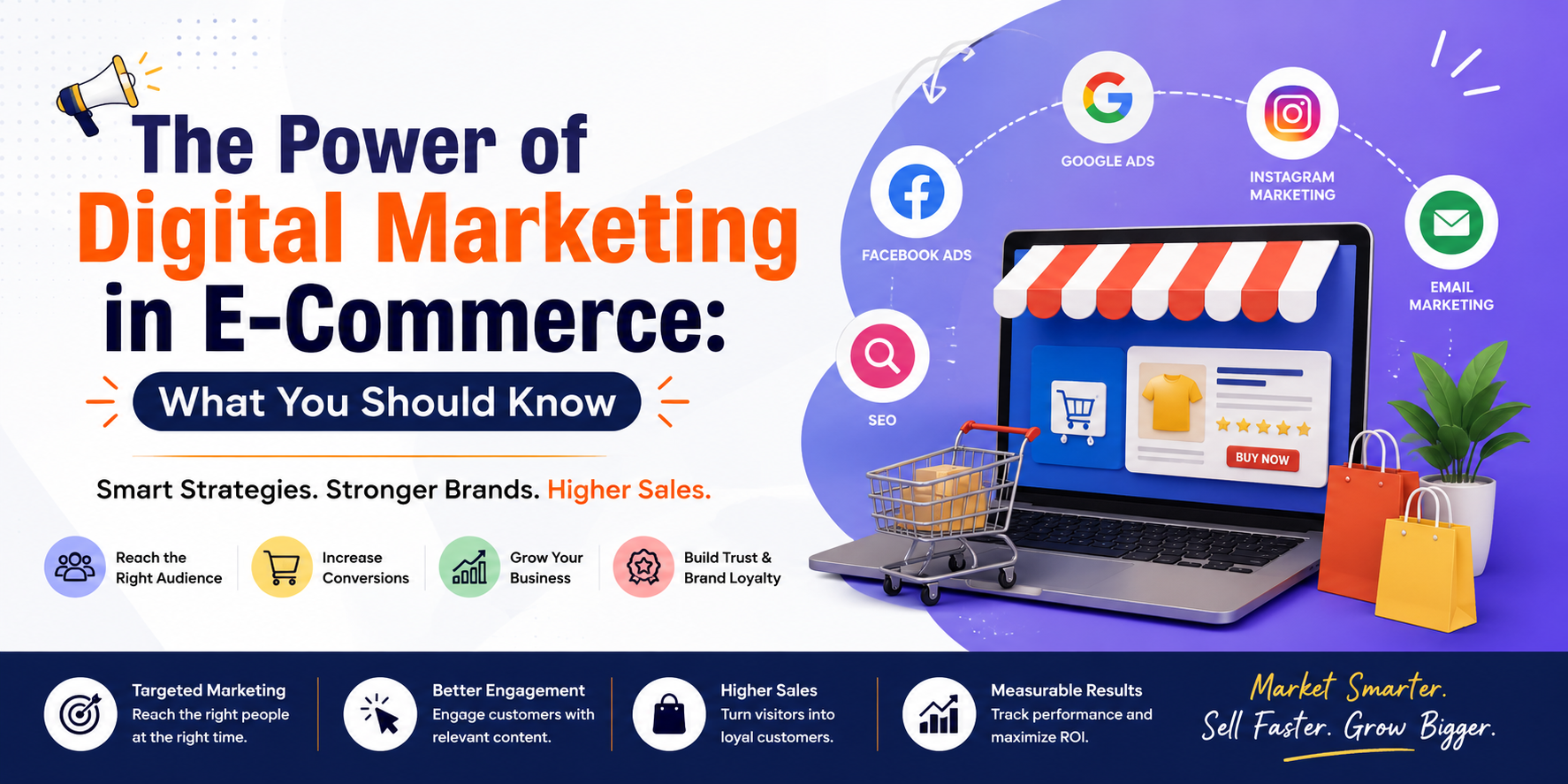
The Power of Digital Marketing in E-Commerce: What You Should Know
Did you know that more than 2 billion people shop online every year? That’s almost one out of every four people on Earth! With so many people buying from their phones and computers, businesses need smart ways to reach them. This is where digital marketing becomes very important. Learn in this article what exactly digital marketing in e-commerce is and why it is revolutionary for all online retailers.
What is Digital Marketing in E-Commerce?
Digital marketing in e-commerce simply means using online channels and digital platforms to promote products, attract customers, and increase online sales.
It includes strategies like:
- Search Engine Optimization (SEO)
- Google Ads
- Social media marketing
- Email marketing
- Content marketing
- Influencer marketing
- Retargeting campaigns
Every activity that helps an online store get discovered and generate sales online is a part of digital marketing in e-commerce. Without the right digital marketing strategy, even the best-designed e-commerce website fails to generate effective leads.
How Digital Marketing is Transforming Modern E-Commerce
Let’s understand this from the very basics. Like what you do when you make a purchase. You don’t buy products instantly after seeing them, right? What you do is go on google search bar, search for your query, compare brands, see prices on different platforms like Amazon, Flipkart, Myntra, and more. You check ratings and then decide whether to buy any product from any particular brand or not.
Online shopping now constitutes a significant portion of global retail sales because international e-commerce networks maintain their rapid expansion. Mobile shopping has become the primary shopping method for consumers, with mobile commerce projected to reach 59% of worldwide e-commerce sales by 2025, according to (soax.com).
This is where digital marketing in e-commerce becomes a game-changer. The system assists online companies to reach their ideal customers while enhancing their online presence and driving customer acquisition and retention.
Difference Between Traditional Marketing and E-Commerce Marketing
Traditional businesses often rely on physical location, banners, newspapers, or word-of-mouth.
But e-commerce businesses rely heavily on:
- Online visibility
- Search rankings
- Paid advertising
- Customer targeting
- Social proof
- Personalized experiences
The era of today is online, so if you have an offline store, then this is not enough. You have to make your online presence dominate as well, and for that, digital marketing in e-commerce is not an option but a requirement.
Why Digital Marketing Matters More Than Ever in 2026
1. Customers Search Before Buying
Modern buyers are smarter. Before making any purchase, they do fine research.
They usually:
- Search on Google
- Compare products
- Read reviews
- Watch YouTube videos
- Check Instagram pages
- Look at customer testimonials
So, yes, a strong digital marketing in e-commerce strategy ensures your business appears where your potential customers are searching. Whether on social media platforms, Google, or GBP.
2. Competition in E-Commerce is Growing Fast
Competition is intense, so you can’t survive without applying effective digital marketing tactics in your strategy because customers have endless options.
Without proper branding and marketing:
- your products remain invisible,
- your website traffic stays low,
- and sales become inconsistent.
Digital marketing helps businesses stand out through:
- SEO
- social media presence
- paid advertising
- and customer engagement.
3. Customer Attention Span is Smaller
People scroll fast. If your content does not grab attention quickly, customers move to another brand.
This is why:
- short-form videos,
- fast-loading websites,
- mobile optimization,
- and engaging creatives
have become essential parts of digital marketing in e-commerce.
4. AI and Automation are Changing Marketing
AI-powered tools now help businesses:
- personalize ads,
- automate emails,
- recommend products,
- and improve customer service through chatbots.
New digital marketing in e-commerce is becoming smarter, faster, and more data-driven. So, ignoring this simply means losing your valuable customers.
Core Components of E-Commerce Digital Marketing
1. Search Engine Optimization (SEO)
Want to secure your place on the SERP (search engine result page). Then seo is your go-to way. This helps your store get online on Google in an organic way. So, whenever people make a query related to the services or products you deal with, you will appear to them.
Good e-commerce SEO includes:
- product page optimization,
- category page optimization,
- keyword research,
- technical SEO,
- and improving website speed.
For example, if someone searches:
“best running shoes for beginners”
Your website should ideally appear in the search results.
Important Areas of E-Commerce SEO
- Product keywords
- Search intent optimization
- Internal linking
- Mobile optimization
- Fast page speed
- Blog content
Strong SEO is one of the most cost-effective forms of digital marketing in e-commerce.
2. Paid Advertising (PPC & Ecommerce Ads)
Paid ads are another way to appear in front of your potential customers. Paid ads like Google and Meta are mostly run on those keywords, on which securing a position in an organic way is impossible.
Popular platforms include:
- Google Ads
- Google Shopping Ads
- Facebook Ads
- Instagram Ads
- YouTube Ads
Paid advertising allows businesses to target:
- specific interests,
- locations,
- age groups,
- shopping behaviors,
- and customer intent.
Well, let me clear this to you that running ads alone is not enough. If your landing pages are slow or confusing, you will end up losing your lead.
Here is what a successful digital marketing in e-commerce combines:
- strong ads,
- optimized landing pages,
- and proper conversion tracking.
3. Social Media Marketing
Social media is one of the marketing tools that impacts more than any other platform. We all know the influence of Instagram on today’s generation. So, using this platform smartly can equip you with an immense brand recognition among people.
Platforms like Instagram, Facebook, Pinterest, and YouTube influence buying behavior every day.
Popular e-commerce strategies include:
- Instagram Reels
- Influencer collaborations
- User-generated content
- Product demonstrations
- Customer testimonials
4. Email & WhatsApp Marketing
Only running ads, doing SEO, or social media marketing is not enough. Taking follow-ups is also important. Many businesses fail or lose customers because they never follow up.
Email and WhatsApp marketing help businesses:
- recover abandoned carts,
- send offers,
- announce product launches,
- and increase repeat purchases.
Examples include:
- welcome emails,
- festive offers,
- loyalty campaigns,
- and personalized recommendations.
These channels usually have high conversion potential because they directly reach interested customers.
5. Content Marketing
We misconcept Content marketing just as blogging, but this is beyond that.
It now includes:
- buying guides,
- tutorials,
- FAQs,
- comparison articles,
- short videos,
- and educational content.
When brands share helpful content that provides information to customers, their trust in the brand begins to increase. The process of educating people through blogs and videos and guides creates stronger relationships, which also improves search engine optimization. Content marketing serves as a fundamental element of digital marketing because it drives e-commerce businesses forward.
Best Digital Marketing Strategies for E-Commerce Success
1. Optimize for Mobile Users
Mobile shopping is dominating the whole e-commerce market. As this is more convenient and easier to use, people respond fast and buy early compared to an offline store visit. So, optimizing your website for mobile users is a must.
Your website should:
- load quickly,
- look clean on mobile,
- and offer an easy checkout process.
A poor mobile experience often leads to lost sales.
2. Use Retargeting Ads
Retargeting is essential cause the ratio for those who buy at first is very low. And when it comes to ads, then you must focus on reminding customers about your services and create urgency among them to make a purchase.
These campaigns often improve conversions because the audience is already familiar with your brand.
3. Build Trust Through Reviews and Testimonials
Reviews create a huge impact on building your trust among your audience. Customers trust the past customers' reviews more than the campaigns you run. Trust is a huge factor in digital marketing in e-commerce.
Adding:
- reviews,
- ratings,
- testimonials,
- and customer photos
4. Use Video Marketing
Video content is gaining more popularity than any other content. Hence, take advantage of this opportunity and use short-form videos that gain the instant attention of people.
Short-form videos like:
- Instagram Reels,
- YouTube Shorts,
- and product demos
help increase engagement and product understanding. Video marketing makes products feel more real and trustworthy.
5. Track Analytics and Data
Successful businesses make decisions using data.
Tools like:
- Google Analytics,
- Meta Pixel,
- heatmaps,
- and conversion tracking
help businesses understand:
- customer behavior,
- traffic sources,
- and sales performance.
Without data tracking, marketing becomes guesswork.
Why Choose DigitalAdda Agency for E-Commerce Marketing
A successful online store needs more than just traffic.
It needs:
- strategy,
- consistency,
- optimization,
- and long-term growth planning.
DigitalAdda Agency focuses on helping e-commerce brands grow through:
- SEO-driven marketing,
- performance advertising,
- social media growth,
- content marketing,
- and customized digital strategies.
Whether you are launching a new online store or trying to scale an existing business, the right marketing strategy can make a major difference.
Future Trends in E-Commerce Digital Marketing
The future of digital marketing in e-commerce is evolving quickly. Some important trends shaping 2026 and beyond include:
AI-Powered Marketing: AI tools are helping businesses personalize customer experiences.
Voice Search Optimization: More users now search using voice assistants.
AR Shopping Experiences: Augmented reality helps customers visualize products before buying.
Personalized Recommendations: Brands now use customer behavior data to recommend products.
Influencer Commerce: Creators and influencers continue to influence purchase decisions.
Short-Form Video Dominance: Platforms prioritizing video content are driving massive engagement.
FAQs
What is digital marketing in e-commerce?
Digital marketing in e-commerce simply means using online platforms to sell your products or services. The use of channels includes Instagram, Facebook, and listing products on Amazon, Flipkart, etc.
Why is digital marketing important for online stores?
To run your online stores, you need digital marketing. It is like a fuel for your vehicle. The right digital marketing strategy helps you optimize your marketing approach that is tailored to your audience.
Which digital marketing strategy works best for e-commerce?
There is no single best strategy. It also depends on your business type like which suits best to your niche. The overall best approach is a good combination of SEO, paid ads, social media marketing, and email marketing, which usually delivers the best results.
How does SEO help e-commerce businesses?
SEO helps websites rank higher on Google search results, bringing organic traffic and long-term sales opportunities.
What are the benefits of social media marketing for e-commerce?
There are lots of benefits of social media marketing, especially for e-commerce. Nowadays, many people are making their purchase from instagram, pinterst and other similar platforms, As they get inspire from the influencers and want to look same like them. So, yes, social media helps brands build engagement, showcase products, connect with customers, and increase conversions.
How do retargeting ads increase sales?
Retargeting ads remind visitors about products they previously viewed, encouraging them to return and complete purchases.
Is email marketing still effective for e-commerce in 2026?
Yes. Email marketing is still one of the most effective channels for customer retention, follow-ups, repurchases, and personalized promotions.
What is the role of content marketing in e-commerce?
Content marketing helps you define content that resonates best with your customers. The content builds an emotional connection and creates urgency among your audience to buy your product and increase sales.