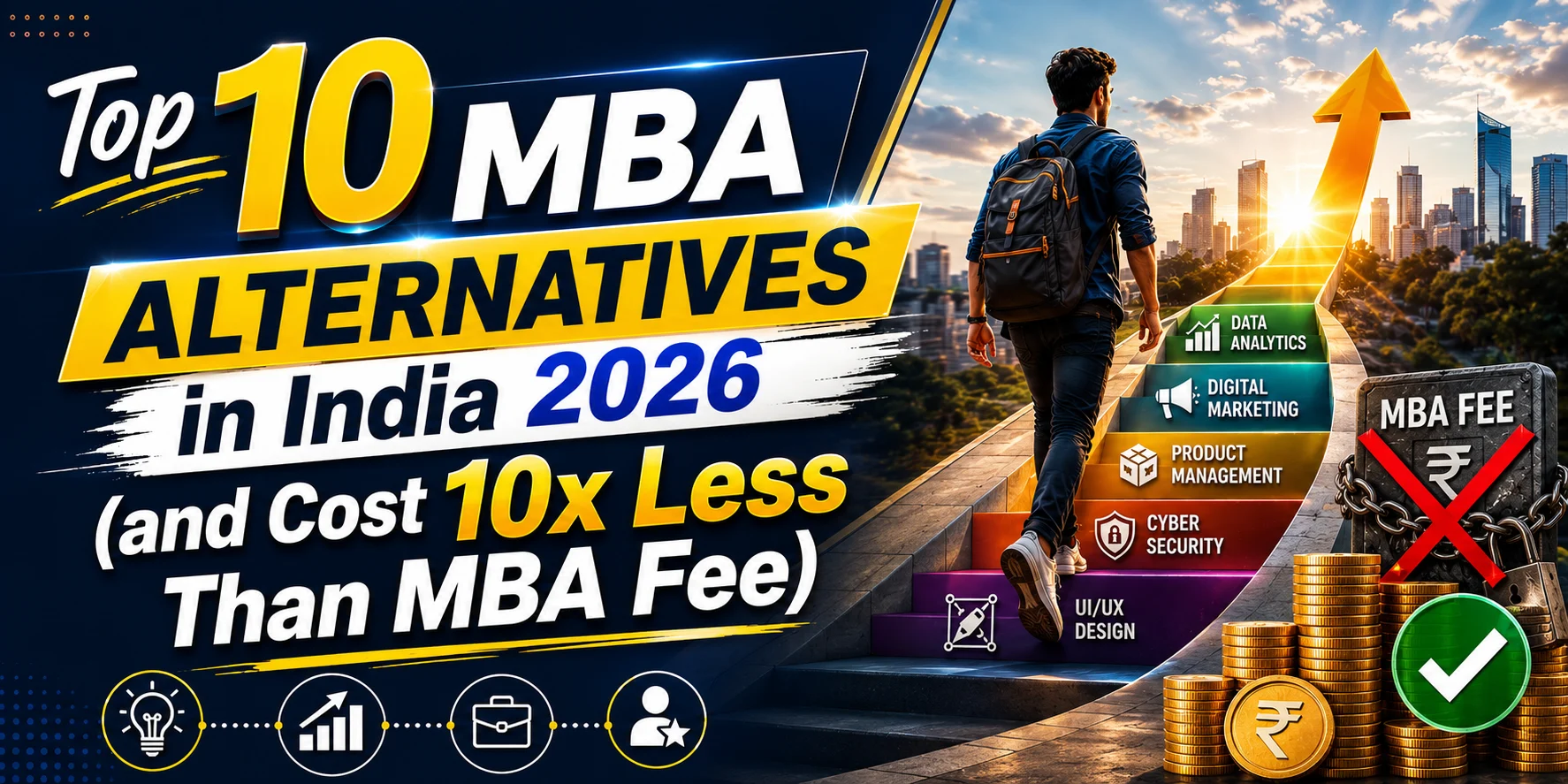
Top 10 MBA Alternatives in India 2026 That Actually Get You a Job Faster (and Cost 10x Less)
Every year, thousands of Indian graduates end up in the same loop — graduation is done, everyone around them is talking about CAT prep, and before they know it, they're sitting in a coaching centre memorising quant formulas for an MBA they're not even sure they want.
Here's something worth pausing on: the MBA made sense in an era when a postgraduate degree was the only way to signal credibility to an employer. That era is ending. Fast.
In 2026, the Indian job market — especially in marketing, technology, data, and digital — is actively hiring on the basis of skills, not degrees. And there are now very credible, very practical alternatives to an MBA that get you to the same destination — a good salary, career growth, and financial independence — in a fraction of the time and at a fraction of the cost.
This guide covers the top 10 MBA alternatives in India worth seriously considering. For each one, we'll tell you what it is, who it's actually suited for, and give you an honest review— so you can make a real decision, not just read another generic list.
Quick Context:
The average cost of an MBA at a Tier-2 private college in India is ₹8–15 lakh. A high-quality, skill-based course in digital marketing, data science, or cyber security costs ₹30,000–₹1,50,000. The question isn't whether an MBA is valuable — it's whether it's the right value for where you are and where you want to go.
1. Digital Marketing Course — The #1 MBA Alternative for Most Graduates in India
Let's get straight to the point: If you're a graduate confused about career options — especially in marketing, content, business, or communications — a Digital Marketing Course is, in most cases, the single strongest MBA alternative available to you right now.
Here's why it stands apart from every other option on this list:
- Time to job: 3–6 months from starting the course to landing a role
- Fees: ₹30,000–₹1,50,000 for a comprehensive program
- Freelancing: You can start earning clients before you even finish the course
- Job market: Delhi NCR alone has thousands of open roles in SEO, paid ads, content strategy, and social media at any given time
- AI-ready: Good institutes now cover GA4, ChatGPT for marketing, Meta Ads, and performance analytics as standard
Digital marketing isn't a niche skill anymore. Every business — from a local shop in Lajpat Nagar to a D2C brand in Bengaluru — needs digital marketing professionals. And that demand is only growing as India's internet economy expands.
Digital Marketing Salary in India 2026 is increasing at an immense rate. So, if you are planning to build a career in this field, then for sure you are going to get an attractive package in the future.
Key takeaways
Best for: Fresh graduates, marketing/BBA/BCom/BA students, homemakers returning to work, working professionals looking to switch lanes, anyone with a budget under ₹1.5 lakh who wants a job within 6 months. Not ideal for: Those specifically targeting consulting or investment banking roles.
2. Data Science & Data Analytics — Best for the Analytically Inclined
Data Science has evolved from a trend into a necessity. In 2026, virtually every mid-to-large company in India has a data function — and the demand for people who can work with data meaningfully far outstrips the supply of graduates who can actually do it. — a gap that NASSCOM's digital skills research has consistently flagged as one of India's most urgent workforce challenges.
A Post Graduate Diploma or certification in Data Science or Data Analytics typically covers Python, SQL, machine learning basics, data visualisation, and business intelligence tools like Power BI or Tableau. Most good programs take 6–12 months.
Salaries for data analysts in India start at ₹4–6 LPA for freshers and climb to ₹12–20+ LPA within 3–4 years of experience. Data scientists command even higher packages, especially in fintech, e-commerce, and tech companies.
If you want to explore the AI and data career landscape in more depth, our guide on AI Jobs in India Salary 2026 covers the highest-paying roles right now.
Key takeaways
Best for: Engineering graduates, BSc students, anyone comfortable with numbers and logic. Not ideal for: Students looking for a creative or communication-heavy career — data science requires genuine comfort with analytical thinking and coding basics.
3. Cyber Security & Ethical Hacking — The Fastest-Growing Career Track in India
India is now one of the most targeted countries for cyber attacks globally — and the gap between cyber threats and trained professionals to counter them is enormous. This is exactly the kind of supply-demand imbalance that creates strong career opportunities.
A Cyber Security or Ethical Hacking certification course typically covers network security, penetration testing, vulnerability assessment, VAPT, and tools like Kali Linux and Metasploit. Certifications such as CEH (Certified Ethical Hacker) and CompTIA Security+ are widely recognised by employers in India and globally.
Starting salaries in cyber security range from ₹3.5–6 LPA at the fresher level, with experienced professionals easily earning ₹15–25 LPA — and bug bounty programs offering additional income streams on the side.
We've covered the salary landscape in detail in our blog on Cyber Security Salary in India 2026.
Key takeaways
Best for: Students with an interest in technology, networking, and problem-solving. BSc IT, BCA, and engineering graduates find this transition particularly smooth. Not ideal for: Complete non-tech beginners with no interest in how systems and networks function.
4. Generative AI & Prompt Engineering — The Newest High-Value Skill in 2026
Two years ago, prompt engineering wasn't even a job title. Today, it's one of the fastest-growing skill sets in the world — and India is at the forefront of adoption.
Generative AI courses teach you how to work with large language models, automate workflows, build AI-powered tools, and integrate AI into business processes. Prompt Engineering specifically focuses on crafting inputs that extract the best possible outputs from AI systems like ChatGPT, Claude, and Gemini.
Companies across sectors — from marketing agencies to legal firms to financial services — are actively looking for people who understand how to use AI tools productively and responsibly. This is genuinely new territory, which means competition for roles is lower and salaries are moving upward quickly.
For a deeper look at how AI is reshaping career paths, know What Is Agentic AI?, as this guide covers the next wave of AI application that every professional needs to understand.
Key takeaways
Best for: Anyone — this is one of the few fields where your background matters less than your curiosity and adaptability. Marketing professionals, writers, developers, and business students are all finding strong entry points. Not ideal for: Those expecting a highly structured, exam-driven certification path — AI is still evolving rapidly and self-directed learning is a big part of staying current.
5. CFA (Chartered Financial Analyst) — Best MBA Alternative for Finance-Oriented Students
If your goal was an MBA specifically to get into investment banking, equity research, or asset management — the CFA is widely regarded as the more direct, more respected credential in those circles.
The CFA is a globally recognised qualification offered by the CFA Institute. It has three levels and typically takes 2–4 years to complete, but can be done while working — which is a major practical advantage over a full-time MBA.
CFA charter holders in India earn between ₹8–20 LPA at the mid-level, with senior finance professionals commanding significantly more. The credential is actively preferred by firms in private equity, mutual funds, and portfolio management.
Key takeaways
Best for: BCom, BBA, and economics graduates with a genuine interest in finance, markets, and investment. Not ideal for: Students looking for quick results — the CFA is rigorous and takes time. It's also not relevant if your career goals are outside finance.
6. Product Management Certification — For Those Who Want to Build Products
Product Management is one of the most sought-after roles in India's tech startup ecosystem. A Product Manager (PM) sits at the intersection of technology, business strategy, and user experience — deciding what gets built, why, and for whom.
PM certification programs are typically 3–6 months and cover product roadmapping, user research, agile frameworks, data-driven decision making, and stakeholder management. Several credible programs are available both online and in hybrid formats.
Starting salaries for Associate PMs at funded startups range from ₹6–12 LPA. Experienced PMs at tech companies earn ₹20–40 LPA, making this one of the highest-paying non-coding tech career tracks in India.
Key takeaways
Best for: Engineering graduates who want to move away from coding, or business graduates who want to work in tech. Ideally suits those who are naturally curious about how and why products are designed the way they are. Not ideal for: Those without any interest in technology or user behaviour — the role requires genuine empathy for how people interact with products.
7. Content Writing & Social Media Management — Low Investment, High Flexibility
Content writing and social media management are often underestimated as career choices — but in 2026, skilled content professionals are genuinely hard to find and well-compensated for their work.
A professional content writing or social media course covers SEO-led writing, brand voice, content strategy, platform-specific formats (Instagram, LinkedIn, YouTube), analytics, and increasingly, how to use AI tools to enhance output without replacing the human element.
Freelance content writers in India earn anywhere from ₹20,000–₹1,50,000/month depending on their niche and client base. Social media managers at agencies start at ₹3–4 LPA and grow quickly with demonstrated results.
We've covered this career path in a detailed guide on How to Make a Career in Content Writing in 2026 — worth reading if this direction interests you.
Key takeaways
Best for: Students from arts, humanities, journalism, and mass communication backgrounds. Also excellent for housewives and career restarters who want flexibility. Not ideal for: Those looking for a highly structured corporate career ladder — content and social media roles tend to be project-based and require self-motivation.
8. Web Development & UI/UX Design — Build Things, Get Paid Well
The demand for people who can build functional, user-friendly websites and applications has not slowed down — and shows no sign of doing so. Web development and UI/UX design are skill-based careers where your portfolio matters more than any degree you hold.
A web development course covers HTML, CSS, JavaScript, frameworks like React or Node.js, and increasingly, how to integrate APIs and AI tools into web products. UI/UX courses cover wireframing, prototyping, user research, and design tools like Figma.
Starting salaries for junior web developers range from ₹3.5–6 LPA. Mid-level full-stack developers earn ₹8–15 LPA, and experienced developers at product companies can command ₹20 LPA+. Freelancing is also extremely viable — a good developer can earn ₹50,000–₹2,00,000/month on project-based work.
Key takeaways
Best for: Students from BCA, BSc Computer Science, or anyone who genuinely enjoys building things and solving technical problems. Not ideal for: Those who want to avoid coding entirely — while UI/UX is less code-heavy, web development requires a meaningful commitment to learning and using programming languages.
9. Entrepreneurship & Startup Programs — For Those Who Want to Build Their Own Thing
If the real reason you were considering an MBA was to learn how to run a business — there are now more direct, more practical, and significantly cheaper ways to do that.
Entrepreneurship bootcamps, startup incubators, and accelerator programs teach business model design, fundraising basics, operations, marketing, financial management, and go-to-market strategy — through real-world application rather than case study analysis. Many programs also connect you with mentors and potential investors.
This path is less about a salary and more about building something. The ceiling is unlimited — but so is the risk and the effort required.
Key takeaways
Best for: Those with a specific business idea they want to develop, or anyone who knows they want to run their own venture rather than work for someone else. Not ideal for: Anyone who needs stable employment income in the short term — entrepreneurship has a longer, less predictable runway.
10. Short-Term Certification Courses (Google, HubSpot, Meta) — Free, Credible, and Widely Recognised
This one often surprises people. Free certification programs from Google (Google Digital Garage, Google Analytics), HubSpot (Content Marketing, Inbound Marketing), and Meta (Meta Blueprint for Ads) are genuinely recognised by employers — especially in digital marketing, e-commerce, and tech companies.
These aren't substitutes for a full course — but they are excellent supplements, and for someone building their first portfolio or looking to validate foundational skills, they carry real weight on a resume.
Key takeaways
Best for: Anyone wanting to validate existing skills quickly or supplement a paid course with additional recognised credentials. Not ideal for: Using as a standalone replacement for structured, mentor-led training — free certifications lack the depth, projects, and placement support that real career transitions require.
Digital Marketing Course vs Traditional MBA — Side-by-Side
Before we get to the decision framework, here's the honest comparison most blogs avoid giving you:
Note: MBA salary figures above reflect Tier-2 B-school outcomes, which is where the majority of MBA graduates land. IIM / Top-10 B-school graduates command significantly higher packages — but those seats are limited and highly competitive.
Which MBA Alternative is Right for YOU? A Simple Decision Framework
This is the section most comparison blogs skip — and it's honestly the most useful part. Use this to figure out your own answer:
If you love marketing, content, social media, or business communication:
→ Digital Marketing Course is your answer. It directly builds the skills hiring managers in this space are looking for. You can specialise in SEO, paid ads, content strategy, or social media — and all of them have active job markets.
If you're drawn to technology, data, and analytical problem-solving:
→ Data Science, Cyber Security, or Web Development — depending on whether you prefer working with data, systems security, or building products. All three have strong, long-term demand in India's tech economy.
If you're a working professional with limited time and budget:
→ Digital Marketing, Generative AI, or a relevant certification course in your current field. These can be done part-time or in hybrid mode — you don't have to quit your job to upskill meaningfully.
If finance is genuinely your passion and you can commit 2–4 years:
→ CFA is a more respected credential in finance circles than most MBA specialisations. It takes time but is globally recognised and directly rewarded in salary.
If you want to build your own business:
→ Combine a Digital Marketing course with an Entrepreneurship program. Digital marketing is the engine of modern business growth — knowing it will directly serve any venture you build.
FAQ — Quick Answers
Q1: What are the best MBA alternatives in India in 2026?
A: The top MBA alternatives in India include Digital Marketing, Data Science, Cyber Security, Generative AI & Prompt Engineering, CFA, Product Management, Content Writing, Web Development, Entrepreneurship programs, and free certifications from Google, HubSpot, and Meta. Each suits a different profile — but for most graduates looking for a fast, affordable career start, a Digital Marketing course offers the strongest combination of speed, cost, and job market demand.
Q2: What to do instead of MBA after graduation in India?
A: If your goal is to enter marketing, tech, or digital business — skill-based certifications and short-term courses are now a credible and often superior choice over an MBA. They're faster, cheaper, and increasingly preferred by employers who care about what you can actually do. We've covered this in our detailed comparison of Digital Marketing Course vs MBA in Marketing.
Q3: Is digital marketing a good alternative to MBA in India?
A: Yes — for most graduates, especially in marketing, business, and communications — it's arguably the best alternative to MBA available right now. It combines a fast time-to-job (3–6 months), low cost (₹30,000–₹1.5 lakh), strong fresher demand across Delhi NCR and other metros, and genuine scope for freelancing and entrepreneurship alongside a full-time career.
Q4: What are short-term courses instead of MBA with good salary in India?
A: Several short-term courses offer strong salary outcomes in India: Digital Marketing (₹3–6 LPA starting), Data Analytics (₹4–7 LPA starting), Cyber Security (₹3.5–6 LPA starting), and Product Management certifications (₹6–12 LPA starting for associate roles at startups). All of these can be completed in 3–12 months at a fraction of MBA fees.
Q5: Can I get a good job without an MBA in India?
A: Absolutely — and millions of people already have. India's job market in digital, tech, and data is explicitly skill-first. Companies like startups, digital agencies, e-commerce platforms, and tech firms actively hire based on demonstrated skills, portfolio, and practical experience. A degree matters far less than what you can show you've done.
Q6: What is the best course for career options after graduation without MBA?
A: It depends on your interest. For marketing and business roles: Digital Marketing. For tech and data: Data Science or Web Development. For security: Cyber Security. For finance: CFA. For creative careers: Content Writing or UI/UX. The common thread across all of them is that they're skill-based, employer-recognised, and faster to complete than an MBA.
Q7: Are MBA alternative courses for working professionals available in India?
A: Yes — most of the options on this list are available in part-time, weekend, or hybrid formats specifically designed for working professionals. Digital Marketing, Data Analytics, Generative AI, and Product Management courses in particular are structured to accommodate people who can't leave full-time employment.
Key Takeaways
- MBA alternatives in India are no longer a compromise — they are increasingly the smarter choice for most graduates in 2026
- Digital Marketing is the strongest all-round option for speed, cost, flexibility, and job market demand — particularly in Delhi NCR
- Each alternative suits a different profile — use the decision framework above rather than following what everyone around you is doing
- Working professionals don't need to leave their jobs to upskill — most of these courses have flexible formats
- The MBA still makes sense — but only for those targeting a top-10 B-school and specific corporate leadership tracks that still filter on the degree
- Skill + portfolio + consistency is the new credential that Indian employers in digital, tech, and data are actually hiring for
Conclusion
The idea that an MBA is the default next step after graduation is one of the most expensive assumptions a student can make — especially when there are now so many credible, faster, and more affordable paths to a strong career.
The best MBA alternative in India isn't the same for everyone. It depends on what you're genuinely interested in, how much time and money you can invest, and where you want to be in 5 years. But the common thread across all the options on this list is this: they're all built around skills that the market actually needs right now.
If you're still figuring out where to start, we'd suggest looking seriously at a Digital Marketing course — not because it's what DizitalAdda offers, but because it's genuinely one of the most versatile, high-demand, and accessible career foundations available to Indian graduates in 2026. From there, you can specialise, freelance, build a business, or pivot into adjacent fields as your interests evolve.