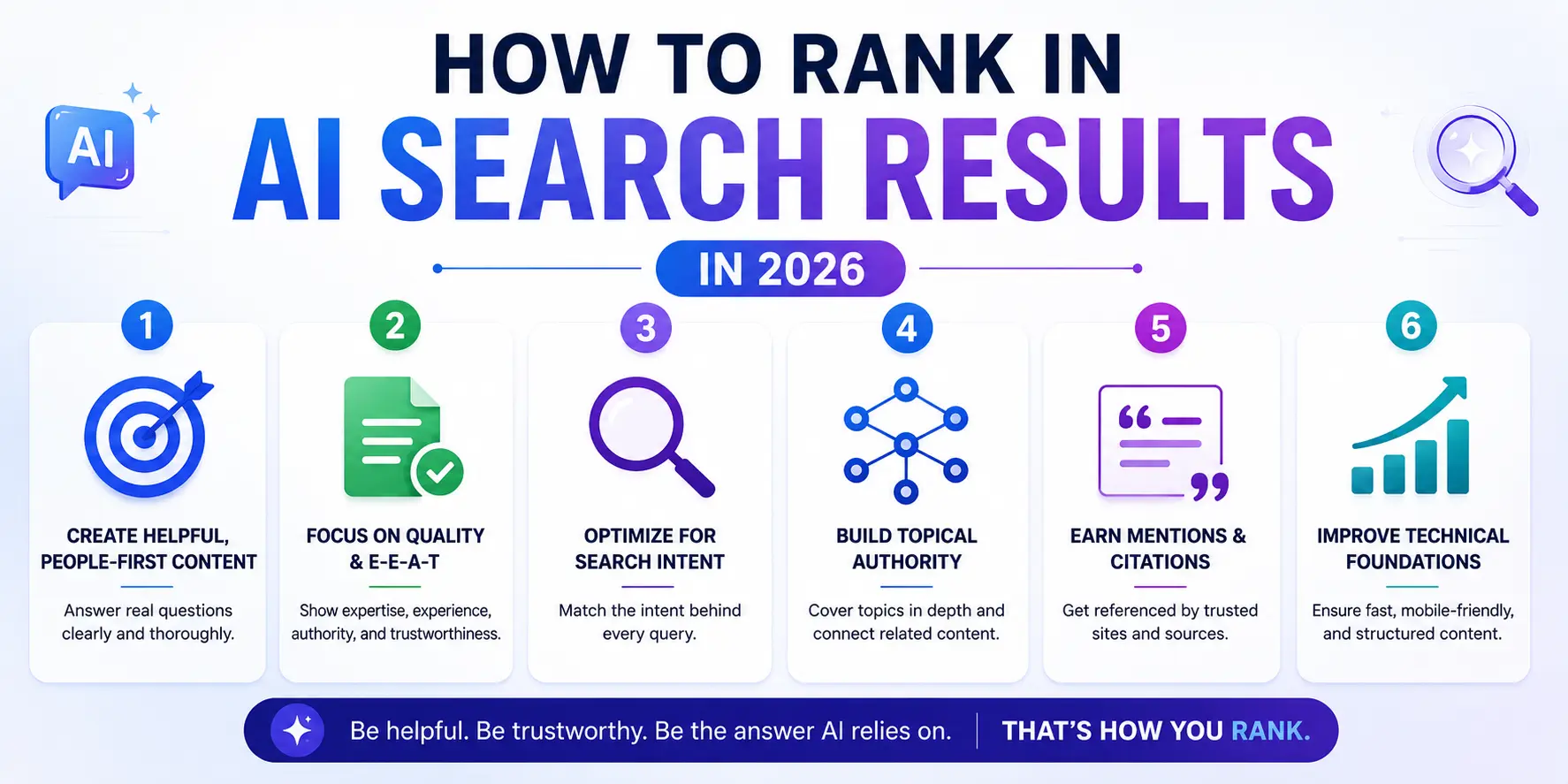
How to Rank in AI Search Results in 2026
Here's a number that should stop you cold: over 60% of Google searches in 2025 ended without a single click. And that was before AI Overviews became the default experience for hundreds of millions of users.
AI-generated answers aren’t just an add-on feature that is available for people to use; instead, they are becoming a new front door in 2026. So, if you are still optimizing your content for the blue links, then you are going to be invisible in this new era of digitalization.
No matter who you are- an SEO pro, a SaaS founder, or a content marketer trying to stay ahead, this article is going to help you with proven tips to rank in AI search results.
What Is AI Search and How Does It Work?
AI search isn't just a smarter autocomplete. It's a fundamentally different system.
Traditional search engines index pages and rank them by relevance signals — backlinks, keywords, page authority. You appear in a list. The user clicks. That's the model we spent 20 years optimizing for.
AI search does something else entirely. It reads across hundreds of sources, synthesizes an answer, and presents it directly — often without listing every source. Tools like Perplexity AI, ChatGPT Search, Google's AI Overviews, and Microsoft Copilot all work this way. They're not ranking pages. They're selecting sources to generate a response.
So the question shifts from "How do I rank #1?" to "How do I become the source AI trusts?"
Did you know? Google's AI Overviews now appear in roughly 47% of all U.S. searches, according to SEMrush data from late 2025. That's nearly half of all queries handled before the user ever scrolls.
How Are AI Search Results Different from Traditional SEO?
The difference isn't cosmetic — it's structural.
Traditional SEO rewards:
- High domain authority
- Exact-match keyword density
- Backlink volume
- Page speed and technical health
AI search rewards:
- Factual precision — AI models deprioritize vague or hedged claims
- Clear sourcing — content that cites data, studies, or named experts
- Semantic depth — covering a topic fully, not just hitting keywords
- Structured content — Q&A formats, tables, lists that are easy to extract
- Brand mentions — appearing in other trusted sources AI already reads
And here's the kicker: AI search doesn't care about your PageRank. A well-structured answer on a mid-authority site can get cited over a thin page from a DA-90 domain. That's a massive shift.
Real-world example: A SaaS company called Scalepad restructured their help docs to use clear Q&A headers and cited their own original research. Within three months, they started appearing in Perplexity answers for product comparison queries — without any link-building campaign.

What Is Generative Engine Optimization (GEO)?
Generative Engine Optimization (GEO) is the practice of optimizing content specifically for AI-generated search results.
It was formally defined in a 2024 Princeton/Georgia Tech research paper that found certain content modifications — adding statistics, citing authoritative sources, using quotation-style formatting — could increase content visibility in generative AI responses by up to 40%.
GEO isn't a replacement for SEO. Think of it as a layer on top. You still need solid technical foundations. But GEO adds:
- Answer-first writing — lead with the answer, then explain
- Named citations — reference specific studies, tools, or people
- Schema markup — especially FAQ, HowTo, and Article schema
- Fluent, quotable sentences — write lines that could be pulled verbatim into an AI answer
Quick tip: Read your content aloud. If any sentence sounds like a legal disclaimer or a textbook, rewrite it. AI models prefer confident, direct prose.
Read this: What is GEO (Generative Engine Optimization) in 2026
What Factors Influence AI Search Rankings?
This is where most guides get vague. Here's what the research and real-world testing actually shows:
1. Topical Authority
AI systems pull from sources they've "seen" behave reliably over time. If your site consistently covers a topic with depth — not width — you build what's called topical authority.
Don't try to cover everything. Be the best source on one thing.
2. E-E-A-T Signals
Google's own documentation now explicitly ties AI Overviews to Experience, Expertise, Authoritativeness, and Trustworthiness. That means:
- Author bios with real credentials
- First-person experience markers ("When I tested this tool...")
- Original data, screenshots, or case studies
(E-E-A-T section): Google's Search Quality Rater Guidelines
3. Structured, Extractable Content
AI models are essentially very good at reading and summarizing text. Make that job easy.
- Use H2/H3 headings that mirror the questions users ask
- Write explicit answers under each heading
- Use numbered steps for processes, bullet points for lists
- Include definition sentences (e.g., "GEO is...")
4. Brand Mentions Across the Web
This is underrated. If AI models see your brand cited on Reddit, in YouTube transcripts, on news sites, and in forums — they treat you as a legitimate entity. Work on off-page brand signals, not just backlinks.
5. Freshness
Perplexity and ChatGPT Search actively pull recent content. For fast-moving topics, publishing dates matter. Update old content with a visible "Last updated" timestamp.

AI SEO Strategy: A Step-by-Step Approach
Here's what I've seen work in 2026, condensed into a practical sequence.
Step 1: Audit your content for answer-readiness: Go through your top-performing pages and analyse how quickly they provide value to the reader. Does each page clearly address a specific question or intent within the first paragraph, or does the user have to scroll or read further to find the answer? If not, restructure it.
Step 2: Add FAQ sections to every major post: These aren't just good for featured snippets anymore. AI models pull Q&A pairs directly. Use FAQPage schema markup on every applicable page.
Step 3: Include original data or research: Even small surveys count. A study of 50 customers is more citable than a generic opinion. Publish findings as standalone posts, then link to them internally.
Step 4: Build your author entity: Make a really detailed author page, with your credentials your social profiles and the stuff you’ve already published. Don’t forget to add structured data. Google and AI tools can use it to double-check your expertise..
Step 5: Get mentioned, not just linked: Reach out to podcasts, newsletters, and industry publications , sure, but also ask for brand mentions in the real text not just a casual hyperlink. Mentions shows up in transcripts and articles, and that ends up helping AI models figure out your authority.
Step 6: Monitor AI search visibility: Use tools like Semrush's AI Overviews tracker, Authoritas, or BrightEdge to track when your content appears in AI-generated responses. This data is still new — but it's growing fast.
Can AI-Written Content Rank in AI Search?
Honestly — yes, but with conditions.
AI-generated content that's generic, unsourced, and lacks any original insight will get filtered out quickly. Both Google's systems and AI search tools are getting better at recognizing thin content, regardless of who or what wrote it.
But AI-assisted content — where a human adds original analysis, real examples, and clear expertise — can absolutely rank. The key word is assisted, not replaced.
The benchmark isn't "Is this AI-written?" It's "Does this answer the question better than anything else out there?"
Quick tip: Use AI to draft structure and pull research. Then add your own examples, opinions, and data before publishing. That combination outperforms both pure AI output and slow-produced human-only content.
Q&A: Common Questions About AI Search and SEO
Q: What is AI search and how does it work?
A: AI search is a system that is based on artificial intelligence to analyse any query and give output according to it. It gives results in the answer format instead of listing web pages. AI relies on LLM models to provide better and more direct responses to users’ questions.
Q: What is Generative Engine Optimization (GEO)?
A: GEO is an evolved form of SEO designed for the era of AI-driven search. It emphasizes optimizing content to feature in AI search results. It involves structuring content clearly, citing authoritative data, using schema markup, and writing in a quotable, direct style.
Q: What factors influence AI search rankings?
A: The main factors are topical authority, E-E-A-T signals, structured and extractable content formats, brand mentions across the web, and content freshness.
Q: How is SEO for AI search different from traditional SEO?
A: The SEO for AI search is quite different from the old SEO for search engines. The modern one is more AI-focused and aims to position your content in AI-generated answers rather than just appearing on search engines like Google. AI-focused SEO prioritizes making content a trusted source for AI answers by emphasizing accuracy, depth, and clear structure over backlink quantity.
Q: Can AI-written content rank in AI search?
A: Generic AI content rarely gets cited by AI search tools. But AI-assisted content that is refined by humans with original insight and clear sourcing has a much stronger chance of ranking well.
Expert Tips and Common Mistakes
What works:
- Writing definition sentences at the top of every section
- Using "As of [year]" datelines for time-sensitive facts
- Submitting your site to Bing Webmaster Tools (Copilot pulls from Bing's index)
- Linking to primary sources — research papers, official docs, government data
What kills your AI visibility:
- Hiding the answer behind a long intro (AI models skip fluff)
- Using jargon without explanation
- Publishing content that mirrors dozens of other articles with no original angle
- Ignoring schema markup — it's table stakes now, not optional
What's Next for AI Search
The pace of change here is real. In the next 12–18 months, expect:
- Multimodal search — AI answering queries using images, video, and audio as inputs
- Personalized AI answers — responses tailored to a user's search history and preferences
- AI agents making purchases — content that speaks to AI agents, not just humans, will become a distinct optimization category
- More attribution — pressure from publishers is pushing AI tools toward more visible source citation
The brands that build trust now — through depth, accuracy, and original content — will have a major head start when these features become standard.
Conclusion
Ranking in AI search in 2026 isn't some abstract future problem. It's already deciding which brands get seen and which get skipped entirely. The shift is real: AI search rewards trust, clarity, and depth over keyword tricks. The good news is those things are achievable — if you build your content strategy around them.
Start with the basics. Structure your content to answer questions directly. Add schema. Build your author entity. Get mentioned in places AI models already trust. And track your AI search visibility the same way you track keyword rankings.