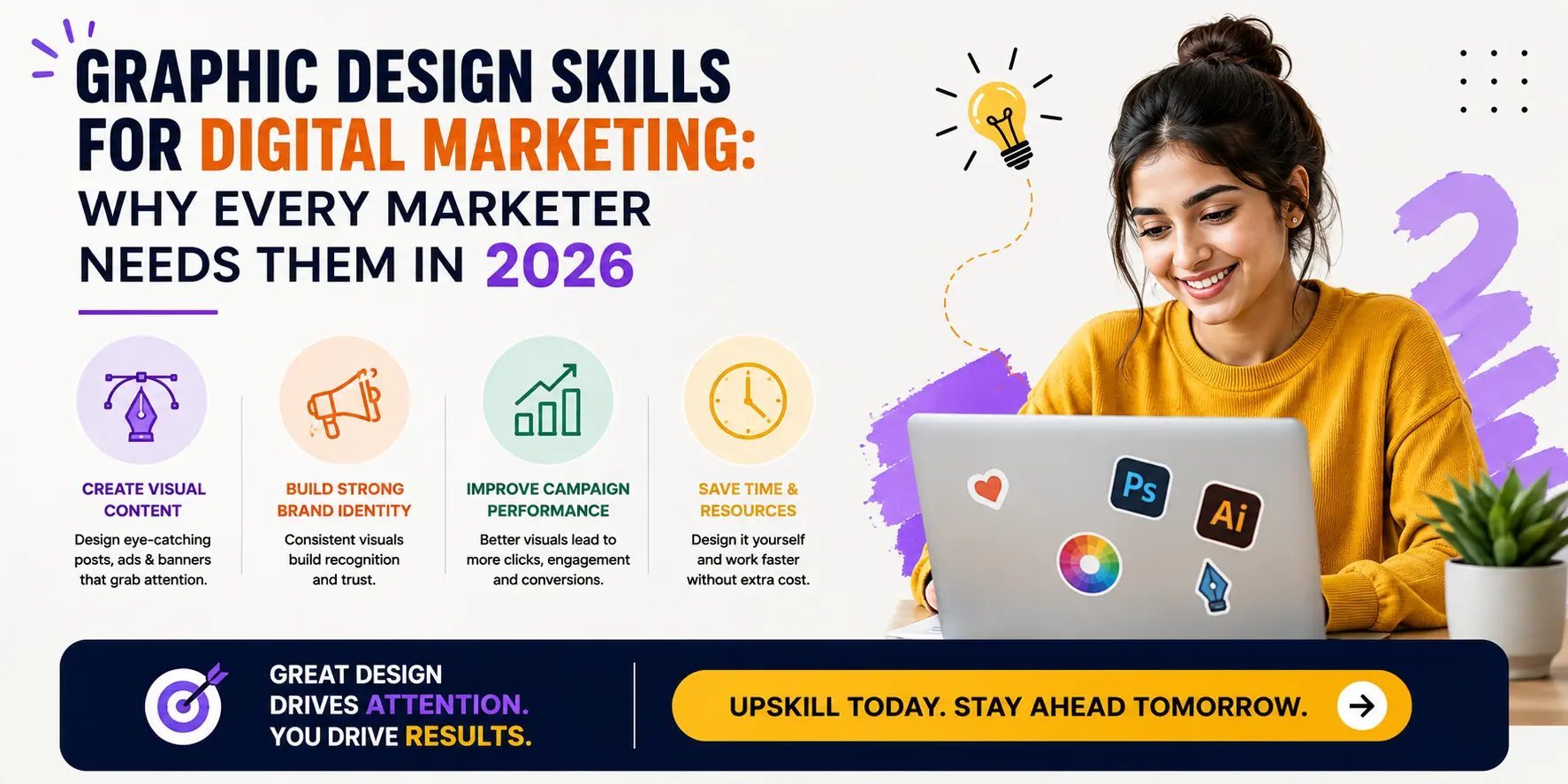
Graphic Design Skills for Digital Marketing: Why Every Marketer Needs Them in 2026
Quick answer: graphic design skills for digital marketing matter because visuals are usually what decide whether a message gets noticed at all, let alone remembered or shared. A marketer who understands typography, color theory, layout, and brand consistency can put out campaigns that load faster, rank better, and actually convert — without having to wait on a design team to turn around every single asset.
This guide walks through why graphic design skills for digital marketing have quietly become non-negotiable, which specific skills matter most, how they play out across channels like social, email, SEO, and paid ads, and how to start picking them up even if you've never touched a design tool before.
Why Visual Communication Matters in Digital Marketing
People are scrolling past hundreds of pieces of content a day — tweets, newsletters, blog headers, product ads, the odd Reel. In that much noise, visual content marketing tends to win attention faster than plain text ever will. A graphic that stops the scroll gets maybe half a second to earn a click. A wall of text often doesn't even get that.
That's really the whole reason graphic design in digital marketing stopped being a "nice to have" left to a specialist team somewhere down the hall. It's a functional skill now, and it shapes:
- Whether a social post gets shared or scrolled past
- Whether an email gets opened and clicked, or quietly archived
- Whether a landing page holds a visitor long enough to convert
- Whether a brand looks credible enough that someone hands over their money
Even a marketer with fairly basic design skills can turn a plain announcement into an infographic, a boring data table into something people actually share, or a generic banner into something that feels like the brand — without leaning on a design department for every little thing.
How Graphics Drive Storytelling and Emotional Connection
Good marketing runs on storytelling, but design is what actually makes a story land. Color, typography, and imagery carry tone and emotion in a way copy alone struggles to — a warm palette with a rounded typeface says something very different than a stark, high-contrast layout does, even before anyone reads a word.
People remember stories, not statistics floating on their own. A stat like "open rates rose 12%" is forgettable on its own, but wrap it in a well-designed graphic and it becomes something a reader might actually recall a week later. That's often the difference between a campaign nobody remembers and a brand people come back to.
Core Graphic Design Skills Every Digital Marketer Should Know
Marketers don't need to become full-time designers. But having a working handle on these four fundamentals changes the quality of pretty much everything a marketing team puts out.
1. Typography
Typography is about arranging text so it's legible and pleasant to read — not just picking a font because it "looks nice." For marketers that mostly comes down to:
- Using font hierarchy (size, weight) so the eye lands on the key message first
- Sticking to fonts that match the brand style guide
- Prioritizing readability on mobile, since that's where most traffic lands anyway
2. Color Theory
Color shapes perception before anyone reads a single word. Blue usually reads as trustworthy and calm, red tends to signal urgency, green often gets tied to growth or sustainability — a connection the Interaction Design Foundation covers in depth as part of core color theory. Marketers who get color theory can pick palettes that actually reinforce the brand's personality instead of working against it, and keep that consistent across every touchpoint.
3. Composition and Layout
Good composition guides the eye toward whatever matters most — a headline, a CTA button, a product shot. A cluttered, unbalanced layout adds cognitive load and pushes people away; a clean, deliberate one does the opposite.
4. Visual Consistency
A brand that's instantly recognizable across channels — same colors, same fonts, same visual language — builds more trust over time than one that looks different everywhere it shows up. Of all the design skills on this list, visual consistency is probably the simplest one to learn and the one with the highest payoff, because it compounds with every asset a brand puts out.
The Role of Graphic Design in Branding and Brand Identity
Brand identity gets built through repetition and consistency, full stop. Every logo variation, social template, email banner, and website graphic either reinforces that identity or chips away at it.
This is really what graphic design for marketers comes down to: keeping a unified visual presence across every channel a brand touches, so people recognize it instantly whether they land on an Instagram ad, an email, or a product page.
None of this is just cosmetic, either. Consistent branding is tied directly to trust, and trust is what actually drives conversions in the end.
Designing Visuals That Reflect Brand Values
Good design also communicates something about a brand without saying a word. A SaaS company might lean into clean, minimal design to signal innovation. A skincare brand built around natural ingredients might reach for earthy tones and organic shapes instead. Marketers with some design literacy can make these calls on purpose, rather than defaulting to whatever template happens to be fastest.
How Graphic Design Skills Benefit Every Channel in Digital Marketing
Different channels call for different visual formats, but design skill improves the outcome across all of them.
Social Media Marketing
Instagram and Pinterest are built around visuals first. Marketers who understand image dimensions, safe zones for text, and platform-specific formatting end up with posts that actually perform, instead of visuals that get cropped oddly or scrolled past.
Content Marketing
Long unbroken blocks of text push readers away. Breaking things up with relevant visuals — charts, custom illustrations, pull-quote graphics — keeps people on the page longer, which helps both engagement metrics and SEO.
Email Marketing
A cluttered, text-heavy email loses to a well-structured one with a clear visual hierarchy almost every time. A strong header image and a well-placed CTA button are small decisions that end up having an outsized effect on click-through rate.
SEO and Website Optimization
Search engines look at pages partly through user experience signals — bounce rate, time on page, load speed. Oversized or poorly compressed images slow a site down and hurt all three at once, which is why Google's own image SEO guidance puts site speed near the top of its recommendations. Marketers who understand basic image optimization — the right file size, format, alt text — end up supporting their site's SEO without needing any real design specialization.
Paid Advertising
On Google, Meta, and Instagram, ad creative is often the single biggest lever on performance, bigger than copy or targeting in a lot of cases. Marketers who can build or brief strong creative tend to see better click-through rates and a lower cost per result.
Beginner-Friendly Tools for Learning Graphic Design as a Marketer
None of this takes years of design school. A handful of accessible tools let marketers put together decent, on-brand visuals without much of a learning curve:
- Canva — Template-driven, drag-and-drop, covers social posts, blog graphics, presentations, and ads. Probably the fastest way in for most marketers.
- Adobe Express (formerly Adobe Spark) — Built for graphics, short video stories, and simple web pages, no deep design training required.
- Crello / VistaCreate — A Canva alternative with a solid template and design-element library aimed at marketing assets.
These tools were built specifically for non-designers, which is exactly why they've become the default in most marketing workflows.
The Impact of Visuals on Engagement and Consumer Behavior
Industry research keeps pointing the same direction: HubSpot's own analysis shows content with visuals tends to outperform text-only content on shares, click-through rate, and recall, and people simply process and retain visual information faster than plain text. This isn't some marginal effect either — it shows up across social, email, and paid ads alike, which is part of why visual literacy has turned into a measurable digital marketing skill rather than staying a creative extra.
Inforgraphics and custom illustrations are especially good at simplifying dense information — survey results, product comparisons, industry data — into something a reader can take in within seconds and is a lot more likely to actually share.
Design-Driven Content Strengthens Campaigns
Design touches nearly every high-performing campaign format out there:
- Data Visualization — Turning raw numbers or survey results into charts makes them instantly scannable.
- Video Marketing — Text overlays, motion graphics, and animation elevate storytelling in the format people are engaging with most right now.
- Social Proof — Testimonial and case-study graphics build credibility faster than a plain quote sitting alone on a page.
Where DizitalAdda Fits Into This
Picking up Canva or Adobe Express solves the tool problem. It doesn't solve the strategy problem — knowing when to use a bold color palette versus a muted one, why a certain layout converts better on a landing page than another, or how a graphic should change depending on whether it's headed to Instagram, an email, or a paid ad. That's the gap between knowing a tool exists and actually using it well.
This is where DizitalAdda comes in. Rather than treating design as a bolt-on skill taught in isolation, DizitalAdda folds graphic design fundamentals — typography, color theory, layout, brand consistency — directly into its Digital Marketing curriculum, alongside SEO, paid ads, content strategy, and email marketing. The idea is simple: a marketer shouldn't have to bounce between five different courses to understand how design decisions actually move campaign metrics.
A few things that make the DizitalAdda approach worth mentioning here:
- Mentor-led, not just video lectures. Design judgment is hard to build from a checklist alone; it helps to have someone review actual work and explain why one version of a graphic outperforms another.
- Design taught in context, not isolation. Instead of a standalone "intro to Canva" module, design skills are tied directly to the channel they'll be used on — social, email, SEO, paid — so the learning sticks to something practical.
- Built for marketers, not aspiring designers. The goal isn't to turn students into full-time designers. It's to get them fluent enough to brief a design team properly, make faster creative calls, and build solid visuals themselves when there's no time to wait on anyone else.
Frequently Asked Questions
- Do digital marketers need to be professional graphic designers?
Not at all. If you are a digital marketer then you don’t need to get any extra professional training. The reason behind is that while doing the digital marketing training you can build your graphic design skills by working simultaneously on typography, color theory, layout and brand consistency. Rest the tools like canva are enough for you to become a proficient graphic designer. - How does graphic design affect SEO?
Mostly indirectly — through page speed, bounce rate, and time on page, which are all signals search engines factor into rankings. Correctly sized, compressed images with descriptive alt text support better rankings, and none of it really requires design specialization. - What's the easiest way for a marketer to start learning graphic design?
Start with a template-based tool like Canva, focus on one skill at a time — typography first, then color theory — and study the brand guidelines of companies you admire. A structured course, like the design modules built into a digital marketing program, can speed this up quite a bit. - Which graphic design skill has the biggest impact on marketing results?
Visual consistency is one of the most valuable skills marketers can develop because it strengthens brand recognition across different channels and customer touchpoints. Good composition and layout are also essential because they determine how easily people notice, understand, and interact with your message. - How much time does it realistically take to get comfortable with graphic design as a marketer?
Most marketers can become proficient in a few weeks of regular practice. The basics — typography, color, layout, and consistency — are simple; improvement comes from repetition. Even 30–60 minutes a few times a week using Canva and studying strong brands can lead to noticeable progress within a month. - Can strong graphic design skills make up for weaker copywriting, or do marketers need both?
Design and copy work together. Design grabs attention, while copy turns that attention into clicks, signups, or sales. Great design with weak copy — or strong copy with poor design — can both underperform. The best campaigns treat design and copy as one combined strategy.
Conclusion
Graphic design skills for digital marketing aren't really optional anymore in a landscape where attention gets won or lost in seconds. From branding and social media to email, SEO, and paid ads, visual literacy ends up shaping almost every outcome a marketer gets measured on — engagement, click-through rate, conversions, brand recall, all of it.
Marketers don't need to replace designers. They just need enough design fluency to make sharper creative calls, brief teams properly, and build strong visuals on their own when the moment calls for it. That combination — marketing strategy plus a bit of design literacy — tends to be what separates the average campaigns from the ones that actually convert.
Want to build these skills alongside a full digital marketing skill set? Explore DizitalAdda's Digital Marketing courses for structured, mentor-led training that covers design fundamentals as part of a complete marketing curriculum.