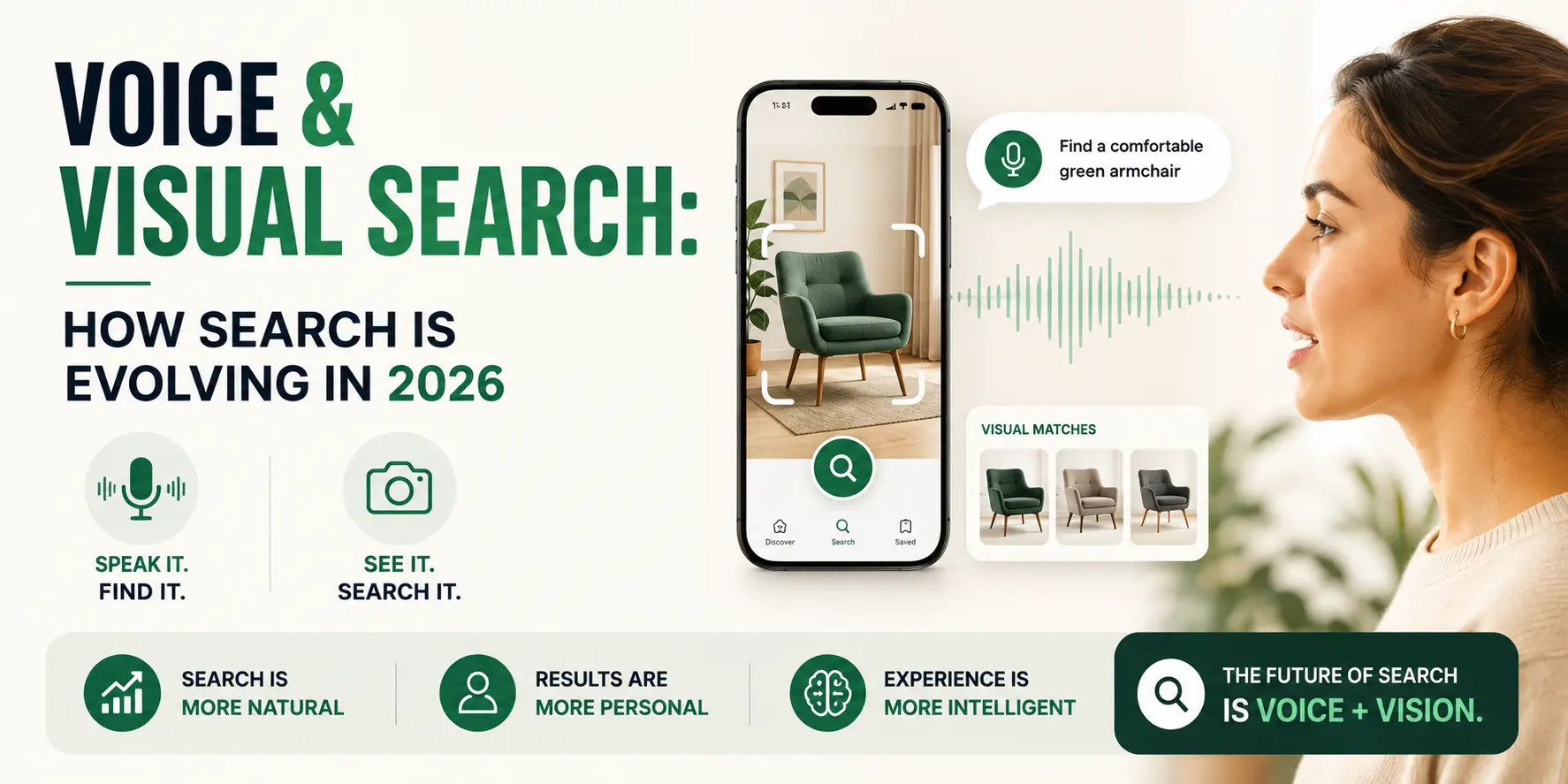
Voice Search and Visual Search: How Search Evolved and How to Optimize for It
We've all done it: pointed our phone camera at something we couldn't name, or asked a question out loud instead of bothering to type it. These aren't niche behaviors anymore. Voice and visual search started as experimental add-ons, but they're now built into how Google's main products work, and the line between the two is blurring fast. This guide walks through how we got here, how the major tools actually work, where they still fall short, what it all means if you run a business, and how to make sure your site shows up in both.
Key takeaways
- Visual search isn't a niche habit anymore. Google says Lens now handles nearly 20 billion visual searches a month, and one in five of those is shopping-related.
- Voice and camera are converging into what's called multimodal search. With Search Live, people in over 200 countries can now talk to Search while showing it what they see.
- Neither is replacing text search. Each simply fits certain moments better than typing does.
- Speech recognition still isn't equally accurate for everyone, which is worth knowing before you lean too heavily on voice as an interface.
- Businesses that invest in structured data, clear imagery and natural, conversational content are the ones best placed as search keeps moving away from the keyword box.
What is voice search?
It's exactly what it sounds like: asking a question out loud instead of typing it, whether that's through a phone assistant, a smart speaker, or the Google app itself. Behind the scenes, your speech gets converted to text, the search runs, and you get an answer back, sometimes spoken aloud. One thing worth noting: people tend to ask voice questions the way they'd ask a person, in full sentences, not clipped keywords.
What is visual search?
Instead of describing what you're looking at, you show it. Snap a photo, upload one, circle something on your screen, or just point your camera at it, and the system figures out what it's seeing and surfaces relevant results. It really shines in the moments where words fail you: an unfamiliar product, a plant you can't name, a landmark you don't recognize.
How voice search and visual search evolved
Visual search platforms and tools today
Google Lens is the largest visual search tool. Google's CEO said at I/O 2025 that Lens grew 65% year over year, with more than 100 billion visual searches already that year. Google has also said Lens queries are among the fastest-growing query types on Search, with users aged 18-24 engaging most. For shopping, Google says it combines its AI with the Shopping Graph to show details like price, reviews and where to buy.
Circle to Search lets you search from any screen by circling, highlighting or tapping something, without switching apps.
Pinterest Lens focuses on inspiration and related ideas. Snapchat's visual search connects the camera to Amazon products.
Multimodal search: voice and camera together
Multimodal search means using more than one input type, such as speech, images and video, in a single search. Google's Search Live is the clearest example. You open the Google app, tap the Live icon under the search bar, and ask questions aloud or show your camera to get real-time help. You can also reach it through Google Lens. It is powered by Gemini 3.1 Flash Live, which Google describes as inherently multilingual. Availability depends on where AI Mode is offered, so check your country before assuming it applies to your audience.
Voice search vs visual search: which works best when?
The two aren't competitors. Search Live shows where Google is heading: letting people combine both in one interaction, asking a question while pointing the camera at something, rather than picking one mode over the other.
Challenges and limitations
- Unclear intent. A photo could mean "what is this?", "where can I buy it?" or "translate the label." Text queries state intent directly; images often don't.
- Uneven speech recognition. A 2020 Stanford study found five leading systems misunderstood 35% of words from Black speakers versus 19% from white speakers, with similar risk for regional and non-native accents. The study is from 2020, so accuracy may have improved since.
- AI accuracy. AP's report on Google's Lens updates noted that AI can sometimes produce misleading information, a risk that applies to any AI-generated answer.
- Privacy considerations. Photos and voice queries carry more personal context than typed keywords, so it's worth understanding how each platform stores and uses that data.
- Accessibility trade-offs. Both modes help some users but depend on hardware and a stable connection, so text search remains the most reliable fallback.
- Cost for businesses. Visual search optimization means maintaining accurate images and structured data on an ongoing basis, more upkeep than text metadata alone.
What this means for businesses
Voice and visual search shift some of the work away from users typing precise keywords and onto the business to represent its products and information clearly enough for AI systems to interpret. A few general examples of how this plays out:
- A retailer with well-photographed products from multiple angles, accurate structured data, and an up-to-date product feed is more likely to appear when a shopper points their camera at a similar item or scans a barcode. A retailer without this may simply be invisible in these results, regardless of how well their site ranks in traditional text search.
- A local service business (a restaurant, a repair shop) benefits from keeping its name, hours, address and offerings consistent and accurate across its site and listings, since voice assistants and Search Live often answer location-based questions directly rather than showing a list of links.
- A content publisher or course provider benefits from writing in a natural, question-and-answer style, since that format is easier for both voice assistants and AI-generated answers to lift directly.
None of this requires guessing at exact ROI figures, since those vary heavily by industry and aren't something we can responsibly state without your own data. The common thread is that content and product information built for humans to skim is not always structured well enough for an AI system to interpret; add clear structure on top of it.
Voice search optimization: what to do
- Answer questions directly. Put a short, clear answer right under each question-style heading.
- Write conversationally. Use natural phrasing that matches how people speak.
- Add FAQ sections for common questions, with FAQ structured data where appropriate.
- Keep business details accurate. Address, hours and contact information should be consistent everywhere they appear.
- Make pages load quickly and work well on mobile, since most voice and camera searches happen on phones.
Visual search SEO: what to do
- Use original, clear images from several angles rather than generic stock photos.
- Name image files and write alt text descriptively, for example "blue-running-shoes-side-view" rather than "IMG_2041."
- Add structured data, such as Product markup, if you sell online, and keep your Google Merchant Center feed accurate. Check Google Search Central's documentation for current requirements.
- Place images near relevant text so search engines understand the context.
- Publish useful video and image content, since Google's newer tools work with both.
- Track results in Search Console. Voice and visual traffic usually isn't labeled separately, so watch overall image and query trends.
What this means for your SEO strategy going forward
As search shifts toward voice, visual and AI-generated answers, a few strategic shifts follow, without needing to abandon standard SEO practice:
- Structure still matters, arguably more. Clear headings, direct answers and structured data help both traditional crawlers and AI systems parse your content.
- Depth beats keyword density. A page that fully answers a topic in one place, the way this guide tries to, is more likely to be pulled from by AI Overviews or a chatbot than a page that lightly touches many keywords.
- Original material carries more weight. Your own images, your own tested screenshots and your own data are harder for competitors and AI summaries to duplicate.
- Multi-platform presence helps. Since AI answer engines often pull from a range of sources beyond a single website, a visible, credible presence across your own content, and mentions elsewhere, supports your visibility over time.
FAQs
- What is the difference between voice search and visual search?
Voice search uses spoken words as the query, while visual search uses an image or camera feed. - What is multimodal search?
Search that combines several input types, such as voice, images and video, in one interaction. - Is Google Lens the same as Search Live?
No. Lens is Google's visual search tool, while Search Live is a voice-and-camera conversation inside AI Mode. You can also open it from within Lens. - Can Google identify a song from humming?
Yes. Hum to Search launched in 2020. - How do I optimize for voice search?
Answer questions directly, write conversationally, add FAQs and keep your business details accurate. - How do I optimize for visual search?
Use original images, descriptive file names and alt text, structured data and accurate product feeds. - Will voice and visual search replace typing?
Nothing I found shows that. They add options, and text search remains widely used. - Is visual search accurate for every kind of object?
Not always. It works best for clearly identifiable items like products, landmarks and plants, and less reliably for ambiguous or unfamiliar images. - Does voice search work the same for every accent or language?
Not necessarily. Research has shown accuracy gaps for some speakers, though search providers continue to update their systems. - Do I need a separate strategy for AI search tools like ChatGPT or AI Overviews?
Not an entirely separate one. The same fundamentals, clear structure, direct answers and credible original content, tend to help across both traditional search and AI-generated answers.
Conclusion
Voice search and visual search are now part of Google's core experience, and Google is combining them with AI through tools like Google Lens and Search Live. For businesses, the practical steps are to improve images, structure content clearly, answer questions directly and monitor results. To see what Google's newest tools can do in detail, read our guide to Google's AI visual and audio search tools.
Sources:-
- Retail Brew (Oct 2024): Lens statistics and Shopping Graph
- TechCrunch (May 2025): Pichai at I/O 2025
- Google blog, "Search Live is expanding globally" (March 2026)
- Forbes (March 2026): Search Live's Sept 2025 launch
- Fortune/AP (Oct 4, 2024): Lens voice and video
- 9to5Google (Oct 2020): Hum to Search
- Wikipedia (Google Lens and Circle to Search dates; cross-check with Google's announcements)
- Business Insider and CNBC (2017): Pinterest Lens
- Marketing Dive (Sept 2018): Snapchat and Amazon
- Stanford News (March 2020): speech recognition study