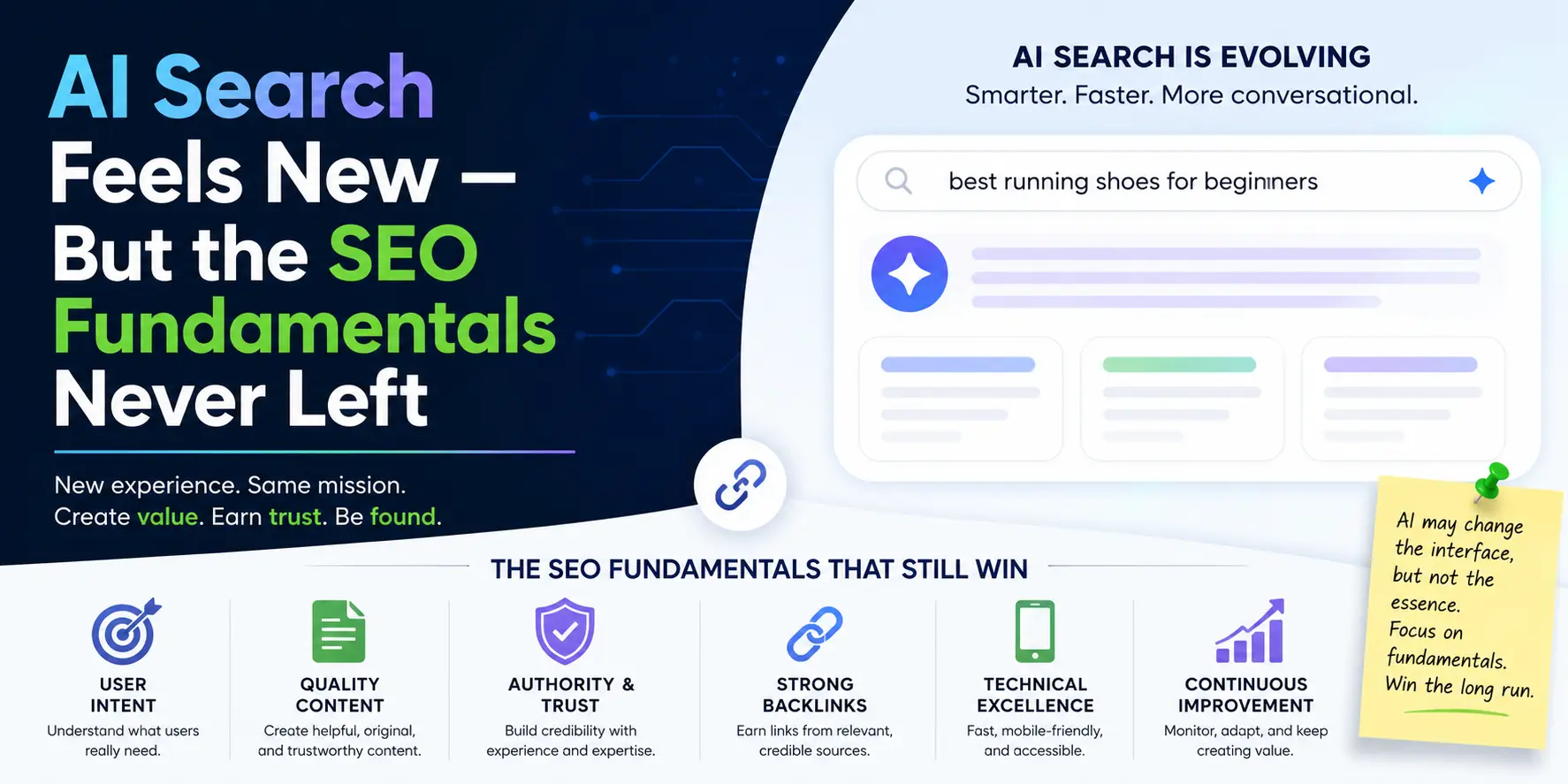
AI Search Feels New — But the SEO Fundamentals Never Left
Quick Summary
- AI search "feeling" disruptive is mostly a symptom of shallow SEO practice, not proof that the rules changed overnight
- Strong AI search fundamentals — entity consistency, topical depth, structured content — are almost identical to what good SEO always asked for
- The GEO vs. AEO vs. SEO naming debate is mostly a distraction from the real issue: many sites skipped the fundamentals in the first place
- Marketers who focused on genuine expertise and consistent signals are already doing fine in AI-generated results, without changing much
- The practical fix isn't a brand-new playbook — it's finally getting the fundamentals right
Introduction
If you're a marketing student, a working professional, or a business owner in India watching AI Overviews and chatbot-style search results take over your feed, you've probably felt a version of this panic: "SEO is dead," "we need a whole new strategy," "nobody actually knows the rules anymore." Take a breath — that panic usually says more about how solid someone's SEO fundamentals were before AI search showed up than about AI search itself.
The Real Divide: Deep Work vs. Shallow Work
It's tempting to treat AI search as a brand-new discipline, separate from SEO altogether — the interface looks different, the results feel different, and website traffic has shifted. But the mechanics that decide whether your content gets surfaced, trusted, and quoted haven't been rebuilt from scratch.
What's actually changed is which shortcuts still work. Thin, keyword-stuffed pages built purely to rank — without real depth, real expertise, or consistent brand signals behind them — were already on shaky ground before AI search arrived. AI-generated answers have simply made that weakness show up faster, by skipping past surface-level pages in favor of sources that clearly know what they're talking about.
Two Races, Nearly the Same Training
Here's an analogy that makes this easier to picture: training for classic Google rankings and training for AI search are a bit like training for a 100-meter sprint versus a 60-meter sprint. Technically two different races, and the winner in each may not be identical — but almost all the training overlaps. Speed, form, and conditioning carry across both.
The same logic applies to AI search fundamentals: real topical authority, consistent information about your brand across the web, content built around the actual questions people ask, and genuine expertise — these are exactly what both classic search rankings and AI-generated answers reward. If you feel like you're starting from zero, it's usually because your old approach leaned on tactics that worked in SEO's weaker corners, not on the fundamentals themselves.
What Strong AI Search Fundamentals Actually Look Like
If your content already had the following, AI search isn't asking you to start over. It's simply continuing to reward what good practice always looked like:
- Entity consistency — your brand, people, products, and claims described the same way across your website, listings, and outside mentions, so both search engines and AI tools can confirm who you are
- Topical depth, not just topical coverage — content that answers the natural follow-up questions a reader (or an AI model) would have, not just the headline query
- Structured, extractable content — clear headings, direct answers placed early, and formatting that makes it simple to pull out a specific fact or step
- Genuine expertise signals — real author credibility, first-hand detail, and specificity, instead of generic writing that reads like a summary of other summaries. This lines up closely with Google's own guidance on creating helpful, reliable, people-first content, which has anchored E-E-A-T (Experience, Expertise, Authoritativeness, Trust) for years — well before "AI search" was a category of its own
- Consistent citations and mentions — being referenced accurately across other credible sites, doing for AI trust roughly what backlinks did for classic rankings
None of this is a new checklist invented for 2026. It's the same standard good SEO practitioners were already pushing toward — AI search has just made it non-negotiable.
Why the GEO vs. AEO vs. SEO Debate Is a Distraction
A lot of energy in the marketing world right now goes into arguing over what to call this — Generative Engine Optimization, Answer Engine Optimization, or simply "SEO, but for AI." That's an interesting conversation, but it often stands in for a harder one: whether the fundamentals were solid to begin with. Technical SEO consultants making this same point have noted that debating labels is easier than admitting the basics were skipped.
For a marketer or a business owner, the takeaway is simple: don't wait for the industry to settle on a name before doing the work. Whatever your team calls it, the actions that actually move results stay the same.
Must read: Google AI Search Evolution: AI Mode Arrives in India
Building Real AI Search Fundamentals: Where to Start
If you're shaping a strategy — or learning one — here's where your time is better spent than chasing a "brand-new AI SEO playbook":
- Audit for shallow content first. Find pages that answer a query only at the surface, with nothing underneath worth citing.
- Fix entity consistency across the web, not just your own site — directories, social profiles, and third-party mentions should all describe your brand the same way.
- Go deeper on your best-performing topics instead of spreading thin across more keywords. Depth is what earns citations in AI-generated answers.
- Structure content for extraction — direct answers, clear headers, and Q&A-style sections make it easier for both search engines and AI tools to use your content. Google's own guide to optimizing for generative AI features makes largely the same point: technical clarity and existing SEO best practices are what determine whether a page is even eligible to be pulled into an AI-generated answer.
- Stop chasing the terminology debate. Whether your team calls it SEO, GEO, or AEO, strong AI search fundamentals look the same either way.
If you're serious about building AI search fundamentals the right way — not chasing shortcuts that stop working every few months — that's exactly what we cover in DizitalAdda's Expert Digital Marketing Course.
Frequently Asked Questions
Q1: Is AI search really that different from traditional SEO?
A: Not as different as it feels day to day. The core AI search fundamentals — entity consistency, topical depth, structured content, and genuine expertise — matter for both classic rankings and AI-generated answers. What's changed is that weak, shallow content now gets exposed faster.
Q2: Do I need a completely separate strategy for GEO or AEO?
A: Not a completely separate one. Most of what gets labeled GEO or AEO overlaps heavily with solid SEO practice. If your fundamentals were already strong, you're adapting existing work rather than starting over.
Q3: Why do some brands rank well on Google but barely show up in AI-generated answers?
A: Often because their Google rankings leaned on tactics — like backlink volume or narrow keyword targeting — that don't automatically carry over into AI trust signals like entity consistency and topical depth. Ranking well and being cited by AI aren't governed by exactly the same signals.
Q4: Do backlinks still matter for AI search visibility?
A: They still help, but they're no longer the whole story. What matters more now is being mentioned accurately and consistently across credible sources, which builds the kind of trust AI models look for — backlinks are one part of that picture, not the entire strategy.
Q5: I'm just starting to learn SEO — should I learn "AI SEO" separately?
A: No. Learn SEO properly first — entity building, topical depth, structured content, genuine expertise. Once those fundamentals are solid, applying them to AI search is a small extension, not a separate subject.
Q6: What's the single highest-impact thing to fix first?
A: Depth. Pages that only skim the surface of a topic are the easiest for AI systems to skip over in favor of sources that actually explain the "how," not just the "what."
Key Takeaways
- AI search hasn't replaced SEO — it's exposed which sites never had strong AI search fundamentals to begin with
- Deep, structured, entity-consistent content wins in both classic search and AI-generated answers
- The SEO vs. GEO vs. AEO naming debate is largely a distraction from the real work
- The fastest fix for most sites is auditing for shallow content and building real topical depth
- Marketers who nail the fundamentals don't need a separate "AI search strategy" — they need to keep doing the work properly