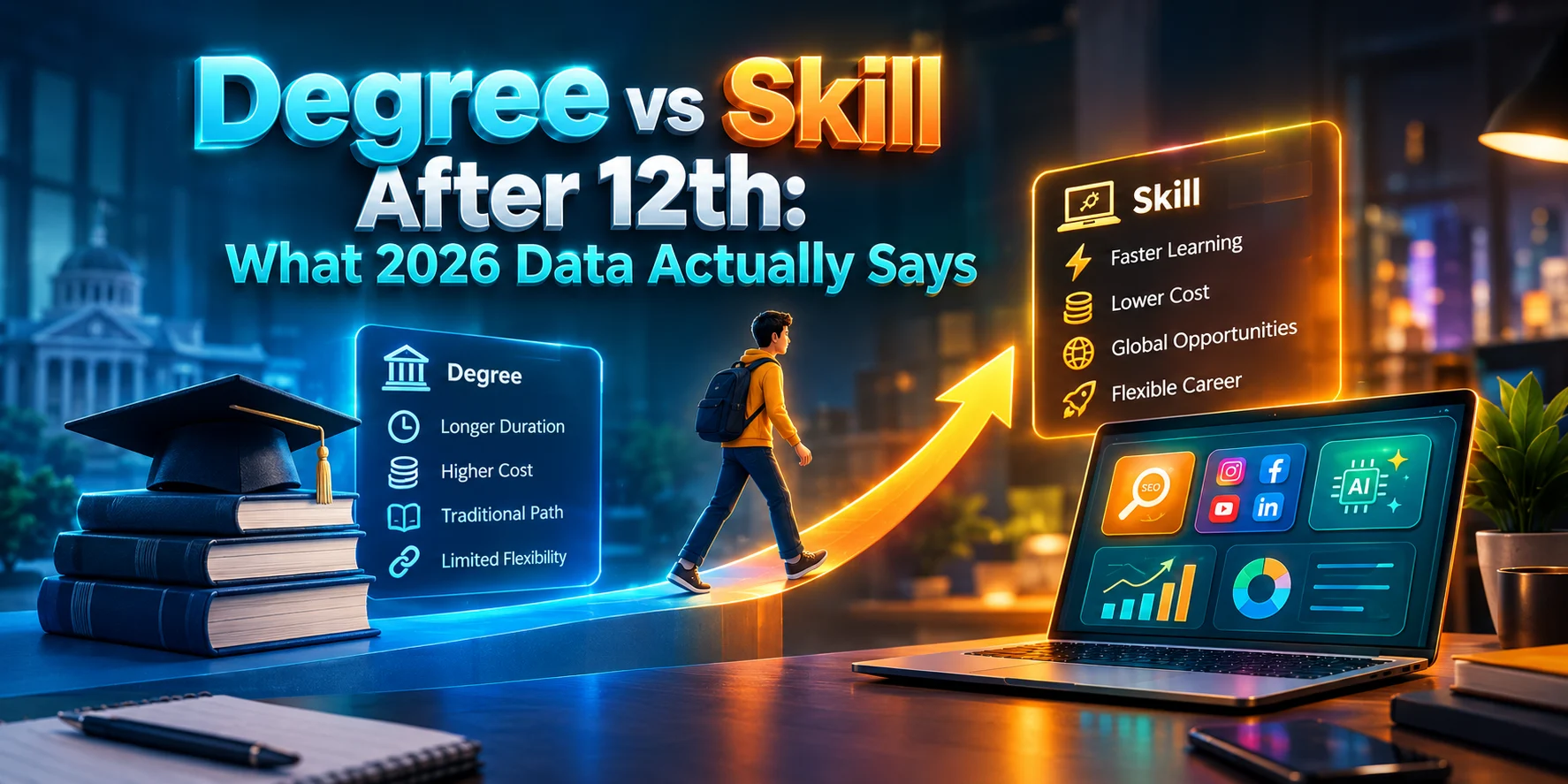
Degree vs Skill After 12th: What 2026 Data Actually Says
Quick answer
- A degree and a marketable skill are no longer either/or — but if you had to prioritize one first after 12th, skill-readiness matters more than the degree label itself.
- Nearly 40% of India's young graduates (15–25 age group) are unemployed, per the State of Working India 2026 report.
- Meanwhile, skill-based fields like digital marketing keep growing, driven by rising ad spend and digital adoption.
- The smartest move isn't "degree OR skill" — it's a degree run in parallel with a job-ready skill, so you graduate already employable instead of starting your job search from zero.
Most articles answering "after 12 which degree is best" hand you a list: Engineering, Medicine, Commerce, Arts, Digital Marketing — pick one. That list hasn't changed much in a decade. What has changed is what happens to the people who follow it. This piece skips the list and looks at what actually happens to graduates after they pick, using recent employment data, so you can decide with evidence instead of guesswork.
The Real Question Isn't "Which Degree" — It's "Degree or Skill?"
Ask any student what to study after 12th, and the answer usually assumes a degree is the goal and the only question is which one. That assumption is worth challenging.
A degree used to function as a proxy for "employable." Employers trusted it because there wasn't a faster way to verify what a 21-year-old could actually do. That proxy is breaking down. Employers increasingly hire for demonstrated, current skills — a portfolio, a certification, a working knowledge of tools — rather than a degree alone. Meanwhile, the number of people holding degrees has grown far faster than the number of graduate-level jobs available to absorb them.
That mismatch is the real story behind every "after 12 which degree is best" search. It's less about which subject and more about whether your education makes you ready to work by the time you finish it.
What the Data Says About the Traditional Degree Path
The numbers are more sobering than most career-advice articles let on.
- State of Working India 2026 (Azim Premji University, March 2026): ~40% unemployment for graduates aged 15–25, ~20% for ages 25–29.
- Only 5–7% of young male graduates land a permanent salaried job within a year of graduating (Business Today, The Wire).
- India added 6.3 crore graduates (2004–2023), but jobs didn't keep pace — 1.1 crore left unemployed as of 2023.
- India Skills Report 2026 (ETS/Wheebox, CII, AICTE, AIU, Taggd): employability at ~80% (CS/IT), 62.81% (Commerce), 61% (Science), 55.55% (Arts); MBA dropped to 72.76% from 78%. (Careers360)
The takeaway isn't "don't get a degree." It's that the degree alone is no longer a guarantee of a job — the field you pick and the practical skills you build alongside it matter more than they used to.
What the Data Says About the Skill-Based Path — Using Digital Marketing as the Case Study
Skill-based careers don't come with a guaranteed outcome either, but the demand-side numbers look different.
- dentsu-e4m Digital Advertising Report 2026 (10th edition, Feb 2026): India's digital ad spend grew 19% YoY to ₹71,621 crore in 2025, projected to hit ₹98,034 crore by 2027 (17% CAGR) — rising from ~59% to ~70% of total ad spend.
- Ad spend growth is a direct hiring signal: bigger digital budgets mean more demand for SEO, performance-marketing, content, and analytics roles. Key sectors driving this: e-commerce, BFSI, retail media.
- No specific degree required — skill and portfolio matter more than the certificate, so Commerce, Arts, and Science students all move into digital roles without friction.
- Comparable entry-level salaries to traditional degree fields, but a shorter time-to-first-job — a 3–12 month skill course vs. a 3–4 year degree.
The trade-off: a skill-based path gives you speed and current market relevance, but it doesn't carry the same institutional credibility, regulatory recognition, or long-term ceiling that certain degrees (medicine, law, government services, core engineering) still offer.
Degree vs Skill: Side-by-Side Comparison
When a Traditional Degree Still Makes Sense
Skip the skill-first path if you're aiming at:
- Regulated professions — medicine, law, chartered accountancy, architecture — where a degree and license are legally mandatory.
- Government jobs and academia — UPSC, banking, teaching, and research roles that explicitly require specific degrees.
- Core engineering and applied sciences — roles that depend on formal technical grounding (structural, mechanical, electrical systems) rather than tools you can pick up independently.
- Long, institution-backed career ladders — where the degree is the entry ticket to a multi-decade progression (e.g., civil services, judiciary).
When a Skill-Based Path Makes Sense
Lean skill-first if:
- You want to start earning within months, not years.
- You're unsure of your long-term direction and want a flexible, transferable skill set rather than an early narrow specialization.
- You're drawn to fields where portfolios beat certificates — digital marketing, content, design, data analytics, development.
- You want the option to freelance or work independently early in your career.
The Hybrid Approach: What Most Students Should Actually Do
The comparison table makes it look binary, but for most 12th-pass students, it isn't. The strongest position is a degree plus a parallel skill, not a choice between them.
Here's what that looks like in practice:
- Enroll in a degree that keeps your options open (B.Com, B.A., B.Sc., or a non-core B.Tech) rather than one you're unsure about.
- Alongside it, complete a skill-based course in a high-demand area like digital marketing — most such courses run part-time or in flexible formats specifically so they don't conflict with degree schedules.
- Use internships, freelance projects, or your course's placement support to start building real work experience before you graduate.
- Graduate with both a degree in hand and 1–2 years of practical, income-generating experience — which is a materially different position than graduating with a degree alone and no work history.
This is the model DizitalAdda's courses are structured around — students often pursue the digital marketing program while still completing their degree, so they leave college already employable rather than starting the job search from scratch. Explore digital marketing courses for beginners here.
What Actually Makes a Skill-Based Program Worth Your Time
Not every digital marketing course delivers on the "job-ready in months" promise. Before committing money and time to one, run it through this checklist:
Use this list on any course you're evaluating — it's a fair way to compare programs regardless of which institute you're looking at.
Where DizitalAdda Fits This Checklist
DizitalAdda's Delhi-based programs are built around exactly these six points:
✅ Practical, project-based classes — every module ends in a real deliverable (a live campaign, an SEO audit, a content calendar), not a written exam.
✅ Curriculum refreshed to match current hiring needs — students train on the tools and workflows companies are actually hiring for right now.
✅ AI tools woven into every course — from AI-assisted content and SEO to campaign optimization, students learn to work with AI as part of the job, not learn about it as a side topic.
✅ Mentorship from working industry professionals — trainers who are actively running campaigns, not reciting theory.
✅ 100% placement guarantee, backed by DizitalAdda's industry hiring partnerships.
✅ Flexible formats designed to run alongside a college degree — the exact hybrid model this article recommends.
This combination is why DizitalAdda has built its reputation as Delhi/NCR's top-ranked digital marketing institute, trusted by thousands of 12th-pass and college students building a skill-first career. See DizitalAdda's digital marketing programs →
How to Decide: A 4-Question Self-Check
Before picking a direction, be honest with yourself on these four questions:
- Does my target career legally require a specific degree? (Medicine, law, govt roles — yes. Most private-sector roles — no.)
- How soon do I need to start earning? If it's within a year, weight toward a skill-based path.
- Am I certain about my specialization, or still exploring? Uncertainty favors a flexible degree + parallel skill, not an early narrow specialization.
- Would I rather have institutional credibility or a portfolio of real results? Neither is "better" — they open different doors.
Your answers, not a generic list of streams, should decide your direction — that's a more useful way to settle "after 12 which degree is best" than picking off a ranked list.
Frequently Asked Questions
- After 12 which degree is best?
There isn't a single best degree — it depends on your target career. If you're aiming at medicine, law, or government roles, the degree is mandatory and the choice is largely made for you. For most other careers, a flexible degree (B.Com, B.A., B.Sc.) combined with a job-ready skill like digital marketing gives you more options than committing early to one narrow specialization. - After 12th, which field is best if I don't want a long degree program?
Skill-based fields — digital marketing, content, design, data analytics, and development — let you become job-ready in 3–12 months instead of 3–4 years, and don't require a specific degree to enter. - Is digital marketing a good career after 12th without a traditional degree?
Yes. Employers in digital marketing hire primarily on demonstrated skill and portfolio rather than degree subject. India's digital ad spend grew 19% year-on-year to ₹71,621 crore in 2025 and is projected to keep growing at a 17% CAGR through 2027 (dentsu-e4m Digital Advertising Report 2026), which is a direct indicator of sustained hiring demand in the field. - Can I do a digital marketing course alongside my degree?
Yes — this is the hybrid approach most students benefit from. DizitalAdda's courses are designed to run alongside college schedules, so you graduate with both a degree and a job-ready skill instead of one or the other. - What's the safest career choice after 12th in 2026?
"Safe" now means adaptable, not just credentialed. Current employment data shows even degree-holders face high unemployment (nearly 40% for young graduates), so the safer bet is a combination: a degree that keeps options open, plus a current, in-demand skill that makes you employable regardless of how the job market shifts.
Conclusion
The old framing behind "after 12 which degree is best" assumes the degree itself is the deciding factor. 2026 employment data suggests otherwise: the deciding factor is whether you're job-ready by the time you finish studying, degree or not. For most students, that means running a flexible degree and a high-demand skill like digital marketing in parallel, rather than betting everything on one path. If you want to start building that skill now, DizitalAdda's skill-based courses can prove to be a great choice for you. Their skill-based courses are structured specifically to fit alongside your degree.