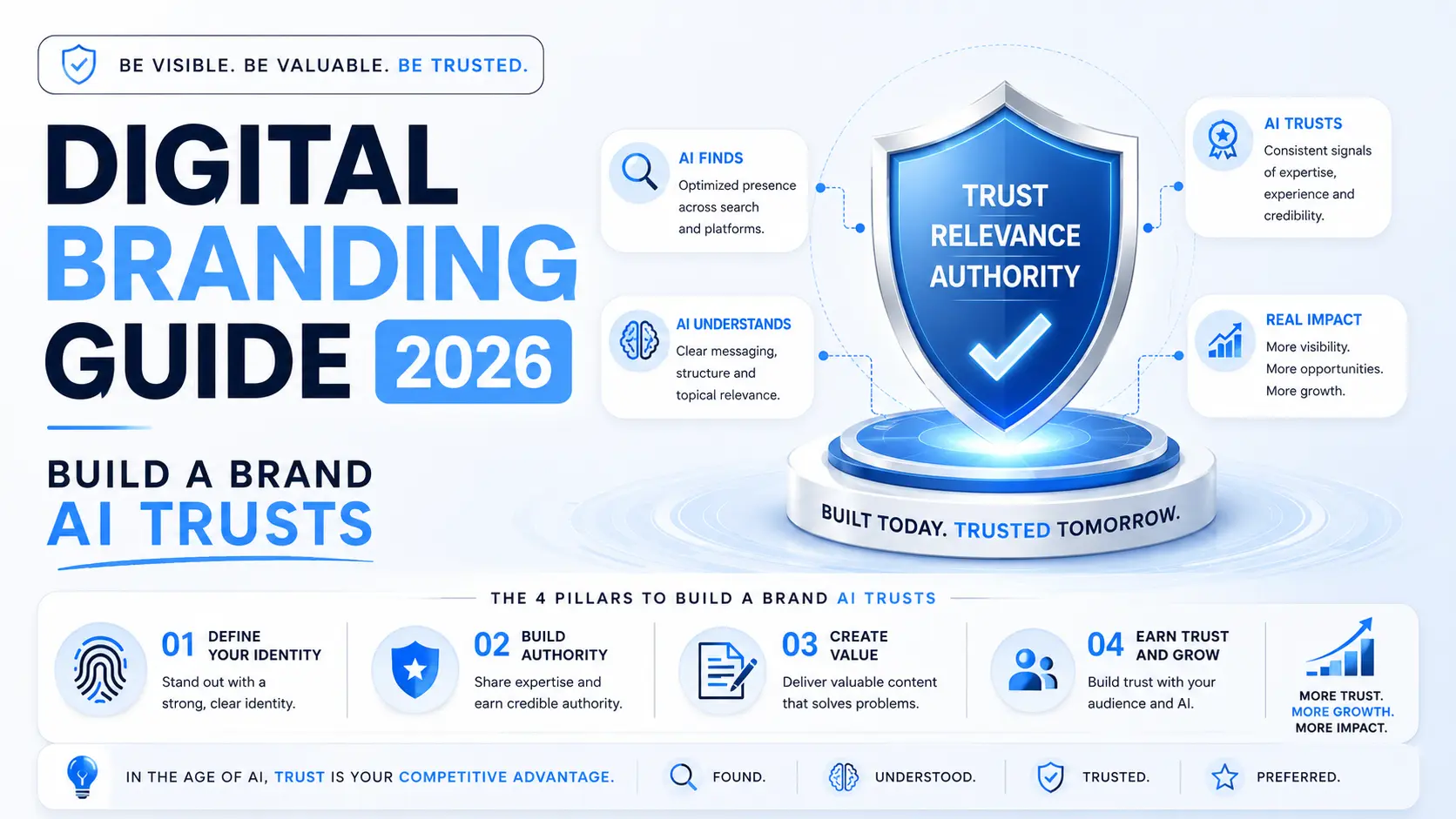
Digital Branding Guide 2026: Build a Brand AI Trusts
Quick Review
- A practical 10-step guide to digital branding in 2026, focused on staying visible to both human readers and AI search tools like ChatGPT and Perplexity
- Clear, skimmable structure with short sections; takes about 5 minutes to read
- Strong section on AI-search visibility, offering actionable tips like Q&A formatting and citing credible sources
- Backed by real references, including a Lucidpress branding study and Google's own guidance
- Stays at an overview level and ends with a promotional pitch for the site's courses and services
- Solid starting point for marketers and founders wanting a modern branding refresher
Here's a question worth sitting with: when someone searches for what you do — on Google, on Instagram, or by typing a question into ChatGPT — does your business actually show up? And if it does, does it look like you?
Branding used to mean a logo, a color palette, maybe a tagline. That's not enough anymore. Today your brand lives on your website, in your social feeds, in search results, and increasingly, in the answers AI tools like ChatGPT, Perplexity, and Gemini give people who never even visit your site. Nail it, and trust builds itself, wherever people bump into you. Miss it, and you quietly disappear from the exact places your customers are now looking. Here's how to build a digital branding strategy that works — for real people and for the AI systems now standing between you and them.
1. What Is Digital Branding?
At its core, digital branding is how your business gets perceived everywhere it shows up online — your site, your social channels, the search results people see, the reviews they read, and now, the answers AI tools generate on your behalf.
It's tempting to reduce branding to "the visual stuff." But it's really about your tone, how accurate and useful your content is, how fast you respond when someone asks a question, and whether your brand identity online shows up the same way no matter where someone stumbles across it.
A brand that's actually working does three things:
- Says clearly who you are and what you stand for
- Turns up reliably, wherever your audience happens to be
- Earns trust through consistent behavior over time, not a flashy one-off campaign
The businesses that fall behind are usually the ones that treated branding like a design project they finished once. The internet doesn't sit still, so neither can your brand.
2. Get Clear on Who You Are Before You Build Anything
Nail down your identity first. Your mission, your values, your personality, and the thing about your approach that's genuinely hard for competitors to copy — this is the foundation everything else sits on. Before you touch a website mockup or open a social account, figure out why your business exists beyond revenue, and what actually makes it different.
Worth asking yourself:
- What do we solve better than anyone else in our space?
- What are we not willing to compromise on?
- If a customer described us to a friend, what would they say?
Know exactly who you're talking to. Good branding starts with real clarity about your audience — their demographics, behavior, and the specific problems your product solves for them. The sharper your picture of them, the less generic your brand will sound.
One of the most common traps here: trying to speak to everyone. Brands that chase every audience at once usually end up meaning something to none of them.
3. Tell a Story People Actually Connect With
Lead with why, not just what. Your brand story should explain what you stand for, not just what's on the price list. People respond to businesses that stand for something real — so build your narrative around the actual impact you want to have, and let it show up in everything you publish.
Stay consistent everywhere. Consistency is what turns a passing impression into a memory. Your voice, visuals, and core message need to line up across your website, socials, email — even the FAQ pages and structured data that AI tools scrape. Inconsistency quietly erodes trust; consistency is what builds recognition and, eventually, authority. A Lucidpress brand consistency study found that businesses presenting their brand consistently across every channel saw revenue climb by as much as 33% — a fairly compelling reason to stop treating brand guidelines as optional.
4. Build an Online Brand Presence People (and AI) Can Actually Find
Your website now has two audiences. Human visitors, sure — but also the AI systems that summarize, cite, and recommend businesses in response to people's questions. Worth investing in:
- A clean, fast, mobile-first site that's easy to navigate
- Solid on-page SEO — keyword-smart titles, headers, meta tags
- Schema markup (implementation guidance from Google Search Central), so AI tools can accurately understand what you actually offer
- Fast, compressed images with real, descriptive alt text
A slow or cluttered site doesn't just lose human visitors. It gets quietly pushed down by search engines and skipped over by AI tools, too.
Show up on social media on purpose. Pick the platforms where your actual audience spends time — not every platform that exists. Short, vertical video is still where attention lives, and staying active in comments and DMs isn't just good customer service; it's a branding signal both people and algorithms pick up on.
5. Rethink Content Strategy for the AI Era
Human content matters more now, not less. As AI-generated text floods the internet, both readers and algorithms are increasingly rewarding the stuff that actually feels human: real expertise, a real point of view, real lived experience — instead of smooth, generic writing that says nothing new.
Use AI to speed up research and first drafts if that's useful, but keep a real person's judgment and voice at the center of what you publish. Content that just repeats common knowledge tends to disappear into the noise, for readers and AI systems alike.
Plan ahead. Map out your topics, your publishing schedule, and where you'll share things. A steady rhythm — even something modest, like one solid piece every couple of weeks — builds more authority over time than sporadic bursts of content followed by long silences.
For more on why this matters for rankings, see why content is important for SEO and how SEO and content marketing work together in a digital strategy.
Write for how people actually read online:
- Keep paragraphs short — 2 to 3 lines
- Use bullets and numbered lists to break things up
- Bold the important terms for people who are skimming
- Write in active voice, and keep most sentences under 20 words
- Let keywords appear naturally — never force them in
- Add real alt text to every image
- End with a clear next step for the reader
6. Actually Engage With Your Audience
Respond like a person. Reply to comments, messages, and mentions promptly. Give people reasons to create and share content about your brand, and treat your community like genuine participants — not just an audience watching from the sidelines.
Take feedback seriously, especially the bad kind. Negative reviews and criticism are useful information, not attacks to defend against. Monitor what people are saying across review sites and social media, and respond to both the praise and the complaints professionally. How you handle a bad review in public often shapes your brand more than the review itself ever could.
7. Team Up With the Right People, Not the Biggest
Look past follower counts. The creators worth partnering with are the ones whose actual audience overlaps with your real customers — not necessarily the ones with the biggest numbers.
Let them be themselves. The partnerships that actually work give creators real creative freedom to represent your brand in their own voice, instead of reading from a script. And track results against clear goals — engagement, traffic, conversions — so you know what's genuinely driving return, instead of chasing vanity metrics.
8. How to Make Your Brand Visible on AI Search
This might be the single biggest shift among current AI branding trends. Tools like ChatGPT, Perplexity, and Gemini aren't just indexing pages the way Google used to — they're pulling clear, factual, well-structured content to build direct answers for people. If your brand's information isn't accurate and well-organized, you risk being left out of the conversation entirely, even if you'd be the perfect answer. Google's own guidance on AI features in Search confirms that standard SEO fundamentals — not special tricks — are what determine whether a page gets pulled into AI Overviews and AI Mode.
For a broader look at this shift, see how AI is transforming digital marketing.
A few things that actually help:
- Write content that's fact-based and genuinely educational — AI tools favor reliability over sales pitches, in line with Google's own people-first content guidance
- Use Q&A-style sections, which make it easy for AI to lift out clear answers
- Use related terms and natural phrasing, not just exact-match keywords
- Cite credible sources — AI tools tend to trust pages that back themselves up
- Add a short summary or key-takeaways section at the end of longer content
- Keep your tone conversational but informative — AI is getting better at telling real, human writing apart from generic filler
A few quick questions people usually have:
- How is AI search actually different from a regular Google search?
AI tools pull from multiple sources and hand people one synthesized answer, instead of a list of links to click through. That means your brand's information needs to be accurate everywhere it appears, because AI might be summarizing you without anyone ever landing on your site. - How does AI affect branding?
It changes who the gatekeeper is. Instead of a person scanning a results page and clicking the link that looks most trustworthy, an AI model decides which businesses even get mentioned in its answer — based on how clear, consistent, and well-structured your information is across the web. - Does this mean traditional branding matters less now?
Not really — the channels and mechanics have changed, but knowing your audience, telling a real story, and staying consistent matter just as much as ever, maybe more, since AI is increasingly the gatekeeper deciding who even gets mentioned. - What's the easiest first step?
Make sure the basics — your name, what you offer, your location, what makes you different — are accurate and consistent across your website, Google Business Profile, and social accounts. AI models pull from all of these when they're forming an answer.
9. Actually Track What's Working
Watch the right numbers. Traffic, engagement, conversions, and — where you can track it — how your brand shows up in AI-generated answers or citations. Google Analytics and Search Console are still essential for understanding how people actually find you.
Let the data drive decisions. The brands that keep improving are the ones reviewing their data regularly, spotting what's actually working, and adjusting — not the ones treating their branding as a project they finished once.
10. Stay Ready to Adapt
The ground keeps shifting. New platforms, new habits, new AI capabilities — staying informed about what's changing in your specific industry, and being willing to adjust, matters more than clinging to a strategy that worked a few years ago.
Treat your strategy as something alive, not fixed. Revisit it regularly as the market shifts and your business grows. Refresh your key content and information every few months to reflect new trends or offerings. Staying adaptable, while staying true to who you are, is what keeps a brand relevant for the long haul.
Need Help Putting This Into Practice?
Reading a checklist is one thing — actually rebuilding your brand identity, restructuring your content, and making sure AI tools can find and trust you is a different job entirely, especially alongside running the rest of your business.
This is where working with a team that specializes in digital branding strategy pays off. DigitalAdda works with businesses on exactly the challenges covered in this guide — from defining a clear brand identity and building a consistent online brand presence, to structuring content and websites so they perform well in both traditional search and AI-generated answers.
If you'd rather have specialists handle the strategy, execution, and ongoing optimization instead of piecing it together yourself, DigitalAdda is a solid place to start the conversation. Prefer to build these skills in-house first? DizitalAdda's digital marketing course covers branding, SEO, and content strategy in depth.
The Short Version
- Digital branding today has two audiences — real people and AI search systems — and both need to trust and understand your brand
- Staying consistent everywhere, including in the structured data AI reads, builds trust and recall
- Genuine, fact-based, human content beats generic, AI-polished writing — with readers and with AI
- Getting found in AI search comes down to accurate information, natural language, real citations, and clear Q&A content
- Branding isn't a one-time project — it's something you track, adjust, and refresh continuously