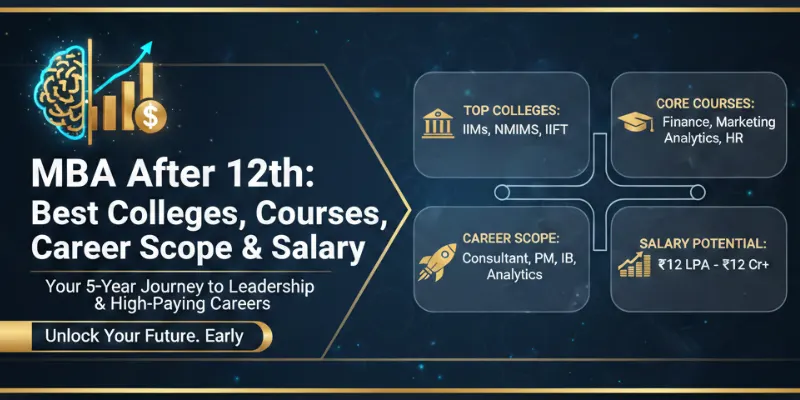
MBA After 12th: Best Colleges, Courses, Career Scope & Salary (2026)
Introduction
If you've just finished Class 12th and you're already thinking about a career in business, management, or entrepreneurship — you don't need to wait.
Yes, you can do an MBA after 12th in India — through a 5-year Integrated MBA program that combines your undergraduate degree and MBA into one continuous course, saving you a full year compared to the traditional route.
This guide is your one-stop answer to every question you have about MBA after 12th:
- Which colleges offer integrated MBA after 12th?
- What are the entrance exams, fees, and eligibility?
- What is the career scope and expected salary?
- Which stream — Science, Commerce, or Arts — is best suited?
Let's break it all down.
Can You Directly Do an MBA After 12th?
Yes — but not through a regular MBA. A traditional MBA is a postgraduate degree that requires a bachelor's degree first. You cannot enroll in a 2-year MBA directly from Class 12.
However, you can join an Integrated MBA (IPM) program directly after 12th. These are 5-year programs that award both a bachelor's degree (BBA/BMS) and an MBA — no separate UG required.
The most recognized route is through IPMAT — the Integrated Programme in Management Aptitude Test — conducted by IIMs like Indore, Rohtak, and Ranchi.
Quick Answer: You cannot do a regular MBA directly after 12th, but you can enroll in a 5-year Integrated MBA program through exams like IPMAT, JIPMAT, and NPAT.
List of Best Colleges for MBA After 12th (2026)
Government / IIM Colleges (Most Preferred)
| College | Program | Entrance Exam | Duration | Avg. Package |
|---|---|---|---|---|
| IIM Indore | IPM | IPMAT Indore | 5 years | ₹25–30 LPA |
| IIM Rohtak | IPM | IPMAT Rohtak | 5 years | ₹18–19 LPA |
| IIM Ranchi | IPM | IPMAT + PI | 5 years | ₹19 LPA |
| IIM Shillong | IPM | IPMAT | 5 years | ₹26 LPA |
| IIM Jammu | IPM | JIPMAT | 5 years | ₹14–15 LPA |
| IIM Bodh Gaya | IPM | JIPMAT | 5 years | ₹13–14 LPA |
Top Private Universities for Integrated MBA After 12th
| College | Program | Entrance Exam | Duration | Avg. Package |
|---|---|---|---|---|
| NMIMS, Mumbai | BBA + MBA | NPAT | 5 years | ₹8–12 LPA |
| Symbiosis (SCMS), Pune | BBA + MBA | SET | 5 years | ₹7–10 LPA |
| Nirma University | Integrated BBA-MBA | IPMAT / Institute Test | 5 years | ₹8–10 LPA |
| Christ University, Bangalore | BBA + MBA Pathway | CUET / Christ Test | 5 years | ₹6–10 LPA |
| ICFAI University | Integrated MBA | IBSAT / Direct | 5 years | ₹6–9 LPA |
| FLAME University, Pune | Integrated Management Program | FLAME Entrance Test | 5 years | ₹7–10 LPA |
Note: Private college packages vary based on specialization, campus, and individual performance.
What About IIFT?
IIFT (Indian Institute of Foreign Trade) is a government-funded deemed university under the Ministry of Commerce and Industry. It is not an IIM, but it is a highly reputed institution for International Business.
- Total Fees (Integrated MBA): ₹15–35 lakhs (varies by institute)
- Average Salary After Graduation: ₹6–15 LPA (higher at top campuses)
Which Entrance Exam Should You Target?
| Your Goal | Best Exam to Target |
|---|---|
| IIM Indore / IIM Rohtak | IPMAT |
| IIM Jammu / IIM Bodh Gaya | JIPMAT |
| NMIMS University | NPAT |
| Symbiosis International University | SET |
| Central Universities | CUET |
| Private colleges | University-specific tests |
Exam Pattern Overview (IPMAT):
- Quantitative Ability (Multiple Choice)
- Quantitative Ability (Short Answer)
- Verbal Ability
- Duration: 120 minutes
Start preparing from Class 11 to maximize your IPMAT score and secure a seat at a top IIM.
Eligibility Criteria for MBA After 12th
Before applying, make sure you meet these requirements:
1. Educational Qualification Must have passed Class 12 from a recognized board — CBSE, ICSE, or State Board.
2. Minimum Marks Most reputed institutes require a minimum of 60% marks in Class 12. For IIMs, this bar may be higher (some require 60%+ in both 10th and 12th).
3. Entrance Exam All integrated MBA programs are entrance-based. You need to clear IPMAT, JIPMAT, NPAT, SET, or a university-specific test.
4. Selection Rounds (for top colleges) After clearing the written exam, shortlisted candidates go through:
- Written Ability Test (WAT)
- Group Discussion (GD)
- Personal Interview (PI)
5. Final Merit List is Based on:
- Class 10th and 12th academic performance
- Entrance exam score
- WAT / GD / PI performance
- Extracurricular achievements and overall student profile
6. Age Limit Most IPM programs require candidates to be below 20 years of age as of the date of joining. Check individual college guidelines.
MBA After 12th: Courses & Specializations
An integrated MBA after 12th is not a generic degree. You can specialize based on your interest and career goals:
| Specialization | Best For | Career Direction |
|---|---|---|
| Marketing | Creative, analytical thinkers | Brand Manager, Digital Marketer, CMO |
| Finance | Number lovers | Investment Banker, CFO, Financial Analyst |
| Human Resources | People-oriented students | HR Manager, Talent Acquisition Lead |
| Operations & Supply Chain | Process-driven thinkers | Operations Head, Logistics Manager |
| Business Analytics | Data lovers | Data Analyst, Strategy Consultant |
| Information Technology | Tech-savvy students | Product Manager, IT Consultant |
| Entrepreneurship | Future founders | Startup Founder, Business Developer |
| International Business | Global thinkers | Export Manager, Global Strategy Head |
| Digital Marketing & E-Commerce | Digital-native students | Growth Hacker, E-Commerce Manager, SEO Strategist |
💡 2026 Insight: Specializations in Business Analytics, Digital Marketing, and AI-driven Management are seeing the highest hiring demand from Indian and global companies.
Who Can Do MBA After 12th? Stream-Wise Guide
MBA After 12th Commerce
Commerce students are naturally aligned with MBA subjects — Accountancy, Economics, and Business Studies form the foundation of management education. You'll hit the ground running in Finance, Marketing, and Operations specializations.
MBA After 12th Science
Science students bring powerful analytical and mathematical thinking — a major asset in Data Analytics, IT Management, and Operations. IIM Indore specifically encourages science students to apply.
MBA After 12th Arts
Arts graduates excel in communication, critical analysis, and creativity — skills that are indispensable in HR, Advertising, Public Relations, and Media Management. Don't let anyone tell you Arts doesn't belong in an MBA program.
All three streams are eligible for integrated MBA programs. Your performance in the entrance exam matters far more than your stream.
Career Scope After MBA After 12th
The career scope after an Integrated MBA is strong and broad — especially if you graduate from a top college and build the right skills during the program.
Top Job Roles & Salaries After Integrated MBA
| Job Role | Industries Hiring | Starting Salary (India) | Growth Potential |
|---|---|---|---|
| Marketing Manager | FMCG, E-commerce, Agencies | ₹6–12 LPA | ₹20–40 LPA (senior) |
| Business Analyst | IT, Consulting, Startups | ₹7–14 LPA | ₹25–50 LPA (senior) |
| Management Consultant | Big 4, Boutique Firms | ₹12–25 LPA | ₹50+ LPA (partner) |
| Financial Analyst | Banks, Finance Firms | ₹6–12 LPA | ₹20–35 LPA (senior) |
| Product Manager | Tech, SaaS, Startups | ₹12–30 LPA | ₹40–80 LPA (senior) |
| HR Manager | All industries | ₹5–10 LPA | ₹15–30 LPA (senior) |
| Sales Manager | FMCG, BFSI, EdTech | ₹5–12 LPA | ₹20–40 LPA (senior) |
| Operations Manager | Manufacturing, Logistics | ₹6–11 LPA | ₹18–30 LPA (senior) |
| Digital Marketing Manager | Tech, Media, D2C Brands | ₹5–12 LPA | ₹20–40 LPA (senior) |
Top Recruiters for Integrated MBA Graduates
Companies that actively recruit from IPM and integrated MBA programs:
Consulting: Deloitte, KPMG, McKinsey, BCG, Accenture Banking & Finance: HDFC Bank, ICICI Bank, Kotak, Goldman Sachs E-commerce & Tech: Amazon, Flipkart, Google, Zomato, Swiggy FMCG: HUL, P&G, ITC, Nestle Startups & Unicorns: BYJU'S, Razorpay, OYO, PhonePe
Steps to Do an MBA After 12th
Here is the exact roadmap, step by step:
Step 1 — Identify your interest area Ask yourself: Am I excited about finance, marketing, people management, or technology? This will help you shortlist the right specialization.
Step 2 — Research integrated MBA programs Look at IIM IPM programs (IPMAT), NMIMS (NPAT), Symbiosis (SET), and private universities. Compare fees, placement records, and curriculum.
Step 3 — Start entrance exam preparation from Class 11 For IPMAT, focus on Quantitative Aptitude, Logical Reasoning, and Verbal Ability. Practice mock tests and solve previous years' papers.
Step 4 — Apply before deadlines Most IPMAT applications open in January–February. Keep track of application windows for each college separately.
Step 5 — Clear the written exam Aim for a score that puts you in the top percentile. Each IIM has its own cutoff — check them every year as they can vary.
Step 6 — Prepare for GD/PI/WAT Practice group discussions on current business topics. For PI, know your academic background, career goals, and why you want an MBA.
Step 7 — Join the 5-year program Once selected, you're on a structured path to a dual degree — and a career in management — starting at age 17–18.
Benefits of MBA After 12th vs Traditional MBA Route
| Factor | Integrated MBA (After 12th) | Traditional MBA (After Graduation) |
|---|---|---|
| Total Duration | 5 years | 6 years (3+2+1 gap possible) |
| Entrance Exams | IPMAT / JIPMAT / NPAT | CAT / GMAT / XAT |
| Age at MBA Completion | ~22–23 years | ~24–26 years |
| Work Experience Required | No | Preferred for top MBAs |
| Career Start | Earlier | Later |
| Cost | 1 admission process | Multiple exams, fees, preparation costs |
| Competition | Moderate | Extremely high (CAT has 3 lakh+ applicants) |
Verdict: If you're clear about wanting an MBA and have no desire to explore a different career path first, the integrated MBA after 12th is more time-efficient and cost-effective. If you're unsure, the traditional route gives you 3 years to explore before committing.
Frequently Asked Questions (FAQs)
Q: Can I do MBA directly after 12th without any entrance exam?
Some private universities offer direct admissions based on 12th marks, but reputed colleges always require an entrance exam. IPMAT is the gold standard.
Q: Is MBA after 12th valid and recognized in India?
Yes. Integrated MBA programs from recognized universities (especially IIMs) are fully valid and highly respected by employers across India and globally.
Q: What is the total fee for MBA after 12th at IIMs?
IIM Indore's IPM program costs approximately ₹14–16 lakh for the full 5 years. Other IIMs vary between ₹10–20 lakh total. Private universities range from ₹5–25 lakh.
Q: Can I get an MBA after 12th from a distance learning program?
Some universities offer distance or online integrated management programs, but for campus placements and peer networking — which are major advantages of an MBA — a full-time campus program is strongly recommended.
Q: What is the IPMAT exam date in 2026?
IPMAT Indore is typically held in May each year. Applications usually open in January–February. Always check the official IIM Indore website for exact 2026 dates.
Q: Is integrated MBA harder than a regular MBA?
The first two to three years are undergraduate-level studies. The difficulty ramps up in the final two years when you study MBA-level subjects. The competitive advantage is that you build the foundation gradually.
Q: What is the scope of MBA after 12th in 2026?
The scope is strong and growing. With India's economy expanding in tech, e-commerce, fintech, and manufacturing, there is consistent demand for young, well-trained management graduates from reputed integrated MBA programs.
Conclusion
Pursuing an MBA after 12th through an integrated program is one of the most strategic career moves a student can make — if you're clear about your direction. It saves a year, reduces total exam burden, and puts you in corporate roles 1–2 years before your peers.
Key takeaways:
- You cannot join a regular MBA after 12th, but Integrated MBA (IPM) is a strong alternative
- IIM Indore, IIM Rohtak, NMIMS, and Symbiosis are among the best choices
- Clear IPMAT/JIPMAT/NPAT — start preparing from Class 11
- All streams (Science, Commerce, Arts) are eligible
- Career scope includes roles paying ₹6–30 LPA at the entry level, with strong long-term growth
The business world is increasingly digital. Consider supplementing your MBA with certifications in digital marketing, data analytics, or AI to stand out from day one.
Last Updated: 2026 | Published by DizitalAdda
Related Reading: How to Pursue an MBA After 12th — Step-by-Step Guide