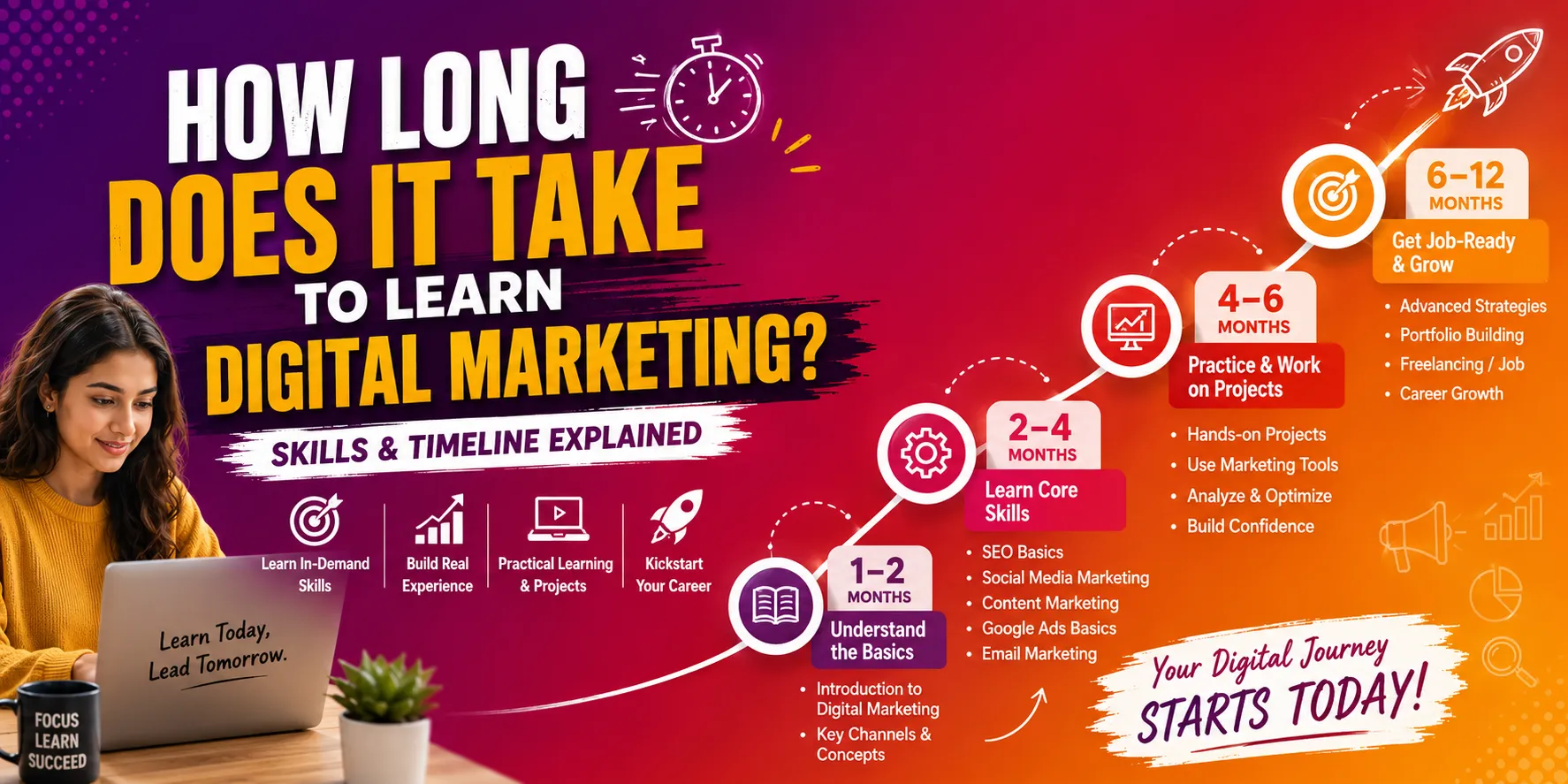
How Long Does It Take to Learn Digital Marketing? Skills & Timeline Explained
Well the answer to the question “how long does it take to learn digital marketing” highly depends on you. The timelines varies on your goals, how many hours you can commit dedicatedly and most importantly the source you are learning from, random YouTube videos or structured learning.
And one more thing that is very common among students that many students rush into digital marketing and want success overnight. But that’s not how things work, you must have patience. Digital marketing is a skill-based field that demands some time, patience and lots of practical work. So, yes, you don't just read theory—you run campaigns, analyse results, and improve through practice.
If you've finished 12th, are exploring career options, or you're a working professional thinking about switching careers, this guide will give you a realistic roadmap.
Quick Answer:
╔════════════════════════════════╗
Quick Answer:
Most people learn the basics of digital marketing in about 2–4 months. But if you want to feel really confident and also job-ready, you should expect closer to 6–12 months of learning, plus a good deal of practical doing. A well-structured program, actual projects, and some mentorship, can seriously speed things up.
╚════════════════════════════════╝
Why Learning Digital Marketing Takes Different Time for Different People
Digital marketing is not one single skill.
It's a collection of skills working together. Think of it like learning cricket. Batting, bowling, and fielding all matter. Similarly, digital marketing includes SEO, content writing, social media, paid advertising, analytics, and more.
That's why one person may learn faster than another.
Your Learning Goal Matters
Someone wanting to manage Instagram pages for small businesses doesn't need the same depth as a future performance marketer handling ₹5 lakh monthly ad budgets. So, yes it highly depends on what you want to become cause the field of digital marketing is quite vast.
Ask yourself these questions:
- Do you want freelancing skills?
- A full-time job?
- To grow your own business?
- Or simply understand digital marketing better?
And then see how your answer changes the timeline for your learnings.
Practice Makes the Difference
Practice is something that you can’t ignore when you are into the profession like digital marketing. Here's something many beginners don't realise.
They assume that watching tutorials is learning but that’s not enough. Practising those learning is important for actual learning. Running a campaign, writing copy, creating ads, or using analytics tools—that's where learning happens.
According to Google Economic Impact reports, digital skills continue to drive employability and business growth worldwide. Practical exposure matters more than certificates alone.
That gap comes from practice.
Structured Learning Saves Time
With structured learning, you don't just learn faster—you save money, gain expert guidance, and build advanced skills that prepare you for real-world opportunities.
This is where many people struggle.
We admit that free resources are a great starting point and even some are really helpful, but they often lack structure. Because you won’t be able to find the whole course material at one place and will end up finding different course materials on different channels. This whole process may feel exhausted.
Whereas structured Online digital marketing courses give you sequence and direction.
You know:
- What to learn
- When to learn
- Which tools matter
- How skills connect
That clarity speeds things up and also gives you right direction.
How Long Does It Take to Learn Digital Marketing for Beginners?
Let's break this down realistically.
Stage 1: Learning Fundamentals (1–2 Months)
This stage focuses on understanding the ecosystem. You will get to know the intro of every module and some basics about them.
You'll learn:
- SEO basics
- Social media platforms
- Content marketing
- Google Ads introduction
- Email marketing
- Analytics basics
Stage 2: Hands-On Learning (2–4 Months)
This is where confidence starts. Now you will implement some of your learnings and practice the theory part.
You'll:
- Create campaigns
- Optimise social posts
- Research keywords
- Learn basic ad targeting
- Use tools like Google Analytics and Search Console
According to HubSpot, marketers who regularly track campaign performance are significantly more likely to report positive ROI.
Here your theory begins turning into skill, cause now you are actually doing it practically.
Stage 3: Job or Freelance Readiness (6–12 Months)
This stage separates hobby learners from professionals.
You work on:
- Portfolio projects
- Client simulations
- Reporting
- Budget management
- Strategy building
By now, you're not just "learning marketing." You're solving marketing problems.
At this stage, you are not merely a marketer who is doing something said work like particularly SEO, Content or running ads. Instead here you become the problem solver for your client and you recommend them what suits best to their business.
Digital Marketing Modules and Their Learning Timeline
Different skills need different effort.
Here’s one thing need to be considered and that is – you can’t master every module at once. So, yes have patience cause quality education demands time. Even most professionals specialise over time.
Can You Learn Digital Marketing in 3 Months?
This is one of Google's most searched questions. So let's answer it directly.
The simple and straight answer to this question is Yes—but with realistic expectations, and here are some mentioned below:
What 3 Months Can Do
Three focused months can help you:
- Understand marketing fundamentals
- Use core tools
- Build beginner-level projects
- Create a portfolio foundation
If you're learning 2–3 hours daily through guided programs, three months is enough to build confidence.
What 3 Months Cannot Do
Three months usually won't make you an expert.
You're still learning:
- Strategy
- Budget management
- Audience psychology
- Campaign optimisation
Digital marketing evolves constantly.
Where to Learn Digital Marketing in India
This question matters more than many people realise. Because the wrong learning environment will waste your both time and efforts.
Free Learning Platforms
As we said this in above para’s that there are plenty of free resources available, especially on YouTube and other like marketing blogs, some free workshops. But what matters is the quality and structure.
These help build awareness. But free learning often lacks accountability. You study when motivated and stop when confused.
Structured Learning Institutes
So, if you are really concerned about your career then must opt for structured program like the one is offered by DizitalAdda’s Digital Marketing Course.
What we provide?
- Updated and Structured Curriculum
- Practical projects
- AI Tool training
- Internship exposure
- Placement guidance
- Mentor support
At DizitalAdda, we've noticed one common pattern. Students progress faster when learning happens with feedback, assignments, and real campaign exposure.
How to Start Learning Digital Marketing Step by Step
Most beginners don't struggle because digital marketing is difficult. They struggle because they lack a clear roadmap.
Step 1: Learn the Basics
Understand how SEO, social media, content, and ads work together.
Outcome: You'll feel less confused.
Step 2: Pick One Skill
Start with SEO, content, or social media marketing.
Outcome: Faster confidence and clarity.
Step 3: Practice for Real
Create a blog, manage a small page, or run mock campaigns.
Outcome: Practical learning and problem-solving skills.
Step 4: Learn Essential Tools
Explore Google Analytics, Canva, Meta Ads, and keyword tools.
Outcome: You'll become job-ready, not just theory-ready.
Step 5: Build Your Portfolio
Share projects, create case studies, and stay active on LinkedIn.
Outcome: Better career and freelance opportunities.
Online vs Offline Learning: Which Is Better?
This is one the most debatable topic among students. They confuse between offline and online learning. Well, their answer rely on their schedule, learning style, and career goals.
Below is the table showing the comparison, you can go through.
What we have seen that online classes is mostly a favorable option for those who are already working or living far away from the location of institute. Also for those students who are engage in their college studies and not able to manage time for offline classes.
So, you think wisely what suits best to you and choose the mode according to it.
What Makes Digital Marketing Worth Learning in 2026?
So, practically!
People aren’t choosing digital marketing just because it’s trending but because it holds plenty of career opportunities even global ones. With the great career prospects, flexible work options, and future ready skills, digital marketing is booming like crazy.
And the demand is quite real.
As businesses continue shifting their budgets online, the need for digital marketing professionals keeps growing. According to Statista, global digital advertising spending is increasing steadily year after year because that's where customers spend their time.
India is seeing the same shift.
From startups, and ecommerce brands, to coaching institutes and local businesses, it feels like every company today needs at least some online presence. Like not optional, almost. So yes, digital skills are no longer just a “nice to have” , they’re more like valuable career assets too.
How DizitalAdda Can Help You Build a Career in Digital Marketing
Most beginners quickly realize they want to learn digital marketing, but the tricky part starts right after that. Trying to decide where to begin, which is, honestly, harder than people expect. Since there are so many courses, tutorials and different resources floating around online, it’s easy to get frustrated, and then you end up bouncing from one topic to another for months… without actually building anything solid.
This is exactly where guided learning helps, because it keeps things from becoming a random scramble. Instead of making students stitch everything together by themselves, DizitalAdda gives a structured learning path, so they can focus on the right skills at the right time.
Practical Learning Instead of Passive Learning
Instead of only explaining concepts, guided programs help learners:
- Work on practical assignments
- Understand campaign structure
- Use real tools
- Build portfolio confidence
- Prepare for interviews and internships
Learning becomes measurable and you can actually see progress.
Mentorship Changes the Learning Curve
Most beginners don't need more information. They need clarity and here guided courses stand out.
When someone reviews your work and points out mistakes early, your learning speed improves dramatically.
Placement and Career Guidance Matter
Gaining knowledge is important, but building a successful career requires more than just learning concepts.
Whether you want:
- Freelancing opportunities
- Internship experience
- Job preparation
- Business growth skills
And that's where guided ecosystems like DizitalAdda can support learners more effectively than scattered self-learning alone.